September 29, 2026

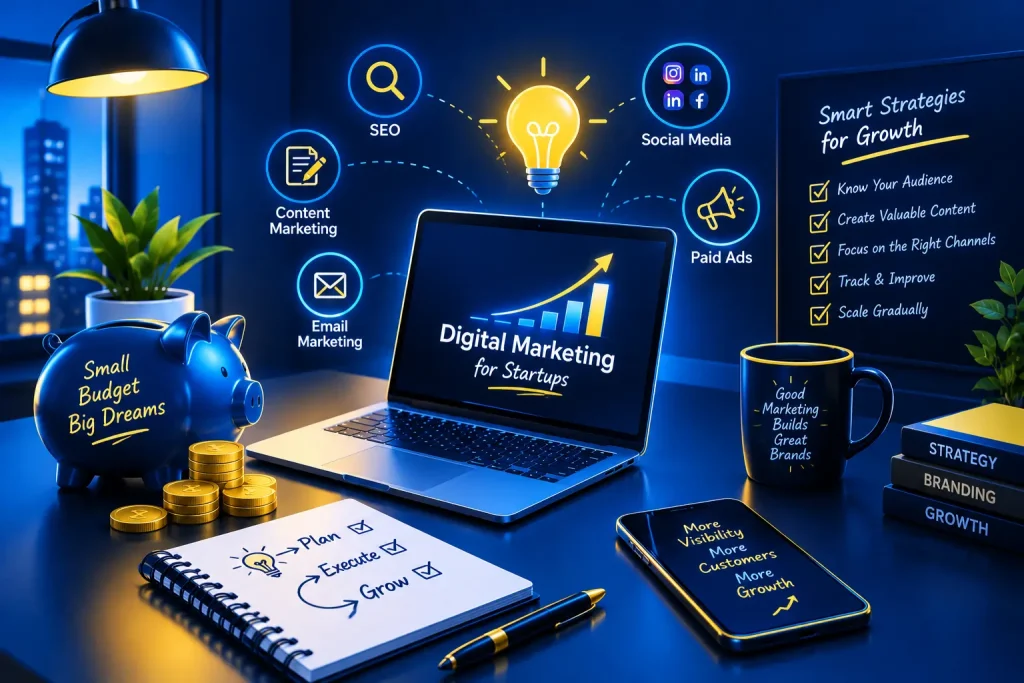
Digital marketing strategy for startups on a small budget, featuring a laptop, piggy bank, growth chart, SEO, social media, content marketing, email marketing, paid ads, and strategic planning elements in a blue and yellow theme.
DIGITAL MARKETING

How Startups Can Use Digital Marketing on a Small Budget

How Startups Can Benefit From Marketing Marketing is often the top priority for any startup. However, with a limited budget and a strong competitive environment, companies should be able to maximize their gains by using the most effective tools. Digital marketing in such cases can solve most problems for a company as an experienced team can address all issues on the web and help the startup make the most of their gains. SEO, social media, content, and email marketing are only a few areas where a startup can get tremendous returns on their investment. Therefore, in this article, some of the most viable methods for low-budget marketing will be discussed. Why Digital Marketing Is Important for Startups Traditional advertising may demand a huge amount of money for television, press, billboards, and other traditional media. Digital marketing makes it possible for small businesses to reach out to the target audience via online resources. Moreover, an appropriate campaign may be launched using a small budget. A properly planned digital marketing campaign will help in building online presence, increasing brand awareness, targeting the most suitable customers, generating leads, establishing relationships with the audience, boosting the quantity of visitors to the company’s website, enhancing customer engagement,  evaluating the performance of the marketing effort, scaling the growth. Instead of trying to be omnipresent, it is better to define who are the most likely customers to buy the company’s products or services and invest in those digital platforms where the target audience spends most of their time. 1. Build a Website Your website is often the first impression for a potential customer. You don’t need an expensive website, a simple and sleek mobile-friendly version will do as long as it has what your business offers, who your customers are, why choose you, how to contact you, calls-to-action. A simple website with clear-cut information will be more helpful than a costly one with unclear calls-to-action. 2. Search Engine Optimization Search engine optimization, or SEO for short, is one of the best long-term ROI marketing strategies for a budget-limited startup. SEO focuses on ranking your website on the first page of search engines for relevant keywords. SEO helps your website gain organic traffic as opposed to paying for website visits. Target Long-Tail Keywords Big companies usually target high-volume keywords which is why long-tail keywords are a good place to start for startups. Long-tail keywords are more specific and have lower competition than high-volume keywords. For example, target “affordable digital marketing agency for startups” instead of “digital marketing.” Create SEO Friendly Content SEO content marketing is about creating content your potential customers are searching for.For example, you can create how-to guides, tips, tutorials, comparison articles, case studies, FAQs, beginner’s guides. Having informative content will establish you as an authority in your space. 3. Social Media Marketing One-third of the global population uses social media. So, it’s a great place to invest your time and money to grow your business. But it doesn’t mean you have to be everywhere. Pick one or two social media networks where your target audience spends the most time. Post Valuable Content Don’t market your products 24/7. Instead, focus on educating and entertaining your audience. Here’s a list of ideas you can try: education, short videos, user-generated content, stories, industry insights, product reviews, tips, product tutorials. For example, if you own a productivity software company, you can post tips and tricks about being productive, how to use your product, and how productivity tools transformed someone’s life. The more they follow you, the more they will trust you to solve their problems. 4. Content Marketing If you think about content marketing, you might imagine a well-produced video or a blog post with an attractive design. While these pieces of content require investment, they aren’t mandatory. There are many ways to leverage content marketing on a budget. Repurpose Your Content For example, one blog post can turn into an Instagram carousel, a LinkedIn post, a YouTube video, an email newsletter, 5+ social media posts, and a visual infographic. Repurposing your content helps you maximize your limited resources. Pro tip: focus on creating helpful content your audience wants to consume rather than filling your content calendar with random topics. 5. Email Marketing Email marketing might seem old, but it is still one of the most powerful marketing strategies, especially for startups. You can use email to build relationships with your customers. Email can be used as a marketing tool, a sales tool, and a customer service tool. To do that, you’ll need a list of engaged subscribers. You can grow your list by adding a subscribe button to your website, offering lead magnets, running email contests, posting newsletters, providing free trials, and hosting webinars. Your email marketing content should be focused on being helpful. Here are some email marketing ideas: educational content, newsletters, product announcements, emails with coupons, case studies. 6. Leverage Organic Marketing Before Investing in Paid Ads Paid ads are a great way to acquire customers, but they are also the riskiest and most expensive marketing strategy for a new business. Start with testing your organic posts before investing in ads. For example, if you see that your Instagram post is getting a lot of engagement, or your blog post is driving traffic, you can use this data to create better-performing paid campaigns. Start Small and Scale When you start with paid advertising, focus on one social media network and run one ad campaign. You’ll want to look at your CTR, conversion rate, cost per lead, CPA, and ROAS. Then, reinvest your profits into the most performing ads and scale them. 7. Local SEO Local SEO is a great budget-friendly marketing strategy for local businesses. Local SEO is all about ranking higher in local searches. For example, if someone searches for “digital marketing agency in Prayagraj,” you want your website to show up on the first page of results. Create local content, optimize your website for local searches, get positive reviews, and make sure your
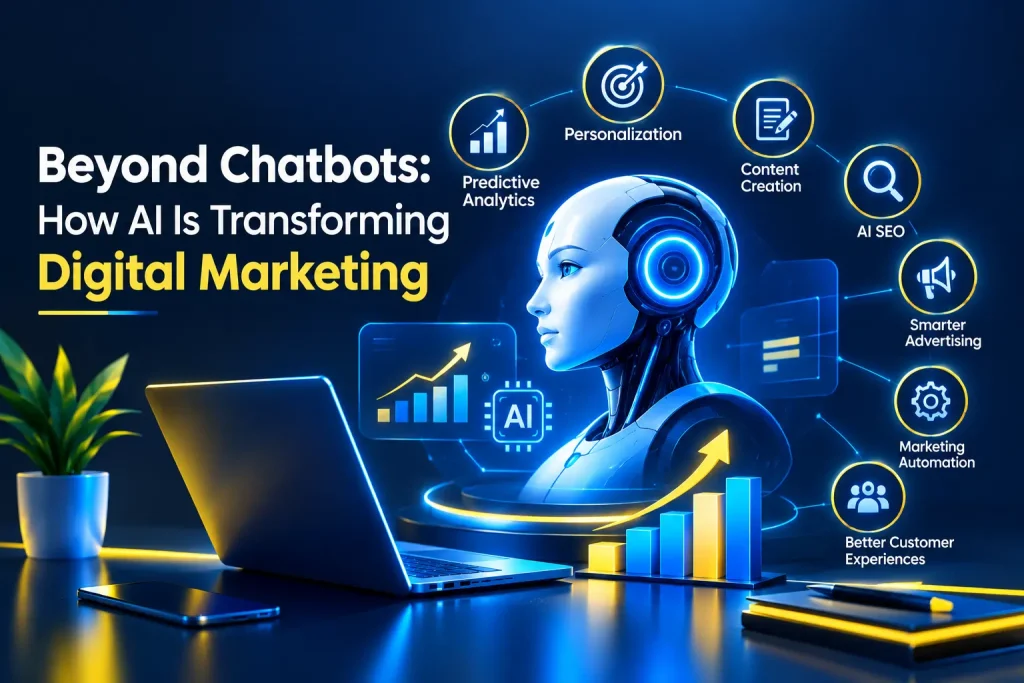
AI-powered digital marketing featuring a futuristic AI interface, predictive analytics, personalization, content creation, AI SEO, smarter advertising, marketing automation, and customer experience.
ARTIFICIAL INTELLIGENCE

Beyond Chatbots: How AI Is Transforming Digital Marketing

Introduction Artificial intelligence (AI) is no more a novelty that powers chatbots to answer simple questions from customers. It has become an integral part of strategies that companies use to reach out to and interact with their audiences. May it be search, predictive analysis, automated ads, or personalized experiences — the role of artificial intelligence in modern digital marketing is impossible to overestimate. As such, businesses are integrating AI technology into their operations at all levels, from acquisition to conversion and retention. The trend is justified as real-time big data analysis, crucial for any marketing process, is unable to keep up with the amount of information that modern customers generate and that companies need to analyze to find meaningful patterns. AI helps to automate and accelerate repetitive marketing tasks and decision-making in general. But what else can AI do apart from chatbots? Let’s take a closer look at AI-driven digital marketing below. What Does AI Mean in Digital Marketing? AI in digital marketing means the ability of artificial intelligence to analyze data, recognize patterns, automate processes, create content, forecast, and influence clients. Thus, AI in marketing is not just about addressing customers but also covering all stages of the customer’s journey. In other words, the technology can be used to: Analyze the current customers’ behavior Make predictions about clients’ future actions Create personalized experiences on websites Generate contenteditable content for different media Optimize SEO Automate advertising processes Segment clients Recommend products or services Analyze and optimize marketing campaigns Therefore, the technology goes far beyond customer service automation and becomes the marketing intelligence layer that transforms the traditional marketing processes into automated ones. How AI Is Transforming Digital Marketing Essay 1. AI-Powered Personalization Customers are expecting more personalized experiences than ever before. With AI, you can take information such as browsing behavior, history, purchases, and engagement into account to help you better personalize your marketing mix. For example, you can use AI to power product recommendations on your e-commerce site or recommend articles based on someone’s interests and engagement. By applying AI to create better personalized experiences, you can supercharge: Product recommendations Email marketing Website experience Customer segmentation Promotions Content recommendations Instead of blasting the same marketing message to everyone, you can personalize the customer journey and deliver more value. 2. Predictive Analytics and Customer Insights One of the most interesting applications of AI marketing is that it can analyze huge amounts of data and find patterns and insights. Vanilla data analytics can tell you what has happened and even why it happened to a degree. Predictive analytics can help you determine what will happen in the future based on past and present data. With AI, you can uncover insights such as: Who are your customers that are most likely to buy What products will sell What campaigns will be the most successful Who is likely to churn You can then use these insights to inform your marketing budget and marketing mix. 3. AI Is Transforming SEO and Search Another area where AI is having an impact is in SEO, search marketing, and search engines in general. Traditional SEO used to be about putting the right keywords on a page so that Google could easily find and rank the page higher in the search results. With AI, the way we optimize web pages and create content is changing. SEO is becoming more about search intent, helpful content, and topically relevant content as well as content quality, information architecture, and much more. There are many factors that influence how Google will rank your page in the search results. AI can also help you optimize your content, find new keywords and topics, analyze competitors, and much more. As far as SEO is concerned, it’s not about writing more content; it’s about writing better content for the right audience. 4. Automated and Smarter Advertising Mix One of the biggest areas where AI is being applied in marketing is programmatic advertising. Advertising platforms are becoming increasingly automated and use AI to analyze signals and make decisions in order to meet your advertising goals. AI can help you with smarter advertising, such as: Better audience segmentation Optimized ad budgets Bid optimization Ad variations Leveraging AI for advertising does not mean you should stop caring about your advertising campaigns. It means you can focus on different parts of your advertising mix, such as creative, audience insights, and much more, while the tedious parts can be automated. 5. AI-Powered Content Creation AI is transforming content marketing and marketing copywriting in general. With AI language models, you can create blogs, social media posts, email marketing copy, ad copy, product descriptions, video scripts, research reports, and much more. You can use generative AI to help you with your content creation tasks, such as outlining a blog post or writing social media copy. However, AI is not a magical marketing content creation machine. It can still make mistakes, and marketing copy created by AI can sound generic or untrue. Humans are needed to add quality, originality, brand voice, and much more. AI-assisted marketing content creation is much better than fully relying on AI to create marketing content. AI Marketing Automation: Getting More for Your Effort Marketing departments are wasting a lot of time doing the same tedious and boring tasks over and over again like reporting, creating segments, chasing down leads, qualifying prospects, and monitoring campaigns. With AI automation, you can save the marketing team time by doing some of the tedious work for them. Visitor → AI → Lead → Personalized Content → Follow-up → Conversion That’s time that the marketing team can spend doing more creative and important tasks instead of doing mundane and robotic tasks that anyone could do. AI and Customer Experience Additionally, it should be noted that AI can also change the customer experience. Beyond the application in chatbots, companies can utilize such technology to personalize recommendation, enable natural language search and assistance, offer virtual helpdesks, and engage in proactive communication. An example of the

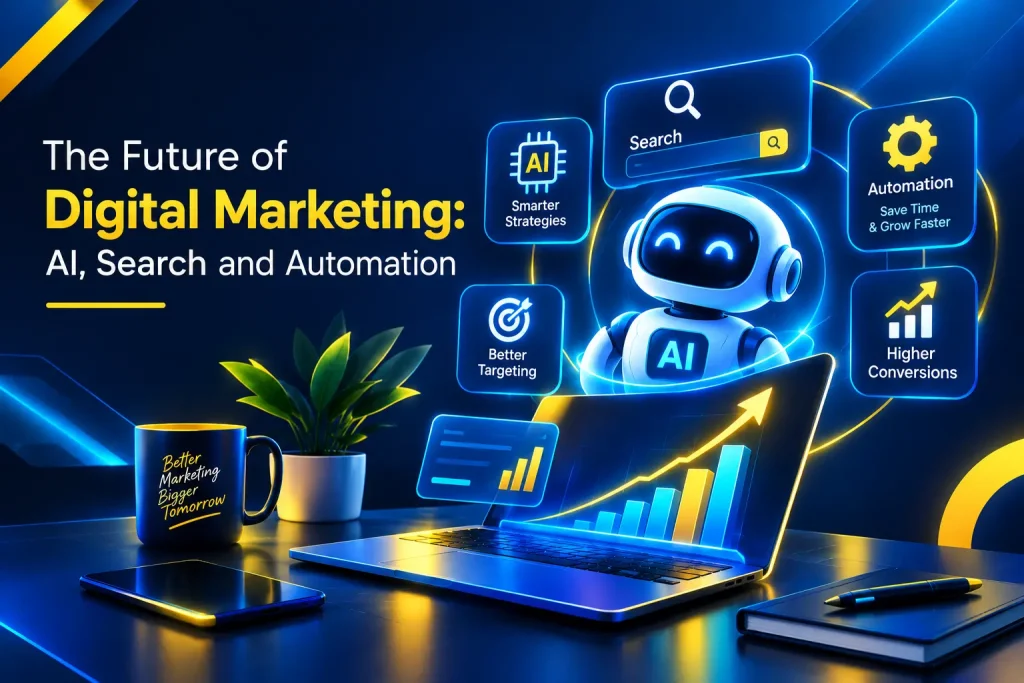
The Future of Digital Marketing featuring AI, search, automation, digital marketing analytics, and business growth in a futuristic neon blue and yellow design.
ARTIFICIAL INTELLIGENCE

The Future of Digital Marketing: AI, Search and Automation

Introduction Nowadays, digital marketing is evolving rapidly due to artificial intelligence, changing search landscapes, automations, and personalization of the media space. Businesses are now realizing that their traditional ways of SEO and advertisement might not be sufficient in the nearest future. Such strategies as SEO, social media marketing, and traditional advertising will remain relevant but occupy a smaller and smaller proportion of the marketing budget. Search engines are becoming smarter, marketing technologies are enabling marketers to create and analyze their content faster, and automations are taking over repetitive tasks in the sphere of marketing. At the same time, artificial intelligence and personalization will allow creating engaging and relevant content for each particular customer. However, it should be noted that for businesses, the future of digital marketing will not be different from what we are used to seeing in traditional media: the technology should be used as an instrument to meet the needs of customers and build a relevant strategy. With that in mind, let us take a closer look at the future of digital marketing and its main trends.  How AI Is Revolutionizing Digital Marketing Artificial intelligence (AI) is proving to be a true asset in helping marketers navigate the ever-growing complexities of digital marketing.With AI, marketers find new ways forward such as analyzing massive quantities of data to unearth patterns, ideas and opportunities, generating content, personalizing the customer experience and automating tasks to help drive productivity. AI-Powered Content Creation Marketers are already seeing value in leveraging AI to help support content creation ideation including: blog topic suggestions, content outlines, ad copy, social media ideas, email draft development, product descriptions, as well as keyword research. But, businesses need to recognize the importance of quality and avoid getting trapped in a race to produce as much content as possible with AI. Instead, marketers should be focused on creating informative, original and valuable work to customers.  Personalization at Scale AI’s ability to learn and understand customer behaviors and help businesses deliver far more personalized experiences to customers at scale. For example, an ecommerce site can harness AI to recommend products based on a customer’s browsing or buying behaviors or, in the context of email marketing, a service can use AI to help decide which email offer to send out based on specific customer activity.As such, it’s fair to say that personalization is going to fuel the future of digital marketing. The Future of Search Isn’t What It Used to Be Searching isn’t what it used to be. Search results are now increasingly more visual and offer a broader range of discovery options than just the traditional “blue links” results. For example, AI-powered assistants can answer questions, compare products, find information and more. As such, businesses need to shift their digital marketing approach and embrace this new era of discovery beyond just the traditional first page of Google.  SEO Is Still Important But Evolving SEO will always be important but will be increasingly fueled by satisfying search intent and creating helpful, informative content. Marketers need to consider things like search intent, helpful information, website architecture, improved user experience, topical authority, trust and credibility, technical SEO and keyword optimization to help improve their overall SEO strategy. While keyword volume and difficulty used to dominate SEO strategy-making, businesses should be increasingly focused on addressing the search intent and needs of its ICP.  Beyond Google: Embracing A Multi-Channel Search Approach Consumers are discovering information using a number of digital channels including social media, video platforms, marketplaces and more in addition to traditional search engines. As such, marketers should be thinking about building a multi-channel digital marketing strategy that not only includes search but extends across other discovery platforms on the web.  Marketing Automation Is Growing in Importance Marketing automation is a great illustration of how digital marketing efforts are being enhanced by emerging technologies to drive productivity and performance. By putting automation in place, not only can companies be more productive, it helps free up marketing teams to do more high-level marketing analysis. Some of the everyday marketing tasks that can be automated across any business include: email marketing nurturing prospects follow-up sequences after a meeting social media publishing report generation audience clustering ad optimization CRM management cart abandonment recovery  AI + Automation = Marketing Superpower AI can support businesses in taking marketing automation to the next level. While traditional forms of automation might just be about sending out the same message to everyone, with AI, you can use that technology to help improve existing forms of automation so you’re serving audiences in an even more personalized way such as delivering a unique message or offer to a customer based on their behaviors. The Importance Of Being Data-Driven Over the years, data has been critical to powering effective digital marketing campaigns and strategies. With increasing access to additional data, businesses need to be smart about utilizing these resources effectively. In particular, marketers can use data and analytics to uncover insights into: customer behaviors  email campaign performance website performance conversion trends audience needs and desires customer journeys With that said, businesses need to think about how they’re respecting consumers’ privacy and obtaining that data in responsible manners as data will play a bigger and bigger role in digital marketing. First-Party Data Is The New Currency Data privacy and access to third-party data is proving to be a big challenge in the marketing and advertising world. As such, marketers and companies must start thinking about how they’ll maximize their own first-party data and understand the value of it. In particular, first-party data refers to any information that a company collects directly from its first-hand sources including newsletter sign ups, purchases, preferences and more. Companies can start to build meaningful dossiers about its customers to help fuel its marketing and advertising approaches. To supercharge such an effort, businesses can utilize tactics such as building email lists, loyalty programs, surveying customers and setting up customer accounts to help obtain more information to better personalize their outreach while also strengthening

Scroll to Top