GOOGLE ADS & PPC

Google Ads vs Meta Ads lead generation comparison.
GOOGLE ADS & PPC

Google Ads vs Meta Ads: Which Is Better for Lead Generation?

Google Ads vs Meta Ads: Which One Better for Lead Generation? Google Ads vs Meta Ads is one of the most common questions that companies ask when developing their strategy for digital marketing. Both these advertising platforms can generate leads, attract new clients, and increase the level of business’s performance. However, they are different, and the choice of one of them can bring considerable benefits to the company. Google Ads helps companies find the right customers by providing the possibility to target them during their research process. On the other hand, Meta Ads, including Facebook and Instagram ads, helps get access to the most relevant clients on the basis of their interests, demography, and behavior. Therefore, the difference between Google and Meta Ads is in their primary functions, targeting possibilities, and dependence on the business’s budget and goals. Thus, it is essential to choose the most appropriate platform on the basis of companies’ specific needs and requirements. In the following paragraphs, the benefits and drawbacks of using Google Ads and Meta Ads will be discussed in detail. Google Ads vs Meta Ads: What is the Difference? Before looking at which platform produces more leads, let’s see how these two giants attract potential clients. What is Google Ads? Google Ads is Google’s advertising platform that allows companies to place ads in Google Search, YouTube, Google Maps, and other Google properties. Google Search ads are perfect for generating leads because they appear when a user searches for a specific service or product. For instance, one of your customers may search for “best digital marketing agencies in Prayagraj,” and an appropriate Google Search ad will appear. This person will see your offer and may decide to choose you among similar companies and become a lead. Lead Generation with Google Ads Google Ads generates most of its leads by targeting customers who already know what they are looking for. In other words, your Google Search ad builds awareness about your company among those who search for the service or product you provide. Other Google Ads types helpful in generating leads are: • Search ads: relevant to the user’s search;• Call and call assets: encouraging one to call you;• YouTube display ads: targeting on the social media platform;• Display and remarketing: retargeting those who have already visited your website.Therefore, Google Ads is suitable for generating leads for local businesses, service providers, professional service providers, products with high purchase intent, and local product searches. What is Meta Ads? Meta Ads is Facebook and Instagram’s advertising system, which lets you target your ads to people according to certain criteria. Facebook and Instagram generate revenue through advertising, and their social media platform’s ads are not limited to users searching for a particular service or item. Thus, unlike Google Search, where one looks for an answer to a question, one can see a Meta Ad while browsing their social media.Therefore, one can target local customers on Meta Platforms, for instance, by displaying a nice ad for a clinic, offering teeth whitening services. This way, the clinic would generate leads for potential customers who may not have known about their services. Lead Generation with Meta Ads Meta advertising can help generate more leads by getting people interested. Mostly, the Meta ads generate leads by targeting customers who do not yet know about you. You can do this by using: • Facebook and Instagram lead forms;• Click-to-WhatsApp ads;• Image and video ads;• Messenger ads;• Retargeting ads for people who have previously visited your page.Therefore, Meta Ads can generate leads for beauty salons, local service providers, online courses, real estate, and any company with attractive goods or services that people may be interested in.   Google Ads vs Meta Ads: Key Differences Factor Google Ads Meta Ads Audience intent Reaches people actively searching Reaches people discovering services Targeting Keywords, location, search intent Interests, demographics, behaviour Lead formats Search ads, call ads, landing pages Lead forms, Instagram ads, WhatsApp Creative Headlines and ad copy Images, videos, engaging content Lead quality Often strong with relevant search intent Varies; qualification is important Lead volume Depends on search demand Can reach broader audiences Remarketing Reconnects with website visitors Reconnects with people who engaged Main strength Capturing existing demand Creating interest and demand Neither platform guarantees high-quality leads. Results depend on your offer, targeting, campaign setup, landing page, follow-up, and ability to convert enquiries into customers. 1. Audience Intent: Who is more likely to become a lead? In general, the difference in audience intent is one of the main differences between Google Ads and Meta Ads. Google Ads: reaching people who are looking for something right now With Google Search Ads, you can reach people at the time of their search, when they are looking for a solution to their problem. For example, if someone is looking for: – “SEO services for small businesses” – “AC repair near me” – “best coaching institute in Prayagraj” Then there is a high probability that they will become interested in your service. With the right keywords and a well-written landing page, you can get a high conversion of visits to enquiries. However, there are also many queries in which a person is not looking for an immediate purchase. Niche informational queries, keywords with long tails, and a low relevance of the ad to the search terms will bring you traffic that is less likely to convert. Meta Ads: reaching people who may need your service With Meta Ads, you can find the right audience for your business and convert them into customers. Unlike Google, Facebook will allow you to reach out to people who have not yet looked for a product or service like yours but are still interested. For example, a fitness centre can advertise a special offer for joining the club to people in their area and nearby through Reels and Facebook advertising. Of course, the audience may not be ready to sign up for a membership program right away. A compelling storyline, the right hook in
PPC advertising and small business growth.
GOOGLE ADS & PPC

Is PPC Advertising Worth It for Small Businesses?

Is PPC Advertising Worth It for Small Businesses? For small businesses, finding new customers can prove a hard endeavour. Especially when you have very little to advertise your services and products with. This is precisely where the worth of PPC advertising comes into prominence.PPC, which stands for pay-per-click, involves placing advertisements in third-party sites, usually search engines, social media sites and other websites. So that every time a customer clicks on the link in the ad, the business that placed the ad pays. But is it worth to invest in PPC advertising for a small business? In truth, it most certainly is, as long as you understand how PPC works, where to advertise with PPC, how much it could potentially cost you, and what possible outcomes you could experience.In this article, we will take a closer look at PPC advertising. From what it is, and how it works, till the benefits and drawbacks of it. We will also take a closer look at how much money you could spend on it and how could a small business use PPC to their advantage. What Is PPC Advertising? PPC advertising is a form of marketing, where businesses pay for every single click their advertisements receive. Instead of trying to wait for customers to come to you, you could use PPC advertising to find them for you.For example, imagine that you have a private practice as a dentist. If you wanted to acquire some form of online presence, you could utilise the power of PPC advertising. You could place an advertisement on a search engine, telling people about your private practice, and the many services you offer.How Does PPC Advertising Work?In general, the mechanism behind PPC advertising is quite simple. First, select a platform for advertising, such as Google Ads, Microsoft Advertising or Meta Ads. Then, select the target audience for your advertisement, i.e. what kind of people would be interested in your service or product.Next, you must create the ad itself, and allocate a budget for it. After which, your advertisement would appear to your target audience. However, besides views, you would need to track the revenue that the PPC advertisement would bring to you.Although, overall, the presence in the advertisements is a good thing, you need to utilise other methods as well, such as a good advertising copy. One that would entice people into actually clicking on the advertisement. That is, after all, the ultimate goal of every PPC campaign: to induce a person to click on the link. Is PPC Advertising Worth It for Small Businesses? In general, yes, PPC advertising is worth it for small businesses, insofar as they are able to utilise the advertisements to find new customers. This can be services offered by the small business, or their products. It could even be a way to market a new service you intend to introduce to the public.The worth of PPC advertising lies in its ability to find the exact target audience for you. Unlike other forms of advertising, PPC would find you people who are actually interested in receiving the service or product you sell. Therefore, even if you do not succeed with PPC, your other marketing efforts, such as handing out leaflets would bring more success.However, as with everything, PPC advertising is not without its drawbacks. The most evident of them is the potential costs, because PPC could get extremely expensive if not utilised correctly.But as long as you know what you are doing and where you want to advertise, PPC advertising is worth it. This, however, brings us back to an age-old question: Does advertising help with sales or not?Generally, the potential outcome for a local small business would be very varied depending on the kind of business, it could work particularly good for a local therapist or a dentist, or other kinds of services. You could advertise services or goods offered by the small business, or even a specific deal.In conclusion, the worth of PPC advertising is a difficult one to answer. As it really boils down to what the small business advertises and how well it is executed. However, we can assert that a well-thought advertisement on PPC would do more good than harm. Key Benefits of PPC Advertising for Small Businesses 1. Instant Discovery by Search Engines Ranking on the first page of organic search results for competitive keywords often requires time and patience. However, with pay-per-click (PPC) advertising, small businesses can appear in relevant search results virtually immediately. New agencies, for instance, could advertise their digital marketing services, such as SEO, website design, and social media marketing to people searching for similar solutions. 2. Full Control Over the Budget Another significant benefit of PPC advertising is that it allows small businesses to have full control over the marketing budget.It is possible to scale an effective campaign by increasing the allocated budget and reducing the size of a failing one. At the same time, it is important to set a realistic budget for a business based on the campaign’s performance and competitive analysis. 3. Reach Your Desired Audience With PPC advertising, it is possible to target your desired audience, defining their characteristics, to identify the best-performing channels and audiences to invest in. Depending on the advertising platform, businesses can utilise various targeting options, such as: • Search terms or queries;• Languages and available targeting regions;• Similar audiences;• User interests and behaviour;• And other considerations. For local businesses, it would be helpful to narrow the advertising area to the city or neighbourhood to get the most relevant results. For example, restaurants, beauty salons, mechanics,dentists, and many other local business categories would benefit significantly from targeting nearby residents rather than international audiences. 4. Easy Tracking and Measurement of Results Measuring the success of a marketing campaign is critical, but it can be challenging when using traditional marketing methods. With PPC advertising, it is possible to measure the advertising performance and assess the marketing budget’s effectiveness easily. Specifically, advertisers can track statistics such as

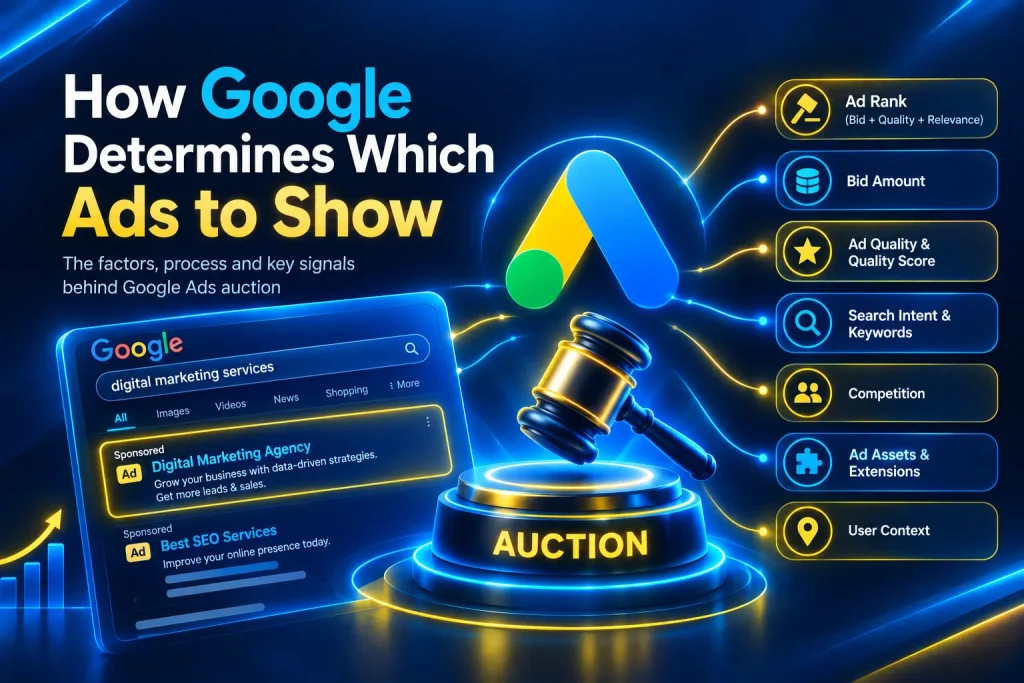
How Google determines which ads to show through Ad Rank, bidding, and ad quality.
GOOGLE ADS & PPC

How Google Determines Which Ads to Show

How Google Determines Which Ads to Show Perhaps, you have searched for a product and saw relevant ads at the top of Google’s results. In fact, the search engine uses an advertising auction mechanism to decide which ads to show. It helps the companies get the right customers and increase the quality of leads. Therefore, understanding how Google decides what ads to display is critical for a company that wants to advertise its goods or services. Google considers several parameters, such as a company’s bid, quality of ads, relevance of keywords, competition, and the impact of provided assets. These calculations occur when Google detects a search query eligible for an advertising auction. This article discusses the auction mechanism and factors affecting Ad Rank. Moreover, it will explain how a firm can improve its position in the auction. What Is the Google Ads Auction? The Google Ads auction is the process Google uses to determine which advertisements (ads) can appear for a specific search or advertising opportunity. Anytime a user conducts a search that could trigger search ads, Google organizes eligible ads and determines their placement in an auction process. However, keep in mind that the advertiser who sets the highest cost per click (CPC) cannot always secure the first position because Google considers the quality and value of the advertisement offered. For instance, if someone searched for “best digital marketing agency.” several advertising agencies would be willing to bid for the ad space. Google would then review their bids, advertisements and other factors relevant to the auction before awarding the ad space to the most competitive bidders. This mechanism ensures that Google provides valuable ads to the searcher while enabling the advertisers to bid for desirable ad space. How Google Selects Winning Ads Google Ads uses a number of factors to evaluate ads and select the winning auction entries. Here are the main elements you should consider when launching online campaigns in order to affect the results of the auction. 1. Ad Rank Ad Rank is one of the key concepts all advertisers should familiarize themselves with. This metric determines whether the ad is eligible to participate in the auction and influences its position in the search results. Google utilizes a variety of factors to calculate this indicator, including the bid amount, ad and landing page quality, ad rank thresholds, auction competition, search context, the expected impact of ad assets. While a higher bid improves an ad’s chances to appear, it does not guarantee that the advertiser will secure a better rank. A strong ad with a relevant landing page will compete successfully against ads with a higher bid but less appealing content. The Significance of Ad Rank and Its Components An advertiser should strive to achieve a high rank in Google’s results as a higher position attracts more users’ attention. Keep in mind that this metric has a significant impact on the way your campaign performs. Hence, it is critical to optimize both the bid and ad content rather than just increase the former. 2. Bid Amount The bid amount is the maximum price you are willing to pay for a particular campaign result. You can choose from a variety of Google Ads bidding strategies to determine the allocation of your advertising budget. A company’s objective, conversion data, budget, campaign type, and many other factors should influence the choice of the bidding strategy. For instance, you may utilize the Maximize clicks option if your goal is to maximize your traffic within the budget, or Maximize conversions if you want to collect more customer data and drive more sales. In addition, you can use the Target CPA (Cost per Acquisition) and Target ROAS (Return on Advertising Spend) options to reach specific objectives. Regardless of the chosen option, you need to keep in mind that a higher bid improves your chances to appear in the search results. However, it is vital to prioritize high-quality traffic that will convert rather than blindly increasing the bid. 3. Ad Quality and Its Impact on Auction Google Ads uses various quality indicators to assess ads and their landing pages. The score Google assigns to your ad determines whether it will appear in search results and its overall placement. Advertisers can view the quality score for each Search keyword if they have access to this metric. Moreover, an advertiser can view the components that factor into a query’s expected CTR, ad relevance, and landing page experience, and analyze how their campaign performs. Let us take a closer look at each of these components. Expected CTR This metric indicates how likely it is for a user to click on an ad. A higher-than-average score suggests that the majority of users are likely to interact with nearly all relevant search ads in Google. Hence, the better the ad appeals to the audience, the better are its chances to appear. A compelling headline combined with a well-crafted description stating the major benefits offered are more likely to attract users’ attention. Ad Relevance Ad relevance score is a metric that indicates how relevant the ad is to the particular search. Obviously, an ad containing details about a company’s services will appeal more to users searching for similar offerings. Landing Page Experience Your landing page should complement the content of the ad by providing the required information and promoting the advertised product or service. First and foremost, the content and the call to action on the landing page should match the ad’s content. Moreover, a responsive design and mobile-friendliness are also vital to ensure an optimal user experience and reduce the bounce rate. It is important to note that Quality Score should not be confused with another metric. The score is a diagnostic aid for the advertisers. In contrast, Google uses auction-time relevance signals to determine the winner of the auction. 4. Search Intent and Keyword Relevance Google gives priority to queries based on the search intent and keyword relevance. Keywords are essential for most ad campaigns and serve as

YouTube Ads campaign with targeting, video advertising, and growth analytics.
GOOGLE ADS & PPC

What Are YouTube Ads and How Do They Work?

What Are YouTube Ads and How Do They Work? With billions of views each month, YouTube has become a favorite platform for businesses to utilize. The company has turned out to be a major advertising medium enabling organizations to benefit from its potential audience reach. YouTube Ads enable businesses to target their desired audience while providing them with the chance to watch entertaining content. Regardless of your business nature or size, ads on YouTube can enable you to achieve your advertising goals. You can use them to raise awareness about your brand, promote your business, products, or services, attract more customers to your website, or sell more items or services. However, how can one effectively utilize the YouTube Ads service? What are the available ad formats? How much does it cost to run ads on the platform? How to get started and make the most out of this online advertising resource? Below you will find responses to these and several other frequently asked questions concerning ads on YouTube. What Are YouTube Ads? YouTube Ads can be described as paid ads that appear on or around videos. Advertisers can use them to promote various goods, services, items, apps, websites, brands, or even their presence in general. In addition, it is beneficial to understand that ads on YouTube can be found in Google’s advertising network.Thus, it becomes possible to run effective campaigns to promote the business by targeting the desired audience both on Google and YouTube. Unlike traditional marketing methods, businesses can utilize YouTube’s Ads service to specifically reach their desired audience. For instance, a digital marketing agency can target business owners looking for SEO optimization, Google Ads, social media marketing, or website development services. How Do YouTube Ads Work? There are several crucial steps in the process of YouTube Ads. These are: 1. Creation of a Video Advertisement The creation of a video advertisement is the first step. The advertisement can be used to introduce the brand, demonstrate a product, describe a service, promote an offer, and/or encourage users to make a certain action. An effective YouTube advertisement needs to immediately catch the viewer’s attention as the user browses the site and can be a quick click away from another video. 2. Selecting a Campaign Objective The selection of the campaign objective is the second step. A clear objective for the campaign should be selected as a starting point for the advertising campaign. Common campaign objectives include: – Brand Awareness – Website Traffic – Leads – Promote Products and Services – Sales and Conversions – App Promotion – Audience Engagement Selecting a campaign objective helps provide a clear direction for the advertising campaign and enables better evaluation of the final results. 3. Defining the Target Audience Defining the target audience is one of the critical aspects of a YouTube advertising campaign. Advertisements can be specifically targeted at users by considering a combination of the following factors: – Age and Demographic – Geographic Location – Users’ Interests – Search Terms and Topics – Keywords – Similarity to a Particular Website or Video – Interaction with a Business This ensures that the advertisements are seen by the right users that are more likely to engage with the content and/or buy the product or service being advertised. 4. Setting the Budget and Bid Amount The fourth step is to define the budget that will be allocated to the advertising campaign. The advertising campaigns on the YouTube platform can have a flexible budget that can depend on the advertising campaign’s specific objective and/or the amount of competition for the specific industry niche. 5. Reaching a Wider Audience Finally, reaching the wider audience is the final step. After the advertisement has been created, the target audience has been selected, and the advertising campaign budget has been defined; the advertisements will begin to appear to users on the YouTube platform (and/or Google Video). And the advertiser will be able to see the results of the advertising campaign and the reach of the YouTube advertisement. Types of YouTube Ads There are various advertising formats on YouTube which can help businesses to accomplish their marketing goals. Skippable In-Stream Ads These video ads can appear before, during, or after videos on YouTube, but users have the option to skip them after a few seconds. These ads are beneficial to businesses which want to tell a story or convey a specific message and give the viewer the choice to interact with the brand. Non-Skippable Video Ads As the name suggests, these video ads cannot be skipped by the user and would need to watch the whole ad before returning to the video they were watching. This can benefit businesses which want to give a clear, concise message to the user as they would not be able to skip the ad. In-Feed Video Ads These video ads can appear anywhere on the site where users can find videos such as the search results and related videos section. These ads are best suited for businesses which want to target users who are searching and engaging with similar content. Bumber Ads Bumber ads are short video ads which only last for 6 seconds and cannot be skipped. Because of the short length, businesses must utilise this time to get their message across instead of providing more detail in one ad. Shorts Ads With the recent rise of YouTube shorts, ads can also be placed within this vertical video format to target users who engage with this feature. As these are short videos, it is important for businesses to create an engaging short video to capture the user’s attention. Why Should Businesses Use YouTube Ads?  There are several advantages of using YouTube advertising services for a business. Big Reach It can be worth using a big platform like google to reach a large audience both locally and internationally Power of Video The video format allows to combine various means of communication. It can help to tell the story about the product/service offered by the

Google Ads performance optimization with analytics dashboard, rising growth chart, targeting icon, and digital advertising metrics in a blue and gold theme.
GOOGLE ADS & PPC

How to Improve Google Ads Performance

How to Improve Google Ads Performance Organizing a Google Ads campaign is a relatively simple task. The challenging moment is to determine how to optimize the ads to benefit the business with CTR, conversions, and increased profits. Google Ads are highly likely to mislead you as they promise to get you more clients, traffic, products sold, and overall revenue. However, a wrong choice of keywords, targeting, ad copy, and a low-quality landing page may spoil your business instead. The good thing is that you do not need to invest more into your advertising to get relevant results. Instead, you should optimize your Google Ads campaign properly to boost the conversion rate, reduce the advertising spend, and maximize ROAS. Whether you are using Google Search, Display, Shopping, Performance Max, or any other Google Ads network, several optimization techniques will help you for sure. Let us show you how to improve Google Ads performance and profit from your advertising budget. Why Google Ads Performance Is Important Google Ads performance is not simply a number of clicks your campaign generates. Instead it should attract the right audience and transform them into paying customers. Below are the KPIs that define a successful Google Ads campaign: • Click through rate • Conversion rate • Cost per click • Cost per conversion • Conversion value • Return on ad spend • Impression share • Quality Score For instance, a campaign with thousands of impressions and clicks might seem as a winner. However, if these clicks do not result in any conversions or sales, it buries you in costs. The main idea is to deliver quality traffic and not the quantity. Let us see how to improve your Google Ads performance. 1. Pick the Right Keywords Google Ads keywords are arguably one of the most critical elements of any campaign. Choosing the wrong keywords will make your ads show up for irrelevant search terms. This wastes your money without achieving any result. Prioritize High-Intent Keywords Not all keywords are created the same. Some of them signal search engines that a user is looking to make a purchase. For instance, instead of using a broad keyword such as: digital marketing use a long-tail keyword: digital marketing agency for small business It specifies that the buyer seeks an agency that provides marketing services to small businesses. Use Negative Keywords Negative keywords prevent your ads from showing up in irrelevant searches. For instance, if your marketing agency specializes in expensive marketing services, you would not want your ads to show up for searches containing the words ‘free’, ‘course’, and ‘jobs’. You can find such keywords in your search terms report and add them to your negative keywords list. 2. Rerun Your Google Ads Copy Your Google Ads copy needs to convince potential customers that they need your services. Here are a few suggestions. Write Relevant and Specific Headlines Make sure you write headlines that include your target keyword. It will help search engines understand what your ads are about. Moreover, avoid generic headlines such as: Our Services Are Available Use instead specific headlines that explain what you offer: Grow Your Business With Expert Digital Marketing Your ad copy must inform customers about what you offer, why they should choose you, the main differentiators, and what they should do next. Include Strong Call to Actions CTAs or call to actions convince customers to take action. The main call to actions are: • Get a Free Quote • Book a Consultation • Shop Now • Get Started Today • Request a Demo • Contact Our Team Use different CTAs and analyze which of them performs better. 3. Increase Your Quality Score Quality score is a metric that shows how relevant your ads are to the searched terms. This score impacts your cost per click and the likelihood of your ads showing up in the search engine results page. Improve Your Ad Relevance The easiest way to improve your ad relevance is to group your keywords and run separate ad groups for each group of keywords. For instance, if you target ‘SEO services’, create separate ad groups for small-business SEO services and enterprise SEO services. Then, write ad headlines and descriptions that are relevant to each keyword group. In other words, write ads that are relevant to the targeted customers. Improve Your Landing Page Experience Google scores your landing page experience based on its ease of navigation, loading speed, mobile responsiveness, and other criteria. A good landing page should convince the customer to take an action. The best practices are to provide value, make the page mobile responsive, and have a clear CTA or call to action. Landing pages are also a great place to convince the customer to choose your service over the competitors. 4. Optimize Your Landing Pages One is never done optimizing landing pages. The main purpose of a landing page is to convert a visitor into a customer. Therefore, it is worth experimenting with different headlines, CTAs, benefits, and other elements. Here is an example: if the user clicks on your ad with the headline ‘Get Professional SEO Services’, he/she expects to see a landing page that explains how your SEO services can help his/her business. At the same time, generic landing pages with vague headlines and CTAs will fail to convince the customer. 5. Measure Your Conversions You cannot improve what you do not measure. That is why conversion tracking is critical in understanding which keywords, ads, audiences, and campaigns drive relevant traffic and sales to your website. In other words, conversion tracking tells you where your money went. There are several types of conversions, including: • Purchases • Form submissions • Phone calls • Booking an appointment or meeting • Subscribing to a newsletter • Requesting a demo • Installing an application Depending on the nature of your business, you will select the type of conversion that suits your business. 6. Use Smart Bidding Strategies Smart bidding strategies help you reach specific goals, including maximizing clicks

Scroll to Top