
DIGITAL MARKETING

Customer reviews and five-star ratings boosting online business growth.
DIGITAL MARKETING

Why Customer Reviews Matter for Online Businesses

Why Customer Reviews Matter for Online Businesses  When we have a choice, we rarely base our decisions by merely listening to what one source has to say. Customers are no different. Prior to making a purchase, paying for a service, or choosing where to get a service, most people look for references. That’s why customer reviews for online businesses are so significant – they represent social proof that a customer has researched and feels strongly enough about that their opinion could influence someone else’s purchasing decision. Regardless of whether you have an online storefront selling products, an online presence providing services, a local business looking to build up its reputation in the area, a SaaS company, or a professional agency, customer reviews can have a major impact on your organization’s ability to grow. What Are Customer Reviews? Customer reviews are a collection of opinions, ratings, or feedback from someone who has purchased a product or received a service. These can be found across a variety of platforms: Google Business profiles E-commerce websites Social media posts Directories Review sites And your own site or directory While reviews can be positive or negative, each one carries a great deal of information that can help you improve, respond to criticism, and boost conversions. For online-based businesses, customer reviews can be much more than just a collection of opinions – they can provide a powerful marketing tool, SEO fuel, reputation management resource, and conversion rate optimization method. Why Customer Reviews Matter for Online Businesses 1. Reviews Inspire Trust Among Customers A company’s prosperity based on the online environment depends heavily on trust. A prospective customer browsing your website is unfamiliar with your company and its products, and he wants to make sure that his money will not be wasted. Customer reviews help you get past this trust barrier by providing social proof that your company is worthy of investment. Reviews are particularly effective as a tool of persuasion when two or more companies compete for the same customers. When a buyer is faced with the choice between your company and a competing business, the value of customer feedback cannot be overstated, as it reassures the customer that they are making the right choice. By motivating the prospective buyer to rely on the experiences of other people, reviews encourage him to think, “This company has proven to be a reliable source of …,” which acts as a strong incentive to buy. 2. Customers Base Their Purchasing Decisions on Reviews Most buyers conduct extensive research before purchasing your product or service. Customer reviews help them determine whether the purchase will meet their expectations. By reading what other buyers had to say about a particular product or service, a prospective buyer can get an idea of the following: • The reliability of the purchased goods/services; • The punctuality of the provided services; • The quality of the goods/services in relation to their price; • The efficiency of customer support; • The degree to which the purchased goods/services match their description, among others. After reading a positive review, a buyer will be reassured that his expectations will be met, which encourages him to complete the purchase. 3. Reviews Help Convert Website Visitors Into Customers The act of getting somebody to your website does not equal a sale. In fact, it is much harder to convert a website visitor into a customer than it is to get him there in the first place. This is where customer reviews come in handy. They can be used as tools of conversion by providing the prospective buyer with the security of trust and by helping him eliminate any doubt that he may have regarding the purchase. For instance, a customer that intends to purchase a good or a service will look for reviews in the section dedicated to customers. A company that employs online marketing can utilize customer reviews by strategically placing them so that they catch the eye of the prospective buyer at the moment when he contemplates the purchase. For instance, an online store can place customer reviews next to the products, whereas a company that provides services can place them near the contact or booking section. How Customer Reviews Can Help with SEO Customer reviews are a win for both customers and business owners: but what many fail to realize is that they can help boost your SEO! 4. Reviews Help Build Local SEO Presence Local SEO should be a core part of any business targeting reviews and aiming to improve search engine rankings. As a customer reviews and shares her experience on a local business, she is likely to stumble on similar services in her locality, and weigh them up in terms of ratings, reviews, services offered, and so forth. So, keeping a regular watch on your online reviews is a crucial element of a local SEO strategy. 5. Reviews Offer Fresh, Customer-Generated Content Customer reviews provide an opportunity for fresh content, as customers are sure to use words and terminology associated with the goods and services you provide. So what’s that mean? It means that reviews open a doorway for search engines and customers to better understand exactly what you do. For example, a customer might write a review and use key terms like: A certain product name What service she availed What issue you helped her solve What geographical area you service Features she liked Customer Reviews Can Provide Powerful Social Proof For Your Business 6. Customer Reviews Provide Social Proof of Real Experiences Any business is bound to showcase the best they’ve got on their sites and promotional material. So, while customers know that businesses will present themselves at their best, reviews offer a third-party perspective. A detailed review can help inform a customer of the extent of a product’s performance, experience during purchase, and specific problems the business helped solve. 7. The More Reviews, The Less Risk for the Customer When making a purchase online, a customer is bound to second-guess herself and
Email Marketing in 2026 with email automation, personalization, ROI, and customer engagement visuals
DIGITAL MARKETING

Email Marketing in 2026: Is It Still Effective?

Email Marketing in 2026: Is it Still Effective With the advent of social media, artificial intelligence, search engines, chatbots, and many other marketing channels, it is reasonable to think, is email marketing still effective in 2026? Short answer: yes, is. But not as you probably think. Email marketing has evolved, not only as a channel to notify and promote to thousands of customers at once, but to personalize, automate, analyze, segment and sell to them, based on behavioral patterns, interests, preferences, and much more. Recent (2026) industry benchmarks show that email marketing can indeed still be effective, with a median return of $36 for every $1 for every dollar spent on them. However, this can vary considerably from industry to industry, and from company to company, depending on the audience, strategy, and metrics used. So, email marketing is not dead, rather, it has evolved into a more sophisticated, personalized, and automated channel to acquire, engage and sell to customers. What Is Email Marketing? Email marketing is a type of digital marketing that involves sending emails to prospects and customers. Companies can use email marketing to do the following: – Drive lead generation– Promote products and services– Deliver educational information– Engage with prospects and customers– Encourage existing buyers to remain loyal– Alert customers to new offers, launches, and promotions– Recover abandoned purchases– Retain customers Unlike social media, which is controlled by an algorithm that only selects what content gets seen by whom, email marketing provides companies a straight channel to those who have given their permission to be marketed to   Is Email Marketing Worth It in 2026? Yes, because blasting the same marketing message to 10,000+ email addresses isn’t going to get the same results it did 10 years agoModern email marketing relies on delivering value to the customer. That doesn’t mean companies should stop blasting acquisition-heavy content to their audiences. But there should be a mix of the following types of sequences: – Acquisition: To drive new sign-ups, these would typically go to your blog or newsletter.– Education: Sending helpful content to your prospects.– Recommendation: Recommending products or services to past customers.– Recovery: To target those who’ve abandoned their carts.– Monetization: Offers to your most engaged customers.– Re-engagement: To get someone who hasn’t interacted with you in a while to come back. The above sequences would get your audience to feel like they’re being taken care of by your brand rather than getting blasted with ads.Also, as of now, industry benchmarks still report healthy returns on investment (ROI) for email marketing, with many companies reporting a $36-$42 ROI for every $1 spent in 2026. Why Email Marketing Still Works in 2026 1. Email Marketing Lets You Get Into the Hands of the Customers Social media platforms are algorithm-driven, while email marketing is much more direct. When a person subscribes to an email list, they give up a bit of ownership. That is precisely why social media’s algorithm does not show your post to everyone you want. 2. Email Marketing Can Produce an Excellent ROI One of the reasons people invested in email marketing heavily in 2003 is because the ROI was just ridiculous. For a $1 investment, you would get 27 cents. But then it started averaging just over $$36 for every $ A study published by EmailToolTester showed that in 2003, most ROI for ecommerce and consumer products ranged between But wait, that number can be yours per dollar. 3. Email Marketing Automations Save Time Email marketing automation has made the channel so much more effective. The ability to make automated sequences helps to reduce the workload and improve results. All kinds of marketing professionals rely on automation, like automated welcome mail lead nurturing sequences abandoned cart recovery birthday or anniversary emails post-purchase sequences product recommendation emails re-engagement campaigns 4. Personalized emails help sell a lot better than bland ones designed by the CEO Customers do not want to receive unspecific emails. A personal touch in an email campaign is essential if the emailer wants to make a sale. Some simple things can personalize an email, like a name website activity the customer’s location the products he or she has shown an interest in his or her interaction data with the brand’s emails customer lifecycle stage It is crucial that emails are not personalized simply because a name was added to the front of the email. True personalization should make the message applicable to that specific person and his or her intent and stage in the buying cycle.  The trends to watch out for in email marketing in 2026. AI-Augmented Marketing Emails Artificial Intelligence (AI) in email marketing will become a must in 2026. AI can write an email, write a subject line, analyze campaign performance, predict customer behavior, recommend products, personalize content, optimize send dates, and segment lists. But remember that AI-driven campaigns should be strategically designed to maximize an email marketer’s efforts and not replace what a professional marketer brings to the table. Automated Behavioral and Time-Sensitive Emails One of the hottest trends in email marketing in 2026 is using behavioral and time-based triggers to send emails. For example, if a customer browses a website and leaves, an abandoned cart email can be sent. After the customer makes a purchase, a thank you email, product educational email, and cross-sell email might follow. Segmentation Is King There has never been a better time to segment lists and nurture customers. Sending one mass email to a list is not the most effective practice in modern-day marketing. Instead, segment lists and send emails accordingly. For instance, new leads may need nurturing emails. prospects may need product or service-oriented emails. existing customers may find value in looking at some special offers. inactive users may get special re-engagement campaigns. Email Marketing Metrics Businesses Should Track in 2026 Your open rate should never dictate if your business needs to tweak their email campaigns Due to Apple’s Mail Privacy Protection feature; companies need to start placing a bigger emphasis on other engagement and

Content marketing strategy featuring blog posts, videos, social media, podcasts, email, eBooks, and growth analytics.
DIGITAL MARKETING

More Than Just Blog Posts: The Complete World of Content Marketing

More Than Just Blog Posts: The Complete World of Content Marketing Although many people still associate content marketing with blog posts, this type of marketing comprises many more elements. Of course, maintaining a blog and publishing articles there is an essential strategy for any company that wants to promote its products or services successfully. However, in addition to blogs, companies also use social media, video content, podcasts, infographics, email marketing, case studies, ebooks, webinars, interactive media, and much more. Therefore, it is especially important for entrepreneurs to understand what all content marketing entails to build the most effective strategy for their business. All these types of content marketing help companies reach their target audience and properly position their brand. At the same time, for different companies, different marketing tools are relevant at different stages of the customer journey. What Is Content Marketing? Content marketing is a type of digital marketing that focuses on attracting and retaining a target audience by providing informative content, developing it, and distributing it consistently. In other words, instead of focusing on promoting a product or service, content marketing creates useful content that educates, advises, informs, or entertains consumers. For example, a digital marketing agency can create content marketing assets, such as SEO guides, social media posts, marketing videos, reports, email marketing content, customer studies, checklists. Through constant creation and sharing, the business can also build itself as an authority in the field and drive traffic to its website to complement its marketing and sales strategy. Why Content Marketing Matters for Businesses Content marketing can be leveraged at different stages of the customer journey. It can raise brand awareness, build trust, and even drive sales. It Can Raise Brand Awareness Informative content can be utilized to educate prospective clients and improve brand image.The marketing assets can also be optimized to increase organic reach and appear in search results, thus, driving traffic and creating brand awareness. Content marketing enables businesses to increase their discoverability and reach new customers. With the help of SEO-friendly blog posts, videos, social media content, and images, businesses can be found by more prospective clients. It Can Help Build Trust Consumers tend to trust companies that offer valuable content regarding their niche or industry. Reports, guides, how-to articles, whitepapers, and case studies introduce businesses as reliable and informative sources in their space. It Can Complement SEO Strategy SEO and content marketing usually work together. Creating blog posts and videos with SEO in mind will improve a website’s ranking on search engines. Moreover, through keyword research, the content published on the business’s website will also aim to answer the questions of prospective clients searching online. While SEO content marketing is essential for improving the visibility of a business online, marketers should avoid keyword stuffing. Instead, they should focus on providing informative, helpful, and high-quality content that will fulfill users’ intent. It Can Generate and Nurture Leads Content created by businesses can persuade website visitors to become leads. For instance, a helpful article can entice readers to download an informative guide. In turn, they may subscribe to the company’s newsletter and be nurtured to a lead and eventually a paying customer. Therefore, content marketing can generate leads and help move them through the sales funnel by providing informative content instead of hard-selling. The Complete World of Content Marketing A successful content marketing strategy makes use of various content types, as opposed to relying on a single source, such as blog posts. Blog Posts & Articles Blogging is the most popular and versatile kind of content marketing. Businesses can leverage blog articles to share informational content marketing , including how-to guides, tutorials, industry insights, listicles, comparisons, beginner’s guides, FAQs, trends. Instead of focusing on the sheer volume, it is advised to prioritize quality over quantity while publishing blog content marketing . In other words, not every business blog post should purely serve the purpose of improving the number of web pages. Video Content Modern content marketing strategies give much importance to video content marketing . Businesses can leverage videos in social media posts and on their websites to narrate a compelling story and effectively communicate their ideas, values, and vision. The content marketing ideas could include educational and informative videos, product or service demos, tutorials, customer testimonials, short videos for social media, behind-the-scenes glimpses. Visual Content Many businesses prefer to complement written content marketing with visual resources, such as infographics or images. Visual content marketing is ideal for presenting data, statistics, and other information in a visually appealing manner. It could also be used for conceptualizing certain ideas and making them more accessible and engaging. eBooks, Guides, Reports EBooks are long articles that offer more in-depth information on a specific topic. Guides could include special offers or reports to help attract clients or improve lead generation. Moreover, businesses could provide potential clients with helpful tips, guides, and tools, asking them to exchange their contact details for the information. Case Studies Many companies prefer to share their success stories and experiences with products and services that helped them achieve their business goals. A compelling case study usually describes what the company was looking for, the background and circumstances of the case, what they eventually did, and the final outcome or result. Email Content Email marketing is crucial for nurturing existing subscribers and clients. Businesses could send email newsletters, updates, news, product announcements, and other special offers to their mailing lists. This way, companies could also keep their clients up-to-date on the latest news regarding a particular topic, industry, or field. Instead of relying only on regular blog postings, business owners could encourage their clients to join the company’s mailing list, where they will receive relevant content marketing updates. Podcasts Companies could share podcast episodes covering a range of topics relevant to their niche or industry. Podcasting is a great way for businesses to demonstrate their areas of expertise and expand their audience reach. Podcasts allow for in-depth conversations, interviews, and even discussions with specialists on various

Content strategy with analytics, planning blocks, and digital marketing elements
DIGITAL MARKETING

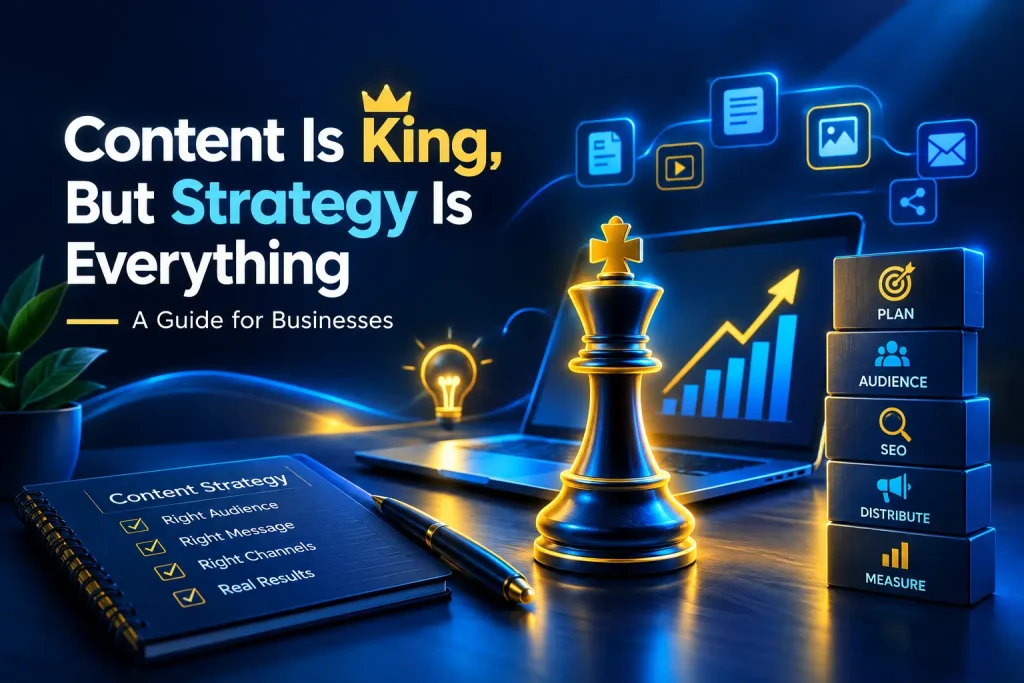
Content Is King, But Strategy Is Everything: A Guide for Businesses

Content Is King, But Strategy Is Everything Ideas for Businesses In the realm of digital marketing, there is a popular saying that “Content is King.” However, when it comes to content creation for businesses, having great content is not enough. A company can churn out articles for its blog, post on social media, make videos, and send emails without a second thought about what they are doing. Unfortunately, this kind of content creation will most likely fail to reach the desired outcome. Therefore, the following visual could serve as a reminder to businesses about the importance of developing a content marketing strategy: Content is King, but strategy is everything. A good content marketing strategy should focus on the content’s purpose, audience, research, and business goals. In other words, a company should invest in content that serves a specific goal, appeals to the target audience, has done the necessary research, and has measured results. Therefore, when companies think about what they want to post, who they want to reach, and what action they want the audience to take, they have a solid base for creating a content marketing strategy. The next section will provide more ideas about creating a successful content marketing strategy. Why Content Is Not Enough  Nowadays, anyone can create content. Whether it is blog posts or social media, video or infographic, email or something else, creating content is no big deal. The problem is that different platforms attract different audiences, and it is not always clear what and how to post to engage with the public. For instance, if a software company writes ten blog posts per month about various issues related to the whole tech industry, not about the company’s niche, it does not mean that these articles are useless. However, if they do not raise any concerns relevant to the company’s potential customers and do not address their problems, then this content marketing campaign will not be very successful. Instead, a company should develop a content strategy that would define its target audience, their problems, what keywords they search, their place in the buyer’s journey, the content type that would appeal to them, what goal it should fulfill,  how to measure the performance. Otherwise, a company would simply waste resources on creating content for nobody. What Content Strategy Means for Businesses In general, a content strategy is a plan of creation and promotion of content items in order to meet certain goals. There is always a specific purpose of each created and published piece, and businesses should closely define their target audience and segment it into groups of people with similar concerns.With the help of these segments, companies can come up with topics and formats that would appeal to their clients the most. Moreover, an efficient content strategy should also include SEO optimization and measurement of results.Therefore, businesses should define their goals, research their audience, create customer personas, write down topics and keywords, choose the content types, establish a publishing schedule, distribute posts, optimize content, and measure results. Start With Clear Business Goals Before writing post, you should define your goals.Depending on your business needs, you may have several goals that your content has to meet. For instance, your blog’s content may have to build brand awareness, bring leads, boost sales, or establish your authority. Let’s take a closer look at each of these goals. Increase Brand Awareness The blogs and social media posts about your products, services, and industry news and events can help you build brand recognition and awareness. Lead Generation You can use lead magnets, landing pages, webinars, case studies, and how-to articles and guides about your industry to get more qualified leads. Drive Sales Product page reviews, product comparison articles, customer testimonials, case studies, and in-depth service reviews can help you increase sales. Establish Authority High-quality content marketing, blog posts, whitepapers, research studies, and expert guides and reviews can position you as an expert in the field. Understand Your Target Audience Before rushing to generate content, make sure to get to know your target audience.Identify what questions they may have, concerns, purchasing habits, and preferences. Focus on the problems they need to be solved, objections they may have when making a purchase, and what platforms they like to consume content on, and what media types interest them.A B2B audience may favor whitepapers, compared to a more consumer-oriented audience that may be attracted to video content. Audience research allows you to shift from generalities about your customers to specifics: the actual people who serve your content will matter greatly to the shape of your copy.  Develop Content Around the Customer Journey One of the main concepts behind content marketing strategy involves the idea that your potential customers are looking for something specific.It’s important to recognize that customers will need different information at different stages of their journey. The usual customer journey breakdown is as follows: 1. Awareness2. Consideration3. Decision4. Retention At the beginning of the journey (the awareness stage), customers may come to your website searching for general information about a particular condition, niche, or product.Types of materials that are helpful at this stage include: • Educational blog posts• How-to guides• Social media• Educational videos• InfographicsAt the consideration stage, prospects will be looking for solutions to the problems they have identified.Applicable materials at this stage may include:• Comparison articles• Blog posts• Case studies• Webinars• In-depth guidesAt the decision stage, the customer is preparing to finalize the purchase and will be looking for testimonials, pricing information, product descriptions, and specifics about how they should make the purchase.Materials at the decision stage:• Testimonials• Reviews• Demos• Pricing guides• FAQsAt the retention stage, the customer is interacting with your company as a post-purchase partner, looking for ways to gain more value through the application of your product or service, or after-sales support.Materials at the retention stage: • Email newsletters• Tutorials• Knowledge base• Product announcements• Educational content Focus on SEO Content Strategy. No matter how good your content is, it will not serve its purpose if none of

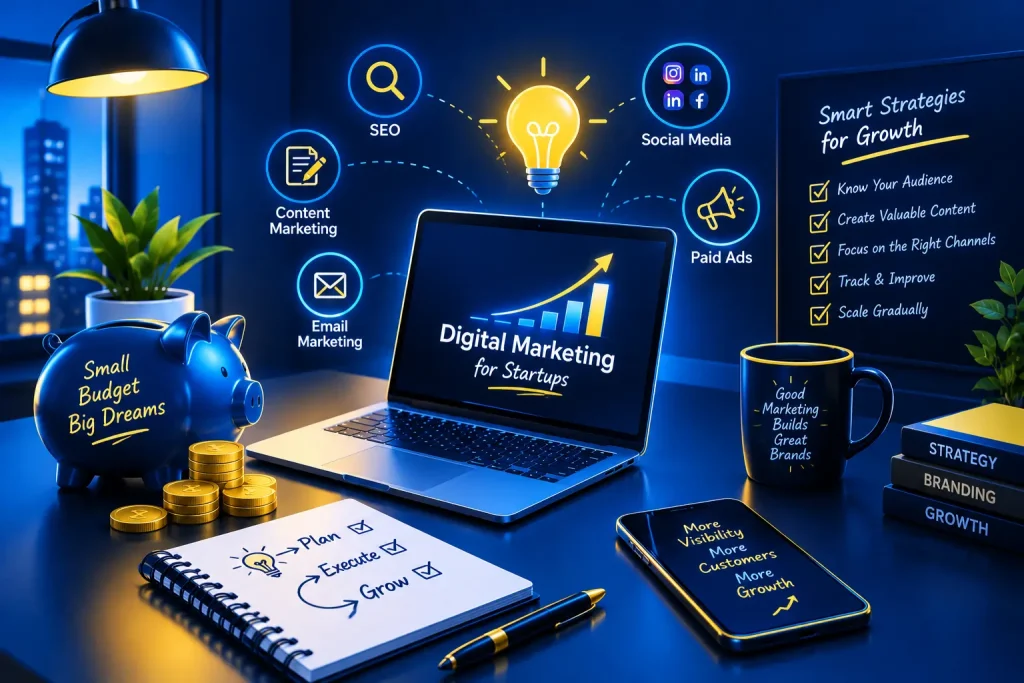
Digital marketing strategy for startups on a small budget, featuring a laptop, piggy bank, growth chart, SEO, social media, content marketing, email marketing, paid ads, and strategic planning elements in a blue and yellow theme.
DIGITAL MARKETING

How Startups Can Use Digital Marketing on a Small Budget

How Startups Can Benefit From Marketing Marketing is often the top priority for any startup. However, with a limited budget and a strong competitive environment, companies should be able to maximize their gains by using the most effective tools. Digital marketing in such cases can solve most problems for a company as an experienced team can address all issues on the web and help the startup make the most of their gains. SEO, social media, content, and email marketing are only a few areas where a startup can get tremendous returns on their investment. Therefore, in this article, some of the most viable methods for low-budget marketing will be discussed. Why Digital Marketing Is Important for Startups Traditional advertising may demand a huge amount of money for television, press, billboards, and other traditional media. Digital marketing makes it possible for small businesses to reach out to the target audience via online resources. Moreover, an appropriate campaign may be launched using a small budget. A properly planned digital marketing campaign will help in building online presence, increasing brand awareness, targeting the most suitable customers, generating leads, establishing relationships with the audience, boosting the quantity of visitors to the company’s website, enhancing customer engagement,  evaluating the performance of the marketing effort, scaling the growth. Instead of trying to be omnipresent, it is better to define who are the most likely customers to buy the company’s products or services and invest in those digital platforms where the target audience spends most of their time. 1. Build a Website Your website is often the first impression for a potential customer. You don’t need an expensive website, a simple and sleek mobile-friendly version will do as long as it has what your business offers, who your customers are, why choose you, how to contact you, calls-to-action. A simple website with clear-cut information will be more helpful than a costly one with unclear calls-to-action. 2. Search Engine Optimization Search engine optimization, or SEO for short, is one of the best long-term ROI marketing strategies for a budget-limited startup. SEO focuses on ranking your website on the first page of search engines for relevant keywords. SEO helps your website gain organic traffic as opposed to paying for website visits. Target Long-Tail Keywords Big companies usually target high-volume keywords which is why long-tail keywords are a good place to start for startups. Long-tail keywords are more specific and have lower competition than high-volume keywords. For example, target “affordable digital marketing agency for startups” instead of “digital marketing.” Create SEO Friendly Content SEO content marketing is about creating content your potential customers are searching for.For example, you can create how-to guides, tips, tutorials, comparison articles, case studies, FAQs, beginner’s guides. Having informative content will establish you as an authority in your space. 3. Social Media Marketing One-third of the global population uses social media. So, it’s a great place to invest your time and money to grow your business. But it doesn’t mean you have to be everywhere. Pick one or two social media networks where your target audience spends the most time. Post Valuable Content Don’t market your products 24/7. Instead, focus on educating and entertaining your audience. Here’s a list of ideas you can try: education, short videos, user-generated content, stories, industry insights, product reviews, tips, product tutorials. For example, if you own a productivity software company, you can post tips and tricks about being productive, how to use your product, and how productivity tools transformed someone’s life. The more they follow you, the more they will trust you to solve their problems. 4. Content Marketing If you think about content marketing, you might imagine a well-produced video or a blog post with an attractive design. While these pieces of content require investment, they aren’t mandatory. There are many ways to leverage content marketing on a budget. Repurpose Your Content For example, one blog post can turn into an Instagram carousel, a LinkedIn post, a YouTube video, an email newsletter, 5+ social media posts, and a visual infographic. Repurposing your content helps you maximize your limited resources. Pro tip: focus on creating helpful content your audience wants to consume rather than filling your content calendar with random topics. 5. Email Marketing Email marketing might seem old, but it is still one of the most powerful marketing strategies, especially for startups. You can use email to build relationships with your customers. Email can be used as a marketing tool, a sales tool, and a customer service tool. To do that, you’ll need a list of engaged subscribers. You can grow your list by adding a subscribe button to your website, offering lead magnets, running email contests, posting newsletters, providing free trials, and hosting webinars. Your email marketing content should be focused on being helpful. Here are some email marketing ideas: educational content, newsletters, product announcements, emails with coupons, case studies. 6. Leverage Organic Marketing Before Investing in Paid Ads Paid ads are a great way to acquire customers, but they are also the riskiest and most expensive marketing strategy for a new business. Start with testing your organic posts before investing in ads. For example, if you see that your Instagram post is getting a lot of engagement, or your blog post is driving traffic, you can use this data to create better-performing paid campaigns. Start Small and Scale When you start with paid advertising, focus on one social media network and run one ad campaign. You’ll want to look at your CTR, conversion rate, cost per lead, CPA, and ROAS. Then, reinvest your profits into the most performing ads and scale them. 7. Local SEO Local SEO is a great budget-friendly marketing strategy for local businesses. Local SEO is all about ranking higher in local searches. For example, if someone searches for “digital marketing agency in Prayagraj,” you want your website to show up on the first page of results. Create local content, optimize your website for local searches, get positive reviews, and make sure your

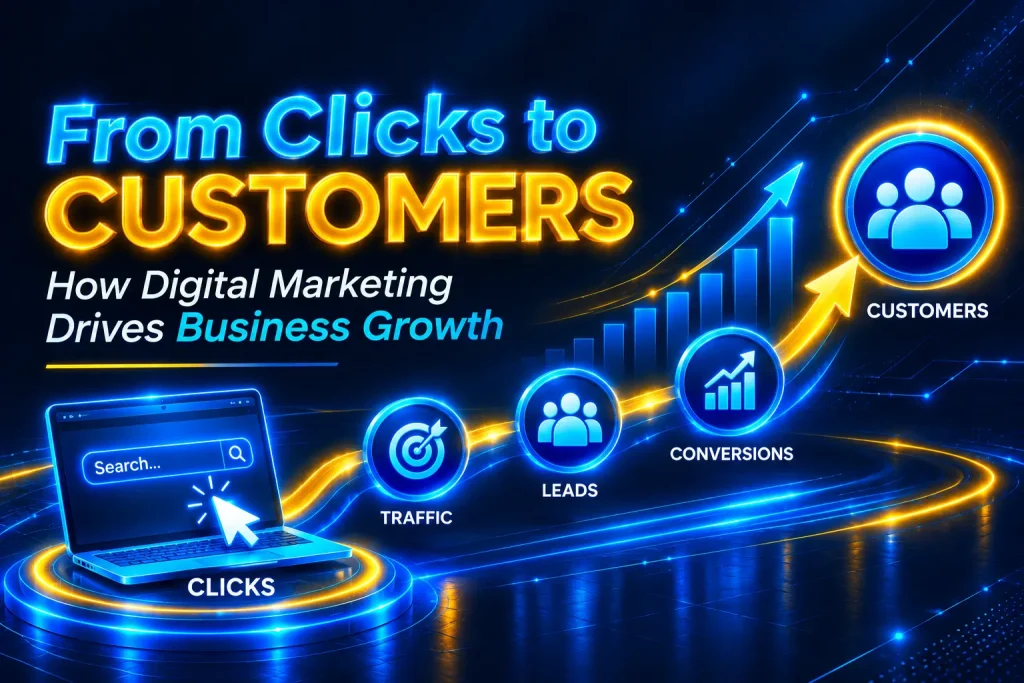
From Clicks to Customers – digital marketing driving business growth through traffic, leads, conversions, and customer acquisition.
DIGITAL MARKETING

From Clicks to Customers: How Digital Marketing Drives Business Growth

From Clicks to Customers: How Digital Marketing Drives Business Growth In the modern era of technology-based business interactions, companies must do more than offer good services or products. Their representatives should be able to reach the target audience and effectively communicate their selling points to get more clients. Digital marketing helps to accomplish this goal and enhances a company’s reputation, attracts new customers, and increases sales.Thanks to marketing services, businesses get many different ways to promote their products. From social media and search engines to email marketing, online advertising makes the company known across the globe. Moreover, they can get high-quality traffic to their site, engage visitors, and convert them into customers. Thus, a company can benefit from digital marketing greatly. Any small business, startup, online shop, or an established enterprise with vast experience can use it to get new clients and promote their goods and services. Now, let’s see what advantages digital marketing brings to businesses and how they can help companies get more customers. What Is Digital Marketing? Digital marketing definition entails the use of online media to promote goods and services. It is different from traditional marketing since it enables the marketer to identify a niche audience and interact with them through electronic channels. SEO, social media, email, and other online strategies are all part of digital marketing.  Here are some common digital marketing tactics: Search engine optimization Social media marketing Content marketing PPC advertising Email marketing Influencer marketing Affiliate marketing Conversion rate optimization While boosting web traffic is just one component of a digital marketer’s job, driving high-quality visitors to a landing page and persuading them to purchase is what determines a successful digital marketing campaign. How Digital Marketing Drives Business Growth How Digital Marketing Drives Business Growth 1. Increasing the Visibility of the Brand The process of any marketing starts with the fact that a person needs to become aware of the existence of a particular business.Search engine optimization, social networks, content marketing, and advertising can help a company appear in front of the person who is looking for exactly the services that the company provides. For instance, in the case of a sports equipment company, one can create content marketing, optimize it for search engines, and thereby appear in front of those who search for keywords such as “home training equipment,” which leads to brand awareness.Moreover, increasing the visibility of the brand means that there will be more people who can potentially become a customer. 2. Target Audience Reach Furthermore, the possibility of digital marketing to increase audience reach implies that the company can also target specific groups of people.Demographics, location, interests, and many other characteristics can be taken into consideration for finding the target audience. By using digital marketing, companies can specifically choose the audience to which they want to target their promotion and thereby waste less money on advertising.Besides, by attracting the attention of people who are interested in what a company sells, the company will have more potential customers. 3. Lead Generation Leads are one of the critical points in any marketing system.Simply put, companies need more visitors to their website to generate more sales.Digital marketing helps with this as it provides a variety of lead generation methods.Those include landing pages as separate pages on the website, modal windows, pop-ups, contacting consultants, getting discounts, newsletter subscription, free samples or trials, and many others.For instance, a company can offer its visitors to get a free trial of its product under certain conditions.In that case, the company can later on contact those people and get them to become a customer. 4. Building Trust and Recognition It is vital that a company builds trust with its potential customers.Often before buying a product or a service people look for reviews or other information about the company.Therefore, digital marketing once again comes in handy as it can help in recognition and trust-building with the target audience.With that being said, creating quality content that would not ignore the needs and the questions of the customers is of paramount importance. A company should regularly post articles, reviews, testimonials, videos, and much more. All of that would build trust as a company would be able to show its potential customers that it can help them in whatever issue they are facing. It is important to note that nowadays content marketing is one of the most effective marketing methods. 5. Converting Visitors to Customers Although generating leads is essential, without converting them to customers, a company will find itself at a deadlock.In other words, it is not enough to attract new visitors; a company should provide them with reasons to choose their brand. Thus, a company has to optimize its website to encourage conversions.Conversion rate optimization includes several methods, such as reducing the bounce rate, improving website design, providing better content, and others.As an example, “Call to Action” buttons can be optimized. A button that says “Get a Free Consultation” will yield better results than a button that says “Learn More.” This particular step will help a company to build a relationship with the customer and provide them with an answer. Key Digital Marketing Strategies for Business Growth Search Engine Optimization SEO SEO could potentially boost the appearance of your company in the organic search results.A good SEO strategy typically contains keyword research, engaging content, technical SEO, internal linking and a website that provides excellent UX. The ultimate aim of SEO is to attract more visitors to the website and increase the number of visitors who are searching for the products or services offered by the company. Social Media Marketing Social media is a powerful tool for community building, word of mouth marketing, and two-way communication with one’s customers. Companies could benefit from both organic social media marketing and paid social media advertising. The key to success in social media marketing lies in figuring out which social media networks one’s target audience is active on, and what content they would like to see. Content Marketing Content marketing is all

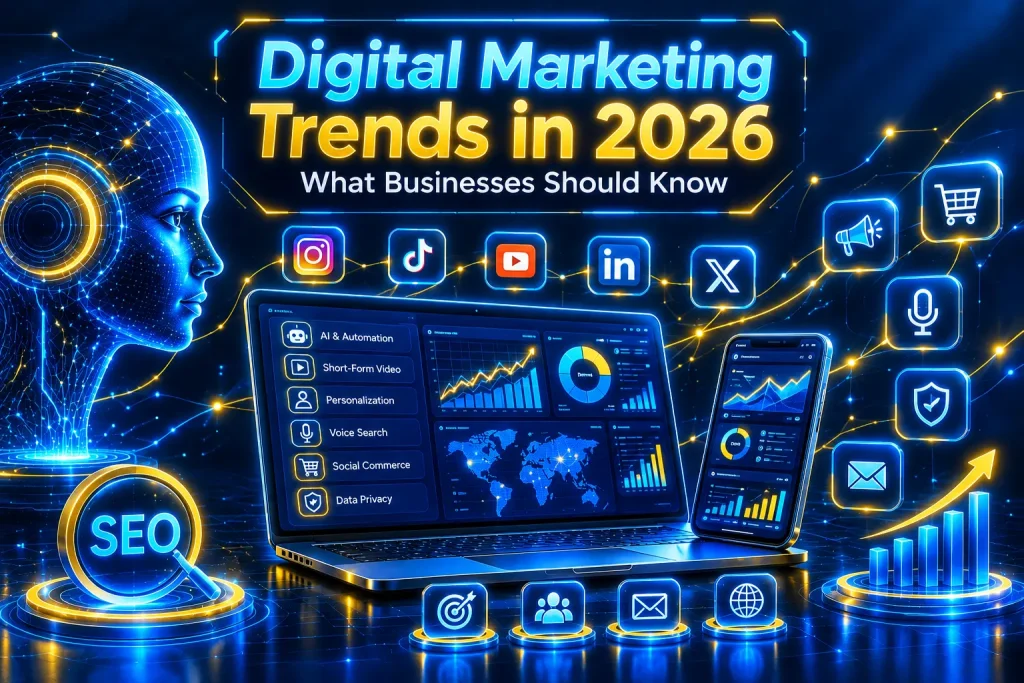
Futuristic digital marketing trends in 2026 with AI, SEO, social media, analytics, laptop dashboard, and business growth icons in a blue and gold neon theme.
DIGITAL MARKETING

Digital Marketing Trends in 2026: What Businesses Should Know

Digital Marketing Trends in 2026: What Businesses Should Know Keeping your business in front of customers on the web doesn’t depend only on doing what you did last year. The ways that customers behave, artificial intelligence, and online search evolve at an astonishing rate. Staying aware of the trends in digital marketing 2026 is a must for any founder, marketer, or small business owner who wants to be able to consistently acquire new customers. Your customers do not engage with the website or social media as they used to. Search engines return synthesized information directly in search results, social networks prioritize real conversation, and privacy rules kill the old practice of buying followers. Customers want to feel safe and served – their expectations of brands are at the highest level. To adapt to the new circumstances, your marketing team does not have to re-invent the wheel. You should rather understand what trends are worth adopting to increase revenue and leave the unworthy ones aside. This article highlights the most significant digital marketing trends 2026 and gives advice on how to harness their potential. ★ The Core Theme of 2026: Technology has made it easy for anyone to produce content, which has made generic marketing ineffective. The winning formula in 2026 combines automated operational efficiency with an undeniable human expertise and audience trust. Why Digital Marketing Trends Matter for Businesses in 2026 Any change in technologies provokes shifts in the ways prospective clients search for and investigate your brand, leading to the necessity of updating your marketing strategy. Such changes as the development of conversational search or the growing importance of social algorithms make obsolete any traditional approaches to promoting a product or service. Paying enough attention to marketing trends for businesses enables you to avoid failures due to inefficient spending on failed advertising campaigns. Besides, the growing consumer awareness of aggressive marketing tactics makes customers skeptical of conventional advertising. In this regard, any organization needs to shape its unique value proposition to identify itself as an expert in a specific sphere recognized by the target audience. Moreover, those who dare to innovate and update their knowledge on a regular basis acquire a competitive advantage. It allows them to reduce their cost per acquisition and build customer loyalty, which other companies find difficult to achieve. Finally, being aware of modern marketing tendencies helps understand how to direct time and resources to achieve better results in promoting the company’s goods or services. It is essential to keep in mind that not all information referring to your business underlines its importance for customers; thus, it must be prioritized depending on the context of the interaction. Top Digital Marketing Trends in 2026  Here are 9 major digital marketing trends that organizations should be aware of this year: 1 AI-Powered Digital Marketing Artificial intelligence and generative AI tools, in particular, have become essential assets to marketing teams in 2026. Marketers are using AI to analyze customer data, develop email copy variations, predict customer churn, and target customer journeys better in digital advertising. However, marketers realized in 2026 that AI should be used as an assistant rather than a primary content creation tool. Companies that posted purely AI-generated content suffered from poor user engagement and search engine rankings. Advanced teams use AI to speed up their research and administrative duties while reserving human workers for creative, fact-checking, and proofreading tasks. 2 Search Is Becoming More AI-Driven Modern search engines are evolving from lists of blue links to AI-driven research assistants that help users find the information they need. With generative AI, searchers can ask for advice on the search window and receive answers on the topic instead of sifting through tens of irrelevant documents. For websites, this trend means that the semantic SEO and topical authority have become even more critical. Instead of creating generic content pieces, webmasters should focus on publishing unique insights, research data, expert opinions, and solutions to specific problems. Search engines prioritize informative and reliable resources that directly address the searcher’s needs and concerns. 3 Short-Form Video and Visual Content Short vertical videos dominate engagement on social media platforms such as Instagram Reels, Facebook, TikTok, and YouTube Shorts. The general public prefers watching a brief tutorial than reading an extended guide. Marketers can capitalize on this trend by distributing various visual content, including short product videos, customer testimonials, employee highlights, and even raw unedited footage. Such video content is easier to produce than many marketers think, and it has a more significant impact than traditional sales-oriented marketing materials. Many companies use video content to respond to frequently asked questions by their viewers. 4 Personalized Marketing and Customer Experience Modern customers have grown tired of one-size-fits-all marketing communications. Using the same marketing email for all clients may lead to poor engagement and unsubscribes. Marketers can employ personalization techniques to recommend products and offer relevant content to individual clients better. At the same time, personalization practices should respect the privacy of the clients. Wherever possible, always seek permission to collect and use personal data. In addition, never use the customer’s data in a way that they did not expect. 5 First-Party Data and Privacy-Focused Marketing As regulatory compliance becomes increasingly important, many traditional marketing strategies, such as installing tracking pixels on the website, become obsolete. Modern customers are concerned about their privacy, and they limit the amount of personal data they share with websites. Marketers should focus on developing first-party data and audience lists rather than using the third-party tracking options. In addition, it is critical to ensure transparency in how the marketer collects, stores, and uses the consumer data. For example, you could build an email list, ask your clients for voluntary assistance in providing feedback, and improve your loyalty program. Having direct access to the consumer is vital when changes to the tracking regulations make it impossible to reach your audience. 6 Social Media Marketing Is Becoming More Community-Focused Many social media platforms are rethinking their policies and have shifted towards

Scroll to Top