SEO

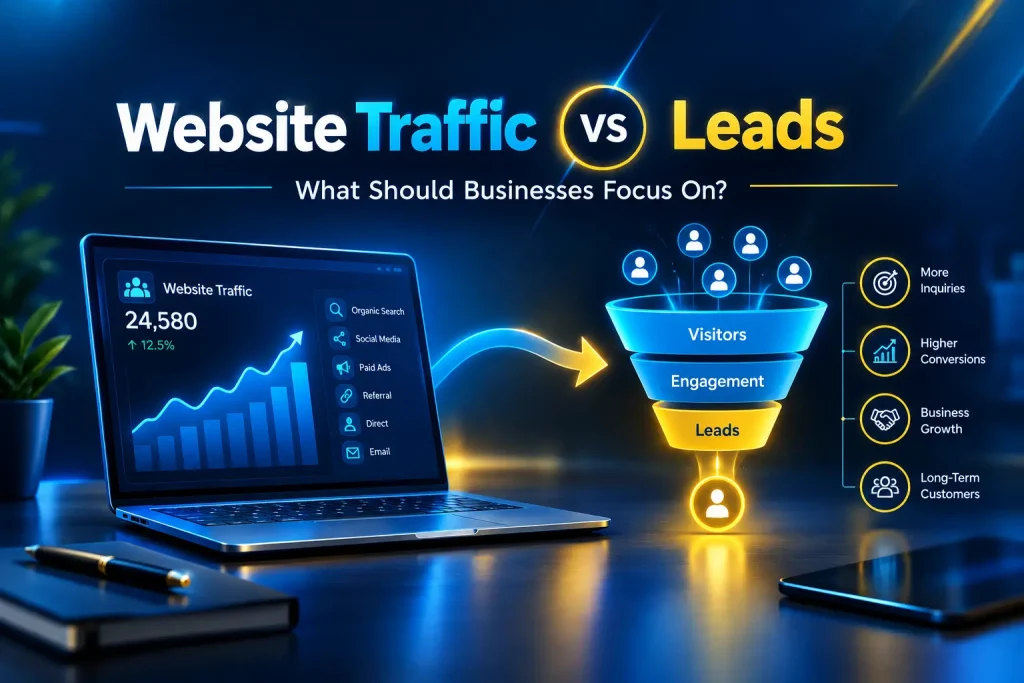
Website traffic converting into leads through a digital marketing funnel.
SEO

Website Traffic vs Leads: What Should Businesses Focus On?

Website Traffic Vs Leads: What Should Businesses Focus On ? For any company that has an online presence, the success is measured in traffic and leads. Website traffic refers to the number of visitors who land on the website, whereas leads denote the number of prospective customers. While traffic is used to measure the reach of the website, leads are a more meaningful metric since it reflects the number of visitors who could be potential customers. However, many companies focus only on the number of website visitors without realizing that they need to concentrate on the leads generated from the website. Leads are crucial to a business’s success as they translate into sales. While the website traffic signifies the scope of the website, leads showcase the potential buyers. A company may have a good number of traffic on its website but if the number of visitors who inquire about buying the products or services is low, the business is not doing well in terms of sales. In contrast, a website that is able to generate enough leads from lesser traffic is capable of translating the visitors into sales. This is essential for any business as sales are the lifeblood of any company and without sales, a company cannot sustain itself in the long run. Therefore, it is essential to have an adequate flow of quality traffic that could be converted into sales. In the following sections, we shall look at the difference between website traffic and leads and understand the importance of both these metrics. What Is Website Traffic? It’s the users who visit your website. These visitors can originate from a variety of different sources, such as: Organic search Social media Paid advertising Referral websites Email marketing Direct access Online communities If you had 10,000 visitors to your website within a month, that means you had 10,000 visitors. Why Website Traffic Matters Unless you have people visiting your website, it makes generating leads and sales very difficult. Having more relevant traffic can allow you to: Boost your brand awareness Drive awareness to any new products or services Create more conversions Drive more sales Lay the groundwork for remarketing Allow you to collect information about your visitors More traffic isn’t always good traffic, however. You could be getting 10,000 visitors a month, but none of them are interested in buying your products or services, which has a significant impact on your bottom line. That’s why it’s important to focus on the quality of traffic, not just the quantity. What Are Leads? A lead is someone or something that will engage with your business and give you an opportunity to sell your products or services. Depending on the type of business you have, a lead might: Fill out your contact form Ask for a quote Book a consultation Subscribe to your email list Download an ebook Attend a webinar Book a demo Call your business Request an inquiry Why Leads Matter Leads directly represent someone who wants to buy from you. A person visiting your website page on the other hand, isn’t likely to provide you with a sale unless you convert them into a lead. Leads gives you a warm start to selling your products or services, and it’s much easier to do so than if you had found a random visitor to the website. Website Traffic vs Leads – The Key Differences  Leads are visitors taking some sort of action at your website It’s the difference between traffic and leads – one measures reach, and the other measures engagement. If we look at two example businesses: Business A Traffic: 50,000 visitors per month Leads: 300 visitors per month Business B Traffic: 8,000 visitors per month Leads: 500 visitors per month Even though Business A has a significantly higher amount of traffic, Business B is doing a considerably better job at generating sales-oriented leads that will actually assist them in generating more revenue. Traffic Measures Reach – Leads Measures Engagement These two important metrics can help you answer a variety of questions about your website, such as: Traffic questions: Are people seeing your website? Where are people finding your website What pages are people engaging with the most? Does your SEO strategy appear to be working? Leads questions: Did they express interest in your offer? What pages are driving the most leads? What are your best channels for generating leads? Is your call to action effective? Why Businesses Need Traffic And Leads There is no need to oppose traffic and leads to each other. Both are part of the same system: Traffic > Engagement > Conversion > Lead > Customer Traffic drives website visitors to engage with the brand. It is the content and website experience that influence a visitor’s decision to become a customer. Calls-to-action and optimized content help to move from engagement to conversion Without traffic, there will be no leads. Without conversion, there will be no customer. Traffic Without Leads Is Simply A Waste Suppose a company invests significantly in SEO and begins to get 20 thousand visitors per month. However, apart from a few inquiries, the business does not see any results. What problem does the company face? The issue may be in the following areas: Target audience Landing pages CTAs Website copy Experience Offer Audience intent The above factors affect traffic conversion into leads. The problem may not be in the lack of visitors but in the inability of the website to convince a visitor to become a lead. Leads Without Enough Traffic Are A Dead End On the contrary, leads without traffic are also not useful. For example, the website receives 500 visitors per month, and all of them become customers. Suppose the company has a good conversion rate, but the number of prospects is still small. In this case, the problem is in the low number of visitors, not in the conversion rate. The company needs to find ways to attract more visitors to the website. Which Is More Important For A
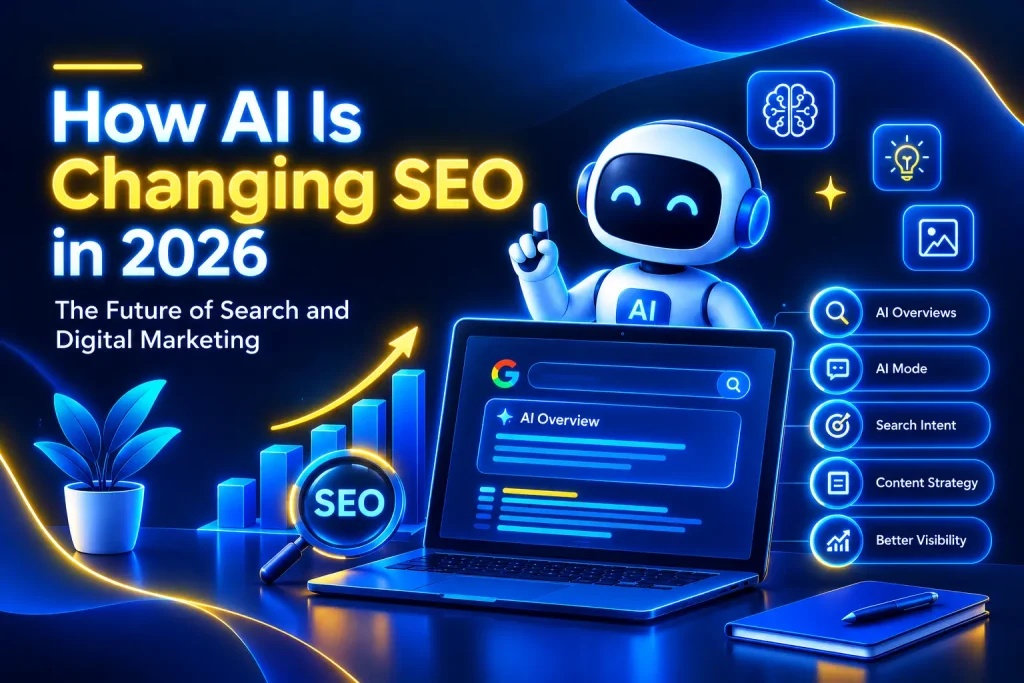
How AI is changing SEO in 2026 with AI-powered search, SEO analytics, AI Overviews, and digital marketing technology.
SEO

How AI Is Changing SEO in 2026

How is AI Affecting SEO in 2026? Search engine optimization has constantly evolved throughout the years. From keyword-based search to semantic search, mobile-first indexing, voice search, and now generative artificial intelligence, search intent keeps changing with technology. The year 2026 promises to bring even more changes to search engine optimization. Search engines are adopting artificial intelligence to a great extent in understanding queries, comprehending content, summarizing information, and giving answers to users’ questions in search results. Therefore, SEO is not dead, it is only changing, and there are several things to consider when optimizing websites in 2026. Let’s take a look at how SEO is affected by AI and what businesses should do in 2026. What Is AI SEO? AI SEO stands for Artificial Intelligence Search Engine Optimization. It means the use of artificial intelligence (AI) to improve various aspects of search engine optimization (SEO). Businesses and SEO specialists can benefit from the application of AI in SEO in a number of ways: Conducting keyword and topic research Interpreting search intent Identifying content gaps Generating content ideas Optimizing content Conducting competitive analyses Recognizing technical SEO issues Understanding extensive SEO data Personalizing content strategies Tracking search performance However, it is important to note that using AI for SEO does not just mean asking an AI to write hundreds of articles for you. Instead, the way to go is to think of ways to apply AI to make your SEO processes more efficient and leave room for your expertise, creativity, precision, and quality content creation as a human being in 2026. How AI Is Changing SEO in 2026 1. Search Is Becoming More Conversational Traditional search has often revolved around a phrase, for example: “best digital marketing agency” Now, the search process allows for more questions and conversation, for example: “What digital marketing strategies should a small business use to generate leads with a limited budget?” AI-powered search experiences can understand context and the relationship between different parts of a query.For SEO professionals, it no longer suffices to optimize only for individual keywords. Your content must address the complete search intent on a topic. What businesses should do: Answer specific questions Cover related subtopics Use natural language Include useful examples Understand different stages of search intent Create content that solves actual user problems  2. AI Overviews and AI Mode Are Changing Search Visibility One significant change for SEO in 2026 is generative AI features and search experiences.Google’s expanded documentation around generative AI features and has provided guidance for optimizing websites for AI-powered Search experiences.This raises the question for marketers: how can my content be a source for AI-generated search experiences? It’s not as simple as throwing more keywords at the wall. Google’s guidance emphasizes that traditional SEO best practices continue to apply for generative AI search features and underscores the value of providing useful, non-commodity content. Therefore, businesses should focus on: Original insights Accurate information Clear explanations First-hand experience where appropriate Helpful examples Strong topical coverage Crawlable and indexable pages  3. Search Intent Is More Important Than Keyword Density Traditional SEO strategies often revolved heavily around repeating target keywords.Modern search engines are much better at understanding what the user wants.For example, someone typing: “SEO audit”may be looking for: An SEO audit definition An SEO audit checklist SEO audit tools An SEO audit Instructions for conducting an audit Having an AI-powered search experience only emphasizes the need to understand what the user wants. In 2026, successful content should focus on: What does the user want to accomplish? Instead of a generic page for a keyword, create content around the user’s problem and journey.  AI Is Transforming Keyword Research Keyword research is another area where AI is transforming SEO to make it faster and more sophisticated. Traditional keyword research tools may tell you about search volume and competition, but AI can take this process further by helping to identify relationships between topics and to organize around keywords based on intent. For example, instead of randomly creating articles for: SEO services SEO agency SEO company SEO consultant SEO optimization AI can help marketers to identify the broader topic and how these terms should be organized within their content strategy. AI Can Help To Identify: Primary keywords Long-tail keywords Related questions Semantic topics Search intent Content gaps Topic clusters Frequently asked questions The important thing is to see AI as your research assistant. AI Is Making Content Optimization Smarter Content optimization is no longer simply about inserting keywords into headings and paragraphs; AI can analyze content and help identify: Missing subtopics Weak sections Keyword opportunities Readability problems Search intent mismatches Internal linking opportunities Content gaps However, optimization should always serve the reader first. Google’s Search guidance again emphasizes creating helpful content and following fundamental SEO practices over trying to manipulate search systems.  Human + AI Content Workflow A possible workflow for 2026 could be as follows: Research → AI-assisted analysis → Human strategy → Content creation → Expert review → SEO optimization → Performance monitoring AI Is Changing Technical SEO Technical SEO involves many areas that can be hard to track, especially for large websites.AI can help to identify patterns within technical data and prioritize potential issues.For example, AI-assisted tools can help to analyze: Broken links Duplicate content Metadata Internal linking Indexing problems Redirect issues Site architecture Structured data Page performance Google continues to emphasize crawlability, indexing, structured data, and overall page experience as important parts of website optimization. AI can therefore make technical SEO analysis faster, but technical decisions should still be reviewed by knowledgeable SEO professionals. AI Is Making SEO More Data-Driven SEO has a wealth of data, and businesses may need to analyze: Organic traffic Clicks Impressions Rankings Conversions Engagement Search queries Landing pages Content performance AI can help to identify patterns within this data much more quickly than a human. For example, an AI system might help an SEO team to realize that several of their pages are seeing impressions but few clicks, and the opportunities would be to review the

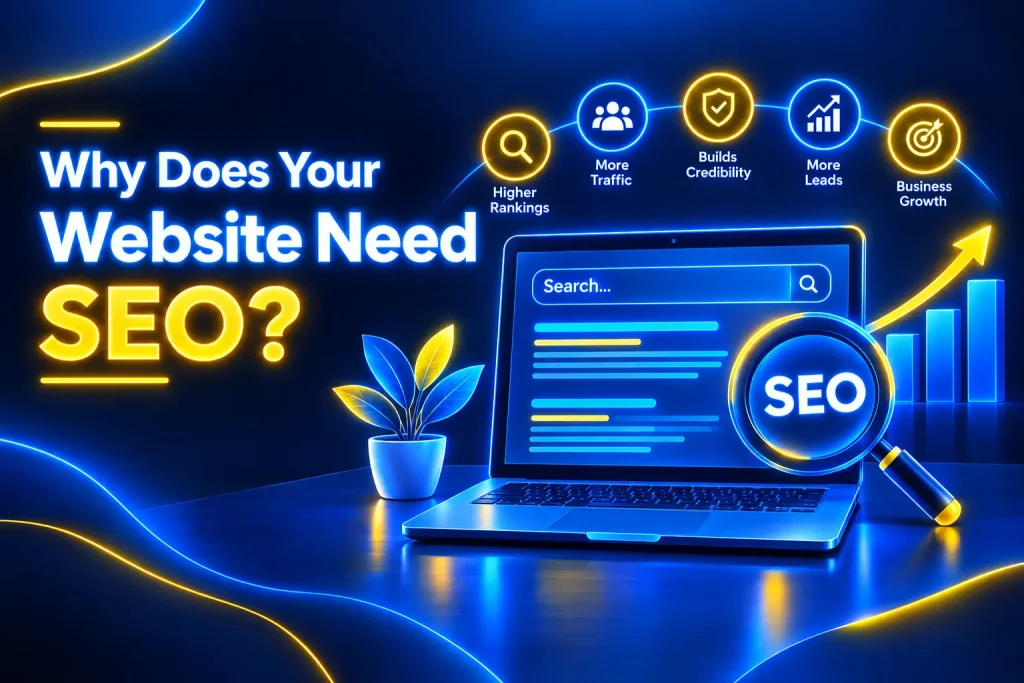
Why Does Your Website Need SEO? — SEO benefits including higher rankings, more traffic, credibility, leads, and business growth shown with a laptop, SEO search icon, and growth chart.
SEO

Why Does Your Website Need SEO?

Why Does Your Website Need SEO? Having a website is no longer sufficient for having a good online presence. A huge number of sites can be found on the Internet, meaning your site can get lost in the crowd. To make your site stand out from the rest, it is required to make it show up in the search results when someone is looking for something that your site offers. But why SEO is so important for our website? SEO helps search engines to find and index your site so that your site appears in their results whenever somebody is searching for something that your business provides. SEO is essential for any site that wants to get more traffic, visitors, and clients and secure a spot on the first pages of Google and other search engines.Local, E-commerce, Services, Startups, Professionals, or Blogs — all types of websites benefit from SEO.SEO is critical for your website to grow exponentially and become visible to your target audience. In this article, we will look at why SEO is vital for a website, its importance, and benefits. What Is SEO? In short, search engine optimization (SEO) is the set of measures that can be taken to improve the visibility of a website in organic search results (i.e., those that appear naturally in the search results without paid promotion). This includes a number of subtasks, such as conducting keyword research, on-page SEO, technical SEO, optimizing content, working with internal links, mobile optimization, improving server response speed, building backlinks, local SEO. For example, if a digital marketing agency offers digital marketing services for small businesses, SEO will help rank higher in the search results for the query “digital marketing services for small businesses.” Note that SEO is not just about putting keywords on a page. SEO practice has evolved and now emphasizes the creation of quality content, improving the user experience, and making the website understandable to search engines. Why does Your Website Need SEO? SEO allows you to compete for visibility in organic search results. These are the key reasons why the practice is beneficial for your website. 1. SEO Enhances Website Visibility The primary benefit of SEO is the increased visibility in search results. By ranking well in organic search results for relevant queries, a company can reach more customers. Without SEO, even high-end websites go unnoticed since they lack exposure to the relevant audiences. For instance, a company specializing in custom furniture requires optimization to ensure that its web data appears before clients searching for such products. The given business would benefit from SEO by targeting queries such as custom furniture, customized wooden furniture, custom furniture near me, handmade furniture 2. SEO Attracts Organic Traffic The next benefit is related to enhanced website traffic. Organic traffic usually brings more customers but does not require the company to invest heavily in payments per click. The more views a website gets, the more prospects it can attract and convert. A company can benefit tremendously from SEO if it can target the right keywords and consistently stay in the first positions in search results. For instance, a business targeting a relevant keyword for digital marketing services will attract clients searching for such services. 3. SEO Targets the Relevant Audiences SEO allows the company to reach out to the right customers searching for the given business’s services or products. A company can identify the keywords related to its field by analyzing the audience’s search behavior. Next, the firm integrates the targeted keywords into its website to ensure that the right clients can find it. SEO professionals usually arrange the information according to the buyer’s journey, which has five stages:            Awareness → Interest → Consideration → Conversion → Retention For instance, a digital marketing services provider may integrate the following keywords for each stage: Awareness: “what is digital marketing,” Interest: “benefits of digital marketing for a business,” Consideration: “how to pick a digital marketing company,” Conversion: “digital marketing services,” Retention: digital marketing tactics and tips. The above example demonstrates that SEO helps the company provide prospective clients with the information required at different stages. 4. SEO Enhances Website Credibility and Trustworthiness Customers tend to perceive a company with a higher search result position as more reliable. While such an assumption is incorrect, the enhanced visibility and the provision of relevant information enhance the firm’s reputation and credibility. Besides, SEO requires that the company’s website has helpful and reliable information as well as a variety of helpful tools such as customer-friendly navigation, secure connections, updated information, fast loading, responsiveness, references, contacts. A company with a credible and reliable website attracts more customers since such an organization appears trustworthy. 5. SEO Improves Website’s User Experience (UX) SEO and improved user experience go hand in hand. For instance, the SEO practices require website owners to make their sites easy to navigate and access as the higher traffic volume will affect the visitors’ experience. The optimization practices enhance the website’s speed and responsiveness in terms of mobile devices, connections, menus, internal linking, structure, scannability, and images. The improved website allows visitors to gain a positive experience and easily access the desired information. 6. SEO Increases Leads and Conversions While more traffic is beneficial, website owners should also focus on enhancing the conversion rates. SEO increases the chances of a visitor converting into a lead or a client. For instance, the firm’s services page targeting a commercial keyword would attract clients searching for the given services. Thus, the company can provide the target audience with the exact services they need, which also enhances its conversion rate. The combination of SEO best practices and higher conversion rates can result in more leads and sales for the firm. A company owner needs to keep in mind that an optimized landing page is not enough. The given page should also feature a call-to-action to encourage the visitor to take specific steps. 7. SEO Lets the Firm Compete With Similar Businesses

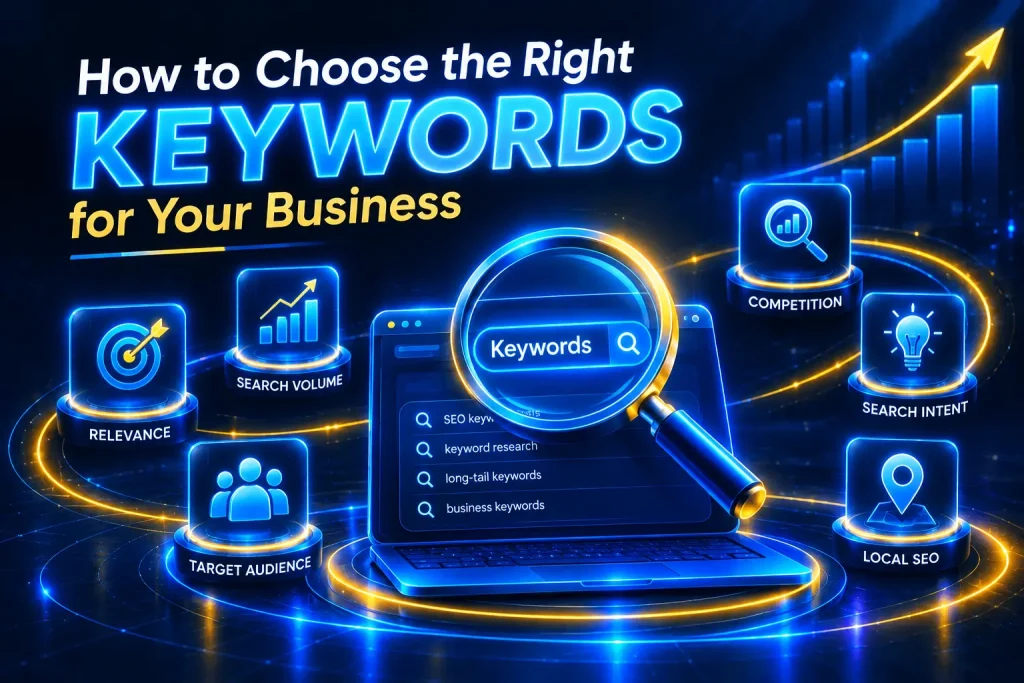
How to choose the right keywords for your business, featuring keyword research, search volume, competition, search intent, target audience, relevance, and local SEO.
SEO

How to Choose the Right Keywords for Your Business

How to Choose the Right Keywords for Your Business If you want to attract the right customers by using search engines, then the choice of keywords is one of the most important aspects of your SEO. Keywords are a bridge between search engines and customers searching for products, services, and information.That said, keyword research is a skillful task since one should be able to pick keywords which reflect the strongest intent to buy and match the customer’s search pattern. A good keyword list will contain relevant keywords matching the customers’ intents and are moderately competitive keywords. After all, it doesn’t matter how much traffic a keyword brings if this keyword has nothing to do with the services or goods that one provides.A company, a local business, an online store, a service provider, or a B2B business – in any case, keyword research will help you attract more customers on your website. In this guide, we’ll show you how to choose the right keywords and use them to boost your SEO. What Are Keywords in SEO? Keywords are words or phrases that users type into search engines to find information, products, services, or solutions.For example, if a company offers digital marketing services, their potential customers may search for: digital marketing agency SEO services for small businesses social media marketing agency affordable SEO services digital marketing agency near me Any of these search terms may be used as keywords. The most important thing is that they should be relevant to your business, i.e., match the user’s request and your service or product offerings. Why Choosing the Right Keywords Matters for Your Business Choosing the right keywords plays an essential role in any SEO campaign. It is critical to optimize the contents for relevant keywords to avoid wasting time and effort on low-quality and highly competitive terms. The importance of choosing the right keywords for a business includes: 1. Ability to target the right audience Using the right keywords assists in targeting the right audience. In other words, keywords define what the business is about; therefore, it is possible to draw the most relevant traffic by optimizing the contents around the words that the target audience may search. For instance, If the business provides website development services to small businesses, it makes more sense to optimize the contents around “website development for small businesses” rather than simply “website.” 2. Attract more relevant traffic to the website Traffic is vital, but it does not mean much if it is irrelevant to the business. It is essential to attract more relevant traffic to a website because it helps convert more visitors into clients. In this case, relevant keywords enable the business to get more traffic that is likely to become customers. 3. Make the website more visible to search engines The search engines’ algorithms work in such a way that they read the contents of the webpage to understand what it is about. As such, it becomes possible to make the website more visible to search engines by choosing the right keywords. 4. Help come up with content ideas It is always challenging to think of what to write about, especially for blog posts, services description, and landing pages. However, finding keywords will help come up with ideas for blog posts or static pages such as FAQs and guides to address the needs and concerns of the target audience. How to Choose the Right Keywords for Your Business Looking for the best keywords in your niche is not as simple as typing in a random search term and hitting the enter key. There are multiple things to consider while selecting keywords for SEO purposes. Let’s see how you can choose the best keywords for your business. 1. Determine your business / audience Before doing anything, have a clear picture of your business and the audience you are trying to reach/interest in your business. You can ask these questions to yourself: What do we offer? Who is our customer base? What problems are our customers facing? What questions do our customers have? What search terms would our customers use to search for us? Which locations do we cater to? For example, if we run a local dental clinic, the keywords that we could target are dentist in [city], dental clinic nearby, teeth cleaning services, etc. Having a clear idea of who our customers are and what do we offer makes our job much easier. 2. Brainstorm seed keywords list Seed keywords are general keywords that would act as a base for your keyword list. For example, if you run a digital marketing agency, your seed keywords could be: digital marketing SEO services social media marketing content marketing PPC advertising if you run an online clothing store, your seed keywords could be: women’s clothing summer dresses casual dresses women’s tops ethnic wear 3. Use keyword research tools Various online tools help you find keywords and provide you with information like search volume, related keywords, keyword difficulty, etc. Some tools are Google Keyword Planner, Google Search Console, Ahrefs, Semrush, Moz keyword explorer, Ubersuggest, etc.It’s a good practice to compare the keyword suggestions from multiple tools and shortlist keywords that are beneficial for your business. While analyzing the keywords make sure you keep in mind things like keyword volume, competition, relevance, search intent, and business value. 4. Understand search intent Search intent is the reason why a user is searching for a specific query. Understanding the search intent is crucial because two very similar search queries may have different search intents behind them. There are four types of search intent: Informational Navigational Commercial investigation Transactional Let’s take an example to better understand the four types of search intent. Suppose a user is searching for the following queries: how does SEO work how to choose keywords how to do keyword research All of the queries have the same search intent, that is, informational intent. This type of search intent is when a person is looking to find information about

Scroll to Top