SOCIAL MEDIA MARKETING

“The future of creator marketing with a content creator, social media platforms, audience engagement, and digital growth analytics.”
SOCIAL MEDIA MARKETING

The Future of Creator Marketing

Future of Creator Marketing Creator marketing is on the rise. As people continue to crave authenticity, discoverability and value, businesses are realizing that a creator’s ability to influence their audience is a valuable asset. In the same way that businesses were once forced to embrace social media as a distribution channel, now they must adapt to a world where influencer and creator marketing holds increasing value. However, businesses must realize that creator marketing is no longer a novelty but rather a complex and nuanced space which must be approached strategically. Short-form video, social commerce, audience analytics, AI, niche communities and a rapidly evolving creator economy are shaping the next frontier of creator marketing. The future of creator marketing will not consist of bigger creators, but rather more authentic, relevant, engaged, performative and loyal creator partnerships. What can we expect from the future of creator marketing? Let’s discuss the key trends that will define the future of creator marketing below. Why Businesses Should Care About Creator Marketing Trends While traditional marketing channels such as TV, billboards, newspapers or even digital ads may have a wider reach, most modern consumers have grown increasingly skeptical of traditional advertising. By partnering with creators, businesses can harness the credibility and audiences of these individuals to reach target markets in a more authentic way. While many factors determine a creator’s impact, having a larger audience does not necessarily dictate their value . An engaged creator with a niche audience could prove far more valuable than a celebrity influencer with millions of followers . Creators provide value by building a community of like-minded individuals that share common interests such as: Fashion and beauty Fitness and health Technology Travel Food and dining Finance Gaming Education Entrepreneurship This is why creator marketing is so valuable, as it enables businesses to target consumers based on their values and passions. Moreover, many consumers are seeking authenticity and genuine experiences Many are no longer satisfied with flashy advertisements, but rather want to witness a product or service being used or reviewed by a creator. This could take the form of unboxing, reviews, tutorials and more. Major Trends That Will Shape the Future of Creator Marketing The creator marketing space will continue to grow and change as technologies and consumer habits continue to evolve. Here are some thoughts and predictions for the future of creator marketing: 1. Micro & Nano Creators Will Rise Influencer marketing is expanding beyond “megastars” and big-name creators toward micro-and even nano-creators. Micro-creators and nano-creators offer key advantages to brands, including a closer connection to their audiences as well as their ability to speak to a wider audience and niche communities at the same time. Benefits of working with mid-tier creators include: More targeted marketing Increased engagement Building stronger relationships More authentic content More options for your content creators 2. The Role of Artificial Intelligence in Creator Marketing Will Only Grow AI tools like chatbots and data analytics are becoming more important and prevalent in the marketing sphere – and that trend is likely to continue as technology advances. Use cases for Artificial Intelligence in creator marketing space include finding relevant creators, analyzing audience data, identifying content opportunities, creating campaign concepts, and other tasks. At the same time, creators themselves can use AI tools during the ideation process, during the creation process (chatbots for editing, writing, etc.), and during the research process. However, it is important to remember that AI tools should only enhance the value of human input; the human touch will always be a vital part of creator marketing. 3. Long-Term Creator Relationships Will Become the Norm Companies and brands are beginning to favor ongoing, long-term creator partnerships over discrete campaign-based collaborations. An engaged creator who understands the brand can often deliver better results and a higher conversion rate for the same spend. Long-term partnerships help both-party build stronger relationships with each other and with customers. They also allow for: More authentic content Repeated exposure to the brand Easier establishment of a consistent narrative 4. The Dominance of Video Content Will Continue Video content continues to dominate the creator space – including short-form content, how-to’s, tutorials, product reviews, behind-the-scenes looks, livestreaming, and more. Short-form video content, in particular, dominates the creator space. These pieces of content are great for establishing a call to action while simultaneously delivering value to the audience in a very condensed format. Examples of video content that brands can use with creators include: Demos Before & after segments Tutorials Customer testimonials How-to’s & tips Product comparisons Behind-the-scenes looks However, it is important that the short-form content not become a straitjacket for the creator. Always leave room for the creator to have input and influence over the message and the delivery. 5. Social Commerce Will Continue to Expand and Focus on Conversions One exciting development in the creator marketing space is the blurring of the lines between content and commerce. Consumers are increasingly expecting not only to discover products via social media and creator content but also to engage, experience, and even purchase those products directly there as well. This represents a huge opportunity for e-commerce-driven brands. Essentially, creator marketing is becoming a full-funnel experience encompassing everything from brand discovery to engagement, consideration, and purchase. 6. The Creator Space Will Focus More on Communities and Niche Cultures In the years ahead, the creator marketing space will become more focused on communities and niche cultures rather than on broad audiences. In this emerging paradigm, a creator with 20,000 highly engaged viewers may be more valuable than a creator with 1 million followers. Relevancy, reach, engagement, and the audience’s interests and demographics will always matter more than the mere quantity of views or followers. How businesses can prepare for the future of creator marketing Businesses in the creator marketing space should focus on building relationships with these creators in order to set up their strategies for the long-term. Prioritize creator relevance over reach When looking at potential creators to work with, businesses should not focus
Social media helping e-commerce businesses increase reach, traffic, sales, and customer loyalty.
SOCIAL MEDIA MARKETING

How Social Media Helps E-Commerce Businesses

How Social Media Helps E-Commerce Businesses Nowadays, a successful online store is no longer a concept with just a website and some goods in it. Since people spend a lot of their time on social media, it has become one of the most important sources for satisfying consumer demand. From finding the products they are looking for to studying reviews, people prefer to use social media to find and shop for items. Some of the most popular social networks are Instagram, Facebook, YouTube, TikTok, Pinterest, and LinkedIn. Each of these resources helps an online store build relationships with its customers and make money by selling goods. However, how exactly can social media help e-commerce? In this article, we will look at the main benefits of social media channels for e-commerce and what advantages they provide to online stores. Why Social Media Is Good for E-Commerce Social media is a powerful tool for businesses, as it creates a direct connection to the target audience. Instead of forcing customers to find the brand, it allows companies to reach out and engage with people, provide information about the products and services, and persuade to make a purchase. Benefits of Using Social Media for E-Commerce 1. Boosts Brand Awareness One of the most apparent advantages of using social media for businesses is raising brand awareness. Through the use of social media, companies get an opportunity to expose their products to a greater audience. The key to success here is consistency, as brands need to keep engaging with their clients and provide them with visual content, helpful information, and other types of media. How to Boost Brand Awareness on Social Media E-commerce companies can boost their awareness by creating visual content, producing interesting videos, using hashtags and keywords, collaborating with social media influencers, posting user reviews, running ads. In doing so, businesses should ensure that their social media accounts are recognizable so that customers can find them easily. 2. Drives Traffic to the Website Social media is great for increasing website traffic. Businesses should include links to their websites in their social media content in order for viewers who are interested in the company’s products and services to be able to find them easily. A company selling clothing, for example, can post videos of its items and put a link to the website, so that those who are interested in purchasing have the ability to do that. How to Drive More Traffic to Your Website via Social Media The e-commerce companies can drive more traffic to their websites by putting calls for action, connecting to particular pages with products, announcing new items for sale, posting articles and buying guides, launching special offers, using social media ads. It is essential that businesses use these strategies in order to drive targeted traffic, as in this case, they will be able to turn more visitors into customers. 3. Increases E-Commerce Sales An important advantage of using social media for business is that it increases sales. Social media accounts allow companies to make their products known to the public, launch special offers and discounts, and persuade customers to make purchases by demonstrating their qualities and benefits. How to Use Social Media to Boost E-Commerce Sales To boost sales, businesses should post information about products and services, make videos demonstrating how to use them, put up reviews and testimonials, launch special promotions, announce new items, run seasonal campaigns. 4. Builds Trust and Credibility In the e-commerce sphere, trust and credibility play vital roles. It is not possible for customers to touch or feel the items before purchasing, meaning that many people choose products based on reviews and word of mouth. How to Build Trust and Credibility on Social Media To build trust and credibility, businesses should post such types of content as customer reviews and testimonials, user-generated content, unboxing videos, product reviews, influencer recommendations, customer success stories. 5. Enhances Engagement Not only do social media let businesses promote and sell their products and services, but they also increase engagement. Through social media, businesses can communicate with customers, respond to their questions and queries, and receive feedback. Moreover, companies can analyze the information that the customers give them in order to see what they want to see and what they are interested in. How to Boost Engagement on Social Media The e-commerce companies can boost engagement by responding to comments and messages, answering questions, posting interesting content that encourages interaction, thanking customers for their feedback, sharing user content. 6. Enables Social Commerce Social commerce is another major benefit of social media. Now, it is possible for customers to shop on social media platforms. It makes the process of finding and purchasing products easier. How Social Commerce Can Benefit Businesses For instance, instead of searching for items on a website, it is now possible to shop via social media. This advantage, in particular, and others, such as hashtags and visual content, shorten the distance between items and customers, making the process faster and easier. As a result, social commerce makes life easier for both businesses and customers. 7. Targets the Specific Audience Social media also allows businesses to target the specific audience. Through the use of social media ads, companies can reach out to those who are interested in their products and services. How to Effectively Target Your Social Media Audience For example, businesses can run ads targeting customers who are interested in anti-aging creams. At the same time, companies can run different ads targeting people who are looking for organic skincare and those searching for products for sensitive skin. A wide range of targeting options allows businesses to identify the most relevant audience and communicate with them. 8. Encourages Users to Post Their Content One of the social media advantages is that businesses can encourage users to post their content on the companies’ social media accounts. These are user reviews, photos, videos, and other media. How to Encourage UGC for Your Brand E-commerce businesses can encourage users to post their

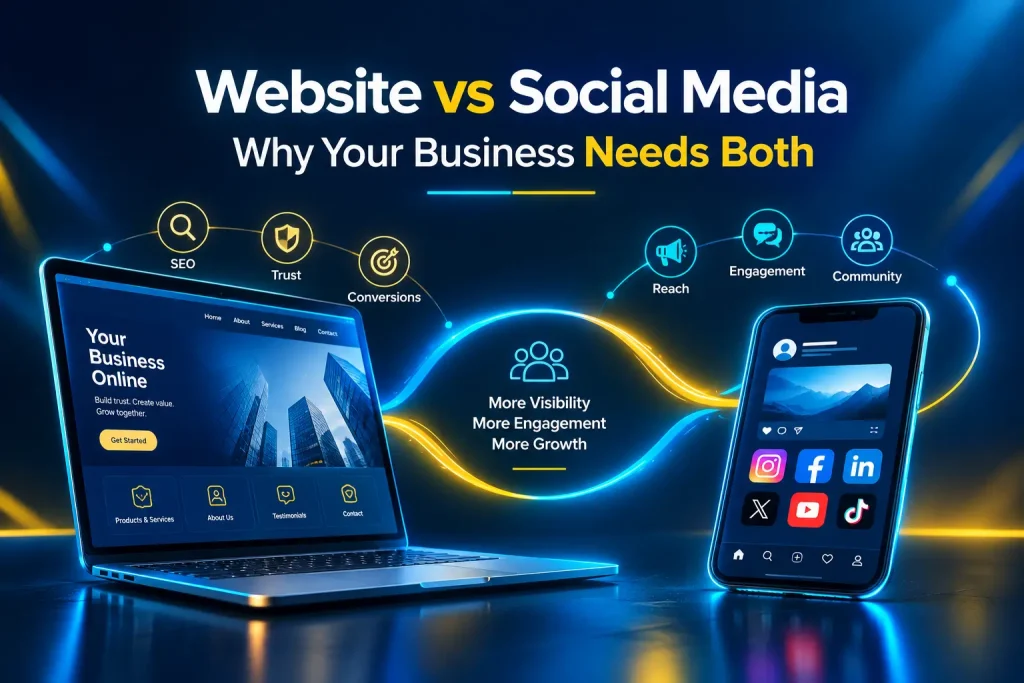
Website vs social media strategy for business growth
SOCIAL MEDIA MARKETING

Website vs Social Media: Why Your Business Needs Both

Website vs Social Media: Why Your Business Needs Both These days, it’s rare for a customer to rely on a single source of information when making a decision to trust or not trust a particular business. A smart customer will gather information from many sources, one of which might be social media. They could find a company’s Instagram page, Facebook group or LinkedIn profile and explore it, then go to the company’s website and make a purchase or get in touchTherefore, the website vs social media discussion is not mutually exclusive. Your company’s website serves as a hub for everything related to your business. It introduces your customers to what you do, who you are, how professional you are and what you offer. Social media helps to promote and popularize your brand and collect statistics about your audience. Any good digital marketing campaign will have both of these elements: one to reach out and communicate with the audience and another to amplify the message and make it more easily found by the right customers. In this article, we’ll try to explain why your company needs both social media and a website. Website Vs Social Media: What’s The Difference? Though both social media and website support your online presence, these two have different purposes. Website is a place where the user has full control over the content and information available there. On the contrary, social media is more about publicity, engagement, and being found online.  1.What Can a Website Do for a Business? In general, websites hosted by businesses offer informative resources pertaining to the company, such as • About page • Products• Services• Contact information• Testimonials• Blog• Landing page• FAQs,• Forms,• E-commerce• Calls to action or CTA.Websites fulfill diverse purposes, from providing customer service and facilitating sales to creating informative resources. Businesses widely use them to help the audience find the information sought, which attracts and retains customers.Thus websites enable businesses to get found on search engines. All in all, a good SEO strategy makes the website rank higher on search engines; therefore, providing relevant and needed information to the target audienc 1. What Can Social Media Do for Businesses? Social media platforms enable businesses to achieve multiple goals, such as increasing brand awareness, enhancing customer engagement, growing the online community around the brand, providing useful and relevant content, and being found online. Here are the key objectives that businesses can fulfill with social media. They include:• Making the brand public.• Educating people.• Selling products.• Community building.• Increasing visibility and awareness.• Promoting offers.• Connecting with influencers and customers alike. The major feature of these media is that they provide the needed resources as per the availability on the hosted platform. Some rules and regulations of these platforms might be changed frequently. Why Your Business Needs a Website Having a website will establish a home for your online presence 1. A site adds credibility. Typically, a person will go to a company’s website in order to decide if they can be trusted. If you have a professional looking website then you are halfway there in terms of credibility. Your testimonials, services, about page, blog, and other informative content will help tell potential clients that you are worthy of their business. 2. You have full control over your website. This is one of the best parts about buying a business website, control! You can choose: what gets posted, how you want to appear, the landing pages, what visitors can do, how everything is organized. You have creative freedom in how you want your online store to look, while keeping your branding colors and fonts intact. With social media comes a great audience reach, but the control over your content is limited. A business website allows for maximum control, creativity, and freedom. 3. It helps build SEO. Search Engine Optimization, or SEO, will organically help your business reach those who are searching for your services or products By creating blogs, unique pages, landing page offers, or location services you’re able to target those with purchasing intent. SEO takes patience and strategy but can be incredibly valuable to growing your business online. It’s your gateway to social proof, blog content, lead magnets, or testimonials, and best of all it actually converts. Why Your Business Needs Social Media Having a social media presence is crucial to boosting website traffic, credibility, sales, and followers. While your website offers credibility and control, your social media accounts can increase your visibility and create engaging experiences with those who visit your links. 1. Social media can boost your overall website traffic. Social media can expose your brand to those who may not know about you yet. If you share a helpful post, engaging video, or stunning carousel, then you’ll get seen by new people that are interested in what you have to offer. When they like, share, comment, and save your post it will help expose your brand even more to their friends, followers, hashtags, locations, and searches. This makes social media so valuable in helping to build brand awareness. 2. It offers a way to build a relationship with your audience. While your website is the perfect place to share your story, mission, services, and more, social media provides a way for customers to connect and build a relationship with you. They’ll be able to ask questions, comment, message, share your posts, and more This can help increase engagement and even gather feedback on what they’d like to see more of. 3. It helps humanize your brand. People don’t just buy products or services, they buy a lifestyle or story. While you have your professional logo, websites, and business cards, social media is a place to share your personality, story, or values. Those who visit your website or posts will connect with you on a deeper level being able to see “who” you are and not just the business you represent. 4. You can drive traffic from social media to your website. Creating a social media strategy

AI-powered social media marketing featuring a smartphone, social media icons, analytics charts, and glowing AI technology on a dark blue neon background.
SOCIAL MEDIA MARKETING

Best Ways to Use AI for Social Media Marketing

Best Ways to Use AI for Social Media Marketing  Social media marketing has become increasingly competitive, which means businesses must find innovative ways to engage with their audiences. They need to produce appealing content, quickly respond to customers’ inquiries, understand audience psychology, and be consistently present on various digital platforms.That is why the best way to use AI for social media marketing is by relying on its capacity to perform routine operations, come up with new ideas, analyze data, personalize the customer experience, and accelerate the decision-making process. Artificial intelligence is not a replacement for marketing professionals. It is, rather, a tool that can help them become more productive and efficient. From generating social media posts to analyzing statistics, there are multiple ways in which businesses can use AI for social media marketing in 2026. Let’s take a closer look at the best ways to use AI for social media marketing below. 1. Generate Social Media Content Ideas One of the leading challenges in social media marketing is thinking of fresh ideas for content. With the right prompts, AI can generate ideas for topics, audiences, industries, and even past content performances. For example, you can use AI to come up with social media ideas like: • Instagram post ideas • Facebook content topics • LinkedIn posts • Short video content ideas • Reels and Shorts topics • Poll and questions ideas • Educational carousel topics • Seasonal campaign ideas Instead of spending hours brainstorming social media content ideas, marketers can use AI to generate a list of topic ideas for their brand. How to Use AI It’s important to give the AI system information about the target audience, industry, voice, and marketing goals to help it come up with relevant content ideas. 2. Create Social Media Captions Faster Creating social media captions can be very time-consuming, especially if you have multiple posts to publish weekly or even daily. With AI, you can generate multiple caption options for a specific topic, image, product, or campaign. For example, businesses with a new service can use AI to generate short Instagram captions, professional LinkedIn posts, promotional Facebook copy content, hooks, calls to action, and hashtags. However, note that AI content should not be used verbatim. It’s important to go through the suggestions, edit, and tweak them to fit a brand’s voice. 3. Use AI for Social Media Content Personalization Not all leads and customers are the same. In fact, they have varying preferences, concerns, questions, and buying stages. With access to consumer data, AI can help marketers personalize social media content for different audiences. For example, businesses can use social media personalization to target: • New followers – Educational and informative content • Engaged followers – Product-focused content • Potential customers – Offers, testimonials, and reviews • Existing customers – Loyalty-based content This way, businesses can improve the relevance of their content to different audience segments. 4. Automate Social Media Tasks There are various recurring tasks in social media marketing, including scheduling, content categorization, organization, analytics tracking, etc. AI can help social media marketers automate repetitive tasks to save time and effort. For example, you can use AI for: • Scheduling social media content • Categorizing social media content • Creating multiple variations of a post • Tracking brand mentions • Reporting campaign performance • Detecting patterns in engagement This way, marketers can focus on more important areas instead of getting stuck in routine, time-wasting activities. AI Automation Should Support, Not Replace, Human Interaction While automation can dramatically speed up tasks, it should not replace human interaction. In other words, make sure to automate the mundane while keeping human qualities at the forefront. 5. Improve Social Media Customer Service Fast and efficient customer support is one of the main reasons why customers keep coming back to a brand. AI can help businesses with social media customer support by providing 24/7 customer care assistance. For example, businesses can use AI to help customers with: • Business hours • Product-specific questions • Pricing inquiries • Shipping details • Service availability • Order tracking It’s important to note that AI chatbots are great for simple and commonly-asked questions. More complex issues should be forwarded to a human representative. 6. Analyze Social Media Performance Perhaps the most important use of AI in social media marketing is analyzing performance. There’s so much data in social media, including likes, comments, shares, saves, clicks, views, followers, DMS, conversions, and more. AI can help businesses analyze this data to discover patterns and trends useful in future marketing campaigns. For example, AI can help answer questions like: • What content engagements the most? • What topics get the most clicks? • What times of the day are the best for posting? • What campaigns gets the best response from the audience? 7. Use AI for Social Listening Social listening is the art of analyzing conversations about a brand, product, service, competitor, or industry in social media. Thanks to its incredible language-modeling capabilities, AI can help marketers find mentions of their brand and sort through conversations in search of themes or common sentiments. For example, marketers can use AI social listening to identify: • What customers are saying about the brand • What topics customers are interested in • Industry-related trends • Common customer complaints • What competitors are saying • What trends are emerging Once again, AI can help by identifying patterns in mentions and themes. For example, if many users are complaining about the same issue, it’s a good indication that something needs to change. 8. Create Better Visual Content Social media is a visual space, meaning businesses need to put more effort into creating images, videos, and other visual content. AI can help with social media graphics, video creation, image-making, and more. For example, AI can help create: • Social media graphics • Video content • Image variations • Backgrounds • Ads • Visual content layout • Short video ideas In essence, AI can dramatically reduce the amount of

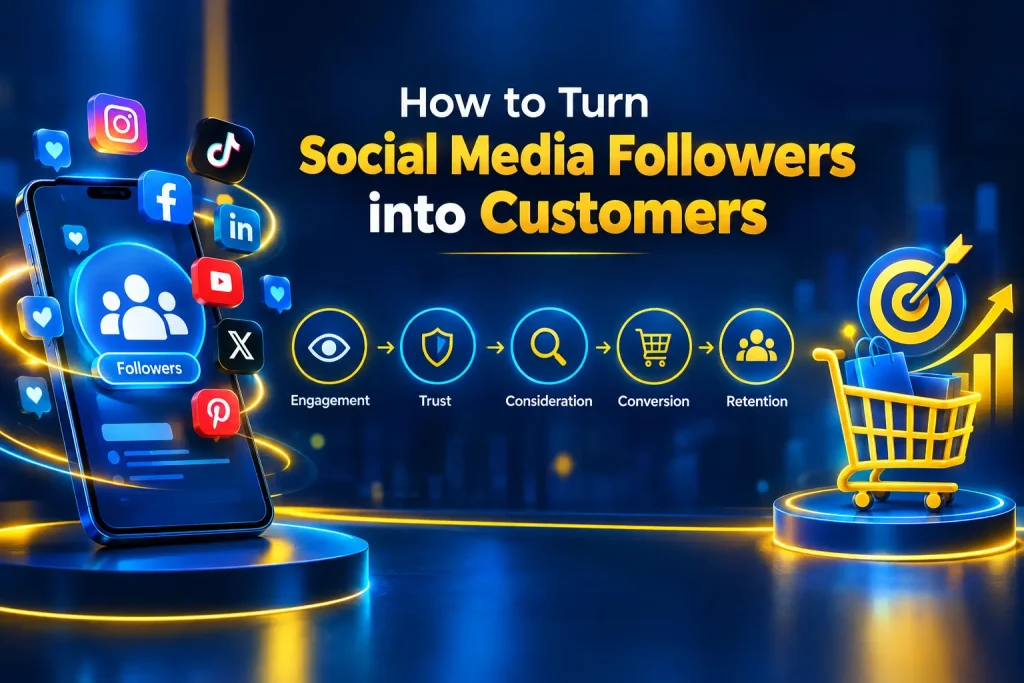
Social media followers turning into customers through engagement, trust, consideration, conversion, and retention, shown in a glowing blue and gold digital marketing design.
SOCIAL MEDIA MARKETING

How to Turn Social Media Followers into Customers

How to Turn Your Social Media Followers into Customers  Having thousands of social media followers can be very exciting, even if they do not bring you any income. But what if they could? What if someone could take your social media followers and turn them into customers? Social media is an essential tool for virtually any business, whether one only has a small online presence or one is a well-established company with hundreds of employees. This tool, when used correctly, can provide the business with a steady stream of customers. However, it requires proper usage to turn social media impressions into actual sales. This blog will provide you with useful tips that will help you get more customers from your social media. In addition, it will teach you how to turn those followers into a social media funnel. Why Do Your Social Media Followers Not Want to Buy From You? A social media follower is a person who follows your social media account. In almost every case, a person who follows you will not be a paying customer right away. A follower could be your friend, family member, or someone who enjoys reading about a particular topic. To turn followers into customers, you need to get them through the buying cycle: AWARENESS → ENGAGEMENT → TRUST → CONSIDERATION → CONVERSION → RETENTION Therefore, your social media activities should not only be focused on getting more followers. 1. Get to Know Your Social Media Audience First of all, understand who your social media followers are. You may track certain metrics such as age, geography, interests, and other audience demographics available on the platform. You may also identify problems they try to solve, products or services they want to buy, types of content they like to consume on social media, and what motivates them to shop. By and large, the social media content you are going to create and share should be solving your buyers’ problems, not necessarily be focused on selling something. Your social media activity should serve more as your digital calling, attracting people who have genuine interest in what you are doing. It makes sense to outline major personas your business is targeting on social media, such as Start Up Owner (who wants to spend less money on marketing) and Small Business Owner (who wants to be able to market more efficiently). Once you understand who you are marketing to, you have better chances to market effectively. 2. Show Value Before Making Any Sales pitch People are not going to shop from you if you spam your social accounts with sales pitches. Instead, prove to buyers that you can help them solve a particular problem. You may do that by publishing valuable content that addresses common questions and concerns. Your social posts may also feature how-to’s, various tips, stories and testimonials from your other customers, video reviews, how your business was created, helpful hints and many other types of content. If you are a digital marketing agency, you are unlikely to post ‘Buy Our SEO Service’. Instead, you may publish content on Search Engine Optimization and its benefits and position your business is a go-to resource for those who want better organic traffic. 3. Add Strong Call-to-Actions To Your Posts A strong call-to-action (CTA) is one of the easiest ways to convert your social media audience. One of the biggest mistakes social media marketers make is forgetting to include a CTA. With a solid call-to-action in your text posts, stories and other social media content, you can get your target buyers to take action and move them through the buying cycle. Your CTA may depend on your content and your stage of the buying cycle. For instance, your CTA may invite people to: Visit your website Contact you Download a guide Book a consultation Subscribe to your email list Inquire for a quote Shop online Try a product for free. Your CTA should be specific and clear. If possible, avoid such unclear CTAs as ‘Learn More’, and instead, use CTAs such as ‘Book a Free Social Media Marketing Consultation’. 4. Create Content That Encourages Two-way Communication Although likes and comments are good, they do not necessarily mean that people are going to shop from you. Therefore, encourage social media users to communicate with you and your brand in an effort to build meaningful relationships and qualify buyers. When you get comments to your posts and messages via DM or Messenger, engage those who express some interest in your offerings. Instead of replying to website inquiry sample messages such as ‘What do you charge per hour?’, ask qualifying questions such as ‘What is it that you are trying to accomplish?’. That way, an engaged prospect will let you know if they actually intend to buy something soon, as opposed to a person who only likes and comments on the posts but does not get in touch. As always, it is important to respond to comments and messages in a timely fashion. If you always reply to inquiries, chances are prospects will also have time to respond. 5. Use Social Proof to Reduce Customer’s Buying Anxiety Some people are simply not going to spend any money unless they know that there are others who have benefited from working with you. That is why a lot of brands leverage on social proof. Social proof refers to the information and numbers demonstrating that you are a reliable company. For example, you can share customer testimonials, reviews and ratings, case studies, and others. It is important to make sure that social proof reflects authentic buyers’ experiences. After providing the first couple services, you may, for instance, post a testimonial from a happy client who appreciates your work. 6. Entice Your Follows With Special Offers As a marketer, it is a good idea to provide social media-exclusive special offers to your followers. Those could be any of the following: Time-sensitive pricing Exclusive buying options Bundles Free trial of a particular subscription plan A free

Scroll to Top