
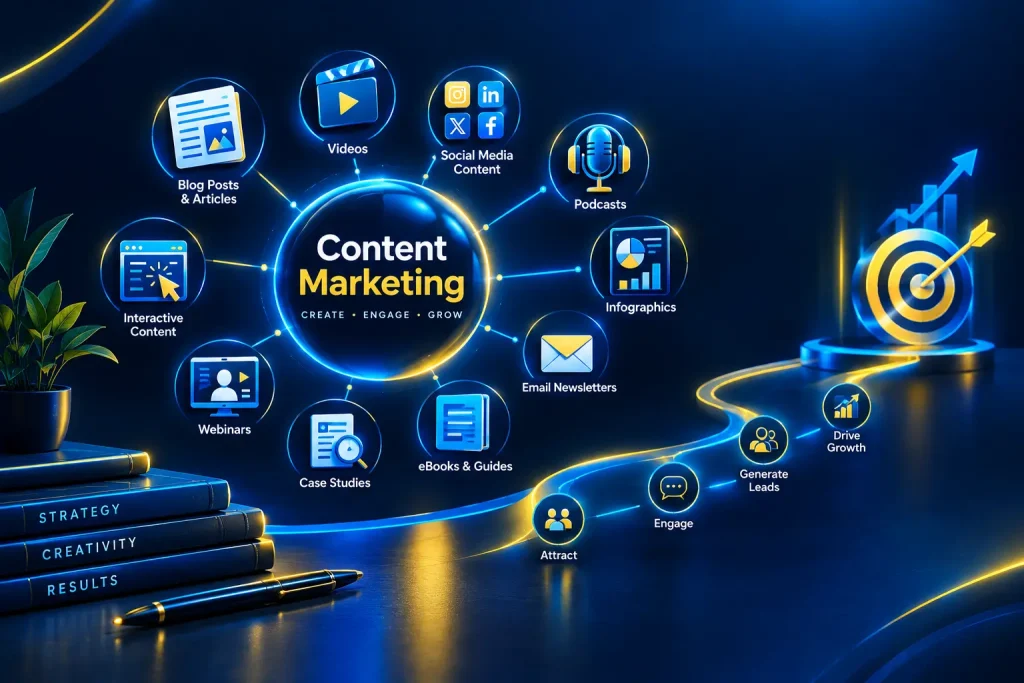
More Than Just Blog Posts: The Complete World of Content Marketing
Although many people still associate content marketing with blog posts, this type of marketing comprises many more elements. Of course, maintaining a blog and publishing articles there is an essential strategy for any company that wants to promote its products or services successfully. However, in addition to blogs, companies also use social media, video content, podcasts, infographics, email marketing, case studies, ebooks, webinars, interactive media, and much more.
Therefore, it is especially important for entrepreneurs to understand what all content marketing entails to build the most effective strategy for their business. All these types of content marketing help companies reach their target audience and properly position their brand. At the same time, for different companies, different marketing tools are relevant at different stages of the customer journey.
What Is Content Marketing?
Content marketing is a type of digital marketing that focuses on attracting and retaining a target audience by providing informative content, developing it, and distributing it consistently.
In other words, instead of focusing on promoting a product or service, content marketing creates useful content that educates, advises, informs, or entertains consumers.
For example, a digital marketing agency can create content marketing assets, such as
- SEO guides,
- social media posts,
- marketing videos,
- reports,
- email marketing content,
- customer studies,
- checklists.
Through constant creation and sharing, the business can also build itself as an authority in the field and drive traffic to its website to complement its marketing and sales strategy.
Why Content Marketing Matters for Businesses
Content marketing can be leveraged at different stages of the customer journey.
It can raise brand awareness, build trust, and even drive sales.
It Can Raise Brand Awareness
Informative content can be utilized to educate prospective clients and improve brand image.The marketing assets can also be optimized to increase organic reach and appear in search results, thus, driving traffic and creating brand awareness.
Content marketing enables businesses to increase their discoverability and reach new customers. With the help of SEO-friendly blog posts, videos, social media content, and images, businesses can be found by more prospective clients.
It Can Help Build Trust
Consumers tend to trust companies that offer valuable content regarding their niche or industry.
Reports, guides, how-to articles, whitepapers, and case studies introduce businesses as reliable and informative sources in their space.
It Can Complement SEO Strategy
SEO and content marketing usually work together. Creating blog posts and videos with SEO in mind will improve a website’s ranking on search engines. Moreover, through keyword research, the content published on the business’s website will also aim to answer the questions of prospective clients searching online.
While SEO content marketing is essential for improving the visibility of a business online, marketers should avoid keyword stuffing. Instead, they should focus on providing informative, helpful, and high-quality content that will fulfill users’ intent.
It Can Generate and Nurture Leads
Content created by businesses can persuade website visitors to become leads.
For instance, a helpful article can entice readers to download an informative guide. In turn, they may subscribe to the company’s newsletter and be nurtured to a lead and eventually a paying customer.
Therefore, content marketing can generate leads and help move them through the sales funnel by providing informative content instead of hard-selling.
The Complete World of Content Marketing
A successful content marketing strategy makes use of various content types, as opposed to relying on a single source, such as blog posts.
Blog Posts & Articles
Blogging is the most popular and versatile kind of content marketing.
Businesses can leverage blog articles to share informational content marketing , including
- how-to guides,
- tutorials,
- industry insights,
- listicles,
- comparisons,
- beginner’s guides,
- FAQs,
- trends.
Instead of focusing on the sheer volume, it is advised to prioritize quality over quantity while publishing blog content marketing . In other words, not every business blog post should purely serve the purpose of improving the number of web pages.
Video Content
Modern content marketing strategies give much importance to video content marketing . Businesses can leverage videos in social media posts and on their websites to narrate a compelling story and effectively communicate their ideas, values, and vision.
The content marketing ideas could include
- educational and informative videos,
- product or service demos,
- tutorials,
- customer testimonials,
- short videos for social media,
- behind-the-scenes glimpses.
- Visual Content
Many businesses prefer to complement written content marketing with visual resources, such as infographics or images.
Visual content marketing is ideal for presenting data, statistics, and other information in a visually appealing manner. It could also be used for conceptualizing certain ideas and making them more accessible and engaging.
eBooks, Guides, Reports
EBooks are long articles that offer more in-depth information on a specific topic.
Guides could include special offers or reports to help attract clients or improve lead generation. Moreover, businesses could provide potential clients with helpful tips, guides, and tools, asking them to exchange their contact details for the information.
Case Studies
Many companies prefer to share their success stories and experiences with products and services that helped them achieve their business goals.
A compelling case study usually describes what the company was looking for, the background and circumstances of the case, what they eventually did, and the final outcome or result.
Email Content
Email marketing is crucial for nurturing existing subscribers and clients.
Businesses could send email newsletters, updates, news, product announcements, and other special offers to their mailing lists. This way, companies could also keep their clients up-to-date on the latest news regarding a particular topic, industry, or field. Instead of relying only on regular blog postings, business owners could encourage their clients to join the company’s mailing list, where they will receive relevant content marketing updates.
Podcasts
Companies could share podcast episodes covering a range of topics relevant to their niche or industry. Podcasting is a great way for businesses to demonstrate their areas of expertise and expand their audience reach. Podcasts allow for in-depth conversations, interviews, and even discussions with specialists on various subjects, as well as storytelling.
How to Come Up With an Effective Marketing Strategy
Coming up with several types of content is not sufficient. You have to define content strategy.
Define Your Audience
First, define the target audience you want to provide value to.
List the criteria such as:
• Pain points;
• Burning issues;
• Questions;
• Information users need;
• Channels where the target audience spends time;
• Factors that drive their purchase decisions.
The clearer the description of the target audience, the better. After that, you have to identify content goals.
Establish Content Goals
Set meaningful goals related to your marketing and business objectives. For instance, your goals can be:
• Increasing organic traffic;
• Lead generation;
• Brand awareness;
• Building authority;
• Engagement;
• Selling products;
• Nurturing.
Depending on your goals, different types of content marketing will be required. The next step is to define search intent, which is important for SEO content.
Align Content with Search Intent
Search intent defines what a person is looking for when typing a query in Google. There are four types of search intents:
• Informational – the user wants to find some information;
• Navigational – the user wants to navigate to a specific website;
• Commercial – the user wants to compare products or services;
• Transactional – the user is looking to make a purchase.
When aligned with search intent, content marketing becomes effective for both the audience and search engines. That is why it is so important to create content around the buyer’s journey.
Buyer’s journey consists of several stages:
• Awareness – informative content about the problem the potential client has;
• Consideration – comparing different options, detailed content, case studies, whitepapers;
• Conversion – product page, reviews, description, call to action.
Conversion is not the end of the line. It is now time to get the customers to the retention stage.
Retention means keeping customers and providing them with interesting content in the form of email newsletters, website content, product tutorials, etc.
It is also essential to remember that the creation of content is only a part of the equation. Equally important is the distribution of content to the right audiences through marketing channels. That is why it is a good idea to plan how far one piece of content can go. For instance, one article can be turned into a carousel, video, newsletter, infographic, Linkedln article.
How to Measure the Effectiveness of Content Strategy
It is vital to measure the effectiveness of content marketing. In this section, we discuss the most critical metrics for any business that are directly affected by content marketing. First, we list organic traffic and keyword ranks. Then, we move to engagement, bounce rate, email newsletter subscribers, leads, conversions, content-assisted conversions, and repeat visits. Depending on the content marketing goals, different KPIs should be taken into consideration. For awareness, it can be impressions and shares. For lead generation, it can be filled forms and subsequent sales.
Common Content Marketing Mistakes to Avoid
Even the companies which possess a great content ideas strategy, underperform it due to the lack of specific processes.
Creating Content without Understanding the Audience
The primary purpose of content creation is to answer specific questions or address certain problems. Thus, it is better to create high-quality articles, blog posts, and web pages, and concentrate on their ability to help the audience.
Thinking That Quantity of Content Matters Most
Although it is essential to regularly post new articles and blog posts, the quantity is less important than quality. The content piece should be unique, informative, relevant, and beneficial for the audience.
Not Paying Enough Attention to SEO
Besides general writing, articles, and web page texts, require keyword and intent research, proper internal and external linking, technical SEO, and other optimization tasks. All of them help search engines understand what the content piece is about and provide the audience with accurate information.
Only Talking About Products and Services
Although companies are created to sell something, content marketing requires a less sales-oriented approach. A large volume of evergreen and educational content helps build relationships with the audience and encourages them to make purchases.
Neglecting the Importance of Updating Old Content
Over time, pieces of content created by companies, including articles, blog posts, and web pages, may become irrelevant. Thus, it is essential to update them by adding new information and deleting the outdated one.
What Is the Future of Content Marketing?
In general, the future of content marketing is highly connected with artificial intelligence, personalization, automation, video, and data.
AI enables companies to perform various tasks, such as writing, researching, outlining, organizing, and prioritizing content. However, it cannot replace human-generated content, such as articles, blog posts, whitepapers, and product descriptions. Thus, companies need to invest in human expertise, the latest technologies, and proper research to benefit from artificial intelligence.
In addition, the future of content marketing is focused on creating more relevant, useful, unique, and diverse content. It does not mean that the volume of content will increase over time, but the audience will perceive it as more valuable and easier to consume.
Final Thoughts
In general, content marketing and its future are not only about creating blog posts and articles. They also include various pieces of content, such as videos, podcasts, social media posts, emails, infographics, case studies, research, whitepapers, and many others. All of them must be organized in a specific way, promoted among the target audience, regularly updated, and connected with the company’s objective.
Frequently Asked Questions
Explore answers to common questions and learn more about how we can help your brand grow.
Content marketing is a strategic approach of distributing and promoting valuable content to a target audience to attract, engage and retain them. Moreover, it should be focused on driving prospecting into the business, building brand equity, and promoting word of mouth.
Yes, indeed, keeping in mind that there is also other content that can be used for marketing purposes such as videos, social media, emails, podcasts, infographics, case studies, and many more.
Blogs, videos, social media, email, podcast, infographics, eBooks, case studies, webinars, and interactive contents are some of the different types of content marketing.
There is no hard and fast rule on how frequently a business should be publishing content, as it will depend on your target audience. However, it is important to keep in mind the quality over quantity rule and stick to a schedule that the business can keep up with regularly without sacrificing quality.
Yes, a small business can do content marketing by starting slow and simple by choosing a few types of content that are suitable for their target audience and then growing from there.
Ready to turn your content into a growth engine?
Don’t limit your marketing strategy to blog posts. Build a complete content ecosystem that attracts your audience, builds trust, generates leads, and supports long-term business growth.