
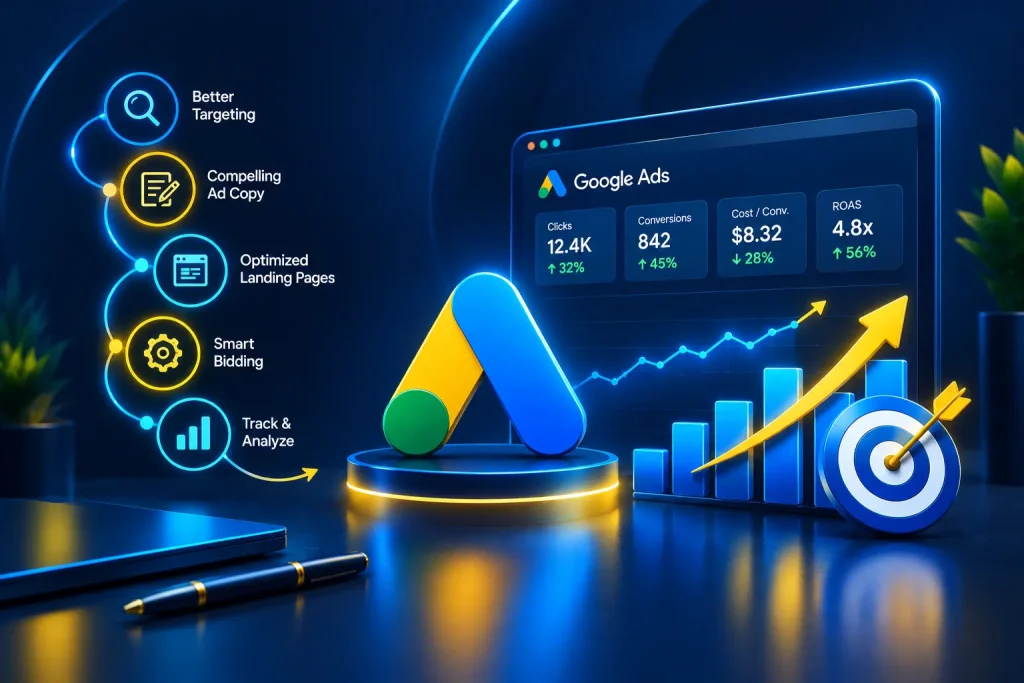
How to Improve Google Ads Performance
Organizing a Google Ads campaign is a relatively simple task. The challenging moment is to determine how to optimize the ads to benefit the business with CTR, conversions, and increased profits. Google Ads are highly likely to mislead you as they promise to get you more clients, traffic, products sold, and overall revenue. However, a wrong choice of keywords, targeting, ad copy, and a low-quality landing page may spoil your business instead.
The good thing is that you do not need to invest more into your advertising to get relevant results. Instead, you should optimize your Google Ads campaign properly to boost the conversion rate, reduce the advertising spend, and maximize ROAS.
Whether you are using Google Search, Display, Shopping, Performance Max, or any other Google Ads network, several optimization techniques will help you for sure. Let us show you how to improve Google Ads performance and profit from your advertising budget.
Why Google Ads Performance Is Important
Google Ads performance is not simply a number of clicks your campaign generates. Instead it should attract the right audience and transform them into paying customers.
Below are the KPIs that define a successful Google Ads campaign:
• Click through rate
• Conversion rate
• Cost per click
• Cost per conversion
• Conversion value
• Return on ad spend
• Impression share
• Quality Score
For instance, a campaign with thousands of impressions and clicks might seem as a winner. However, if these clicks do not result in any conversions or sales, it buries you in costs.
The main idea is to deliver quality traffic and not the quantity. Let us see how to improve your Google Ads performance.
1. Pick the Right Keywords
Google Ads keywords are arguably one of the most critical elements of any campaign. Choosing the wrong keywords will make your ads show up for irrelevant search terms. This wastes your money without achieving any result.
Prioritize High-Intent Keywords
Not all keywords are created the same. Some of them signal search engines that a user is looking to make a purchase. For instance, instead of using a broad keyword such as:
digital marketing
use a long-tail keyword:
digital marketing agency for small business
It specifies that the buyer seeks an agency that provides marketing services to small businesses.
Use Negative Keywords
Negative keywords prevent your ads from showing up in irrelevant searches. For instance, if your marketing agency specializes in expensive marketing services, you would not want your ads to show up for searches containing the words ‘free’, ‘course’, and ‘jobs’. You can find such keywords in your search terms report and add them to your negative keywords list.
2. Rerun Your Google Ads Copy
Your Google Ads copy needs to convince potential customers that they need your services. Here are a few suggestions.
Write Relevant and Specific Headlines
Make sure you write headlines that include your target keyword. It will help search engines understand what your ads are about. Moreover, avoid generic headlines such as:
Our Services Are Available
Use instead specific headlines that explain what you offer:
Grow Your Business With Expert Digital Marketing
Your ad copy must inform customers about what you offer, why they should choose you, the main differentiators, and what they should do next.
Include Strong Call to Actions
CTAs or call to actions convince customers to take action. The main call to actions are:
• Get a Free Quote
• Book a Consultation
• Shop Now
• Get Started Today
• Request a Demo
• Contact Our Team
Use different CTAs and analyze which of them performs better.
3. Increase Your Quality Score
Quality score is a metric that shows how relevant your ads are to the searched terms. This score impacts your cost per click and the likelihood of your ads showing up in the search engine results page.
Improve Your Ad Relevance
The easiest way to improve your ad relevance is to group your keywords and run separate ad groups for each group of keywords. For instance, if you target ‘SEO services’, create separate ad groups for small-business SEO services and enterprise SEO services. Then, write ad headlines and descriptions that are relevant to each keyword group. In other words, write ads that are relevant to the targeted customers.
Improve Your Landing Page Experience
Google scores your landing page experience based on its ease of navigation, loading speed, mobile responsiveness, and other criteria. A good landing page should convince the customer to take an action. The best practices are to provide value, make the page mobile responsive, and have a clear CTA or call to action. Landing pages are also a great place to convince the customer to choose your service over the competitors.
4. Optimize Your Landing Pages
One is never done optimizing landing pages. The main purpose of a landing page is to convert a visitor into a customer. Therefore, it is worth experimenting with different headlines, CTAs, benefits, and other elements.
Here is an example: if the user clicks on your ad with the headline ‘Get Professional SEO Services’, he/she expects to see a landing page that explains how your SEO services can help his/her business. At the same time, generic landing pages with vague headlines and CTAs will fail to convince the customer.
5. Measure Your Conversions
You cannot improve what you do not measure. That is why conversion tracking is critical in understanding which keywords, ads, audiences, and campaigns drive relevant traffic and sales to your website. In other words, conversion tracking tells you where your money went. There are several types of conversions, including:
• Purchases
• Form submissions
• Phone calls
• Booking an appointment or meeting
• Subscribing to a newsletter
• Requesting a demo
• Installing an application
Depending on the nature of your business, you will select the type of conversion that suits your business.
6. Use Smart Bidding Strategies
Smart bidding strategies help you reach specific goals, including maximizing clicks and conversions, while controlling the cost of your campaigns. Smart bidding strategies can vary depending on your industry, product, and the volume of conversions.
The most common smart bidding strategies are:
• Maximize clicks
• Maximize conversions
• Target CPA
• Maximize conversion value
• Target ROAS
Do not change your bids often: it will confuse your Google Ads. Pick one strategy and stick to it for a while before selecting another one.
7. Optimize Your Audience Targeting
Google Ads gives you an option to target specific audiences. However, not all audiences are equal. Use the data and your common sense to select the target audience that is more likely to convert. You can use a variety of audiences, including:
• Location
• Demographic
• Interests
• Search terms
• Website visitors
• Customers
For local businesses, location is one of the most important factors. Why waste your money on customers that are located in a different city or country if you only provide services in a specific region?
8. Run Multiple Experiments
One of the easiest ways to boost your Google Ads performance is to experiment with different ad headlines and descriptions. You do not know which variation will work until you test it. So, it is time to set up A/B tests and see which ad variation delivers more conversions. Some of the variables you can test include:
• Headlines
• Descriptions
• Offers
• CTAs
• Benefits
• Landing pages
Do not test multiple variables at the same time: pick one variable and test it against another.
9. Follow Your Campaigns and Optimize Them
Google Ads optimization is an ongoing process: you should continually look for ways to improve your campaigns. That is why you need to analyze your reports on a regular basis and identify:
• Expensive keywords that do not drive any conversions
• Low-performing ads with a low click-through rate
• Landing pages with a poor conversion rate
• Keywords with a sudden increase in costs
• Irrelevant searches that waste your money
• High-performing campaigns, keywords, ads, and audiences
• Opportunities to bid more on highly converting keywords
• Days and times when your keywords, ads, and audiences perform better than average
Set up a Google Ads optimization plan and follow your campaigns on a regular basis.
10. Focus on ROI Instead of Clicks
While clicks are important, they are not a guarantee of success. Two hypothetical campaigns clearly show why a business should focus more on conversions rather than clicks. One has 1,000 clicks, 20 conversions, and a high cost of advertising. Another has 500 clicks, 40 conversions, and a lower cost of advertising.
Which of these campaigns is more successful? Based on the quantity of generated clicks, one might say the first campaign is more successful. However, the second campaign has a better conversion rate and might be a better investment.
Common Google Ads Mistakes to Avoid
There are several common Google Ads mistakes that good campaigns still make – even if everything seems planned well.
Avoid the following:
- Using broad keywords
- Missing negative keywords
- Having unoptimized ad copy
- Sending users to the same homepage
- Poor mobile landing page experience
- Misconfigured tracking of conversions
- Adjusting the campaign too often
- Not analyzing search terms
- Only optimizing for clicks
- Not testing new ads
Avoiding these Google Ads mistakes makes your advertising budget significantly more efficient.
1. How to Create a Google Ads Optimization Process.
Creating a simple process for Google Ads optimization will help you optimize your campaigns much more effectively.
The optimization process can consist of the following steps:
- Reviewing the current state of the campaign
- Finding the most problematic areas
- Working on keywords and search terms
- Optimizing ad copy
- Improving landing pages
- Checking conversion tracking
- Refining the targeting and bid strategy
- Testing new options
- Measuring the performance
- Starting the optimization process over again
The point of optimization is to analyze and improve based on actual data rather than guesses.
Frequently Asked Questions
Explore answers to common questions and learn more about how we can help your brand grow.
Optimize keywords, ad copies, targeting landing pages, and conversion pixels.
Use negative keywords, relevancy analysis, and removal of irrelevant spend.
It depends on the vertical, specifics of the Google Ads campaigns, and the advertiser’s objectives.
It is necessary to track and optimize Google Ads regularly.
The issue may be in targeting, landing page, offer, and pixels
Conclusion
Improving the performance of Google Ads is not a matter of throwing more and more money at the campaigns. Instead, it is a case of extracting more value from every dollar spent.
From picking the right keywords and crafting a compelling ad to optimizing the landing page, tracking returns, focusing on targeting, and A/B testing, there is always room for improvement in a Google Ads campaign.
The most successful companies are those that constantly study their Google Ads performance, looking for underperforming areas that need improvement. They are always testing new elements and pushing themselves to obtain better statistical results and enhance the bottom line.
Therefore, if Google Ads are not performing as desired, it is time to start analyzing and optimizing.
Ready to Grow Your E-Commerce Business?
Want to attract more customers and increase online sales? Build a strategic social media marketing plan that connects your brand with the right audience at the right time.
Start strengthening your e-commerce presence today and turn social media engagement into measurable business growth.