
Is PPC Advertising Worth It for Small Businesses?
For small businesses, finding new customers can prove a hard endeavour. Especially when you have very little to advertise your services and products with. This is precisely where the worth of PPC advertising comes into prominence.
PPC, which stands for pay-per-click, involves placing advertisements in third-party sites, usually search engines, social media sites and other websites. So that every time a customer clicks on the link in the ad, the business that placed the ad pays.
But is it worth to invest in PPC advertising for a small business? In truth, it most certainly is, as long as you understand how PPC works, where to advertise with PPC, how much it could potentially cost you, and what possible outcomes you could experience.
In this article, we will take a closer look at PPC advertising. From what it is, and how it works, till the benefits and drawbacks of it. We will also take a closer look at how much money you could spend on it and how could a small business use PPC to their advantage.
What Is PPC Advertising?
PPC advertising is a form of marketing, where businesses pay for every single click their advertisements receive. Instead of trying to wait for customers to come to you, you could use PPC advertising to find them for you.
For example, imagine that you have a private practice as a dentist. If you wanted to acquire some form of online presence, you could utilise the power of PPC advertising. You could place an advertisement on a search engine, telling people about your private practice, and the many services you offer.
How Does PPC Advertising Work?
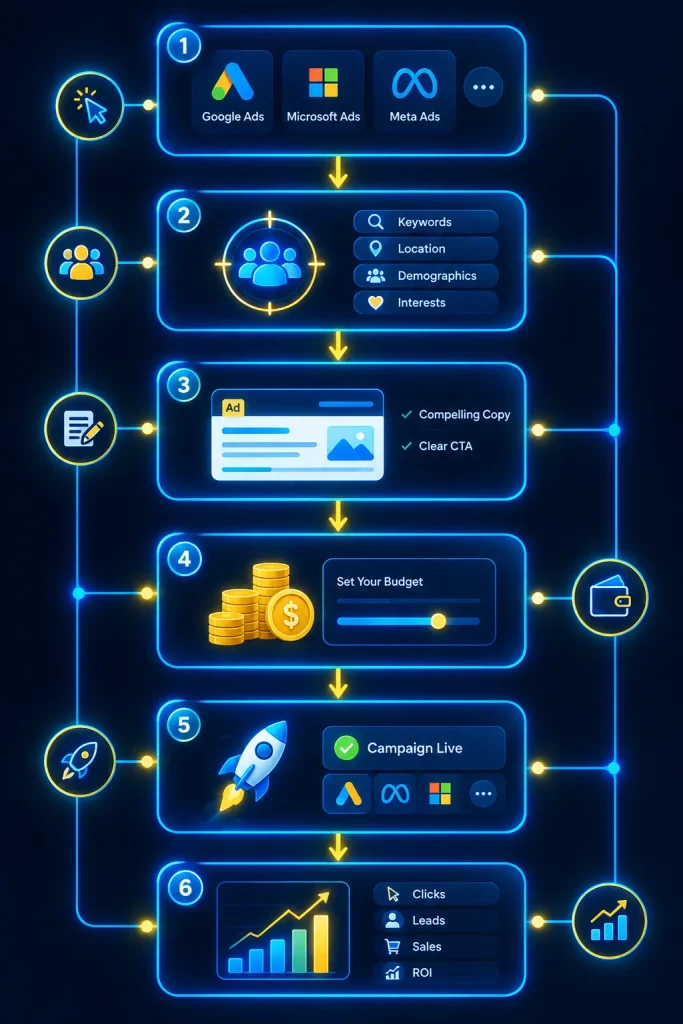
In general, the mechanism behind PPC advertising is quite simple. First, select a platform for advertising, such as Google Ads, Microsoft Advertising or Meta Ads. Then, select the target audience for your advertisement, i.e. what kind of people would be interested in your service or product.
Next, you must create the ad itself, and allocate a budget for it. After which, your advertisement would appear to your target audience. However, besides views, you would need to track the revenue that the PPC advertisement would bring to you.
Although, overall, the presence in the advertisements is a good thing, you need to utilise other methods as well, such as a good advertising copy. One that would entice people into actually clicking on the advertisement. That is, after all, the ultimate goal of every PPC campaign: to induce a person to click on the link.
Is PPC Advertising Worth It for Small Businesses?
In general, yes, PPC advertising is worth it for small businesses, insofar as they are able to utilise the advertisements to find new customers. This can be services offered by the small business, or their products. It could even be a way to market a new service you intend to introduce to the public.
The worth of PPC advertising lies in its ability to find the exact target audience for you. Unlike other forms of advertising, PPC would find you people who are actually interested in receiving the service or product you sell. Therefore, even if you do not succeed with PPC, your other marketing efforts, such as handing out leaflets would bring more success.
However, as with everything, PPC advertising is not without its drawbacks. The most evident of them is the potential costs, because PPC could get extremely expensive if not utilised correctly.
But as long as you know what you are doing and where you want to advertise, PPC advertising is worth it. This, however, brings us back to an age-old question: Does advertising help with sales or not?
Generally, the potential outcome for a local small business would be very varied depending on the kind of business, it could work particularly good for a local therapist or a dentist, or other kinds of services. You could advertise services or goods offered by the small business, or even a specific deal.
In conclusion, the worth of PPC advertising is a difficult one to answer. As it really boils down to what the small business advertises and how well it is executed. However, we can assert that a well-thought advertisement on PPC would do more good than harm.
Key Benefits of PPC Advertising for Small Businesses
1. Instant Discovery by Search Engines
Ranking on the first page of organic search results for competitive keywords often requires time and patience. However, with pay-per-click (PPC) advertising, small businesses can appear in relevant search results virtually immediately.
New agencies, for instance, could advertise their digital marketing services, such as SEO, website design, and social media marketing to people searching for similar solutions.
2. Full Control Over the Budget
Another significant benefit of PPC advertising is that it allows small businesses to have full control over the marketing budget.
It is possible to scale an effective campaign by increasing the allocated budget and reducing the size of a failing one. At the same time, it is important to set a realistic budget for a business based on the campaign’s performance and competitive analysis.
3. Reach Your Desired Audience
With PPC advertising, it is possible to target your desired audience, defining their characteristics, to identify the best-performing channels and audiences to invest in.
Depending on the advertising platform, businesses can utilise various targeting options, such as:
• Search terms or queries;
• Languages and available targeting regions;
• Similar audiences;
• User interests and behaviour;
• And other considerations.
For local businesses, it would be helpful to narrow the advertising area to the city or neighbourhood to get the most relevant results. For example, restaurants, beauty salons, mechanics,dentists, and many other local business categories would benefit significantly from targeting nearby residents rather than international audiences.
4. Easy Tracking and Measurement of Results
Measuring the success of a marketing campaign is critical, but it can be challenging when using traditional marketing methods. With PPC advertising, it is possible to measure the advertising performance and assess the marketing budget’s effectiveness easily.
Specifically, advertisers can track statistics such as impressions, clicks or click-through rate (CTR), cost per click (CPC), conversions, cost per lead, and return on ad spend (ROAS). These metrics can help advertising professionals identify what marketing campaigns, ads, and landing pages drive traffic and conversions and improve their performance based on the insights.
For example, if a social media campaign has a higher conversion rate and a lower cost per lead compared to a Google Ads campaign, it would make more sense to shift the marketing budget to social media to get more value for the money invested.
5. Quick Generation of Leads and Sales
Finally, with the right strategy, PPC advertising can help businesses get more leads, enquiries, sales, views, appointments, and calls. As mentioned earlier, search advertising can target prospective customers searching for products or services similar to the ones offered by a business.
Meanwhile, social media advertising can utilise targeting options to reach out to the desired audiences and promote an offer. A successful PPC campaign will have a strong value proposition, an attractive ad, and a compelling landing page to persuade website visitors to take action.
What Are the Disadvantages of Using PPC?
While Pay-Per-Click (PPC) advertising has a number of advantages for small businesses, it is important to understand the disadvantages before investing in them.
1. Advertising Budget Can Soak Up Fast
Popular keywords can be costly since many companies bid on them making it hard to reach the target audience. This can be too expensive especially if one fails to maximize the returns on investment.
The best way to avoid this is by researching keywords, setting realistic expectations, and monitoring the progress. Another thing that should be done is to avoid targeting irrelevant searches since this could end up being very expensive.
2. Traffic Will Dry Up Once You Stop Paying
With SEO, it is possible to keep attracting customers organic traffic once the content has been optimized. However, with PPC, this will not happen since one has to keep on paying to sustain the results.
It is important, therefore, to keep in mind that while PPC campaigns are a powerful tool, they should not be the only marketing strategy being used.
3. It Might Take Time Before Anything Happens
PPC requires experience and knowledge of how to go about installing and managing it. There is also a need to constantly research, write and test the best ads, track conversions, and monitor and adjust the bids.
Failure to do this can be very expensive since the company ends up spending money on unproductive PPC ads.
The easiest way out of this is by learning the basics of PPC marketing or hire a professional agency with extensive experience in the field.
How Much Does PPC Advertising Cost For A Small Business?
The thing is, there is no set rate for pay-per-click advertising. Everything depends on the advertising platform, the industry, the competition, location, keywords, and other factors.
For example, the advertising cost for a women’s lawyer will be much higher than, say, an advertising budget for a children’s hair salon.
In addition to the cost of placing ads, a small business may need to budget for:
• agency or freelancer fees (if not using in-house services),
• development of landing pages,
• analytics and conversion tracking,
• production of creative assets (for image or video ads)
How Should Small Businesses Set A PPC Budget?
Do not set a budget based on a hope or guess. Set it according to your specific business needs.
Estimate how many leads you need to reach your revenue goal and how much it will cost you. Then calculate how many of these leads will have to be paid (on average, 4 out of 100 shall turn into customers).
Say you have a budget of ₹10,000 for a campaign. If, as a result of it, you get 20 leads, this means that each of them has cost you ₹500. Of these 20 leads, 4 will become customers with an average cost of ₹2500.
Whether it’s worth it or not will depend on how much profit these customers bring and how much the company itself needs to make. This is why the cost per click is not the only thing that deserves attention. The most important thing is the cost of the customer and their profitability to the company.
Best PPC Strategies for Small Businesses
1. Focus your efforts on the high-intent keywords.
By utilizing high-intent keywords, a company can specifically target those who are interested in purchasing a certain product or service.
For example, “affordable website design services” might possibly yield a higher conversion rate compared to “what is website design,” depending on a company’s specific needs.
2. Create a compelling ad copy.
The description must contain the basic information on the advertised product/service, clearly state the key differentiators, and include a persuasive call to action.
In turn, the latter’s primary purpose is to encourage a visitor to take any specific action, e.g.,“Book an Appointment,” “Get a Quote,” or “Shop Now.”
3. Make sure your landing pages are optimized.
Do not direct traffic to generic URLs, such as the company’s landing page. Instead, build separate optimized landing pages for every PPC advertisement.
An optimized landing page implies a number of essential elements:
• attention-grabbing title and ad copy;
• informative and benefit-oriented content;
• trust factors;
• contact/purchase CTA;
• responsive design;
• fast loading.
A poorly optimized landing page might fail to demonstrate the benefits of the advertised product/service and will result in the loss of a potential customer
4. Measure conversions.
A competent PPC manager should have a robust conversion tracking system, defining which conversions were valuable, how they correspond to one’s business objectives, and what types of visitors should be prioritized.
5. Test and tweak your campaigns.
In many ways, a successful PPC campaign is a continuous process that requires extensive tweaking.
It is essential to constantly test headlines, descriptions, offers, keywords, and landing pages, analyzing what works and what does not.
Simultaneously, one should not make rash conclusions based on only one CTR or conversion.
PPC vs. SEO: Which Is Better for Small Businesses?
PPC and SEO serve different purposes. The best choice depends on your business goals.
Factor | PPC Advertising | SEO |
|---|---|---|
Visibility | Can begin quickly | Usually takes time |
Cost | Paid ad spend | Content and optimization investment |
Traffic duration | Stops when ads stop | Can continue over time |
Targeting | Detailed campaign targeting | Search relevance and intent |
Best for | Quick visibility and testing | Long-term organic growth |
Tip: Combine PPC for faster results with SEO for sustainable traffic.
How to Measure PPC Advertising Success
Before launching the campaign, define what success means for your business.
You need to track the following metrics:
Click-through rate:
The percentage of impressions that result in clicks.
Cost per click:
The average cost per click.
Conversion rate:
The percentage of visitors who complete a desired action.
Cost per lead:
The advertising cost per lead.
Customer acquisition cost:
The cost of acquiring one customer; it is calculated by using a certain set of costs.
Return on ad spend: The amount of money from sales that goes back to the advertisers. For instance, you spent ₹10,000 on ads, and the revenue from them is ₹40,000; therefore, your ROAS is 4x.
It is hard to say that every 4x ROAS equals 4x profit, as you should calculate the expenses on goods and services and other costs related to the production.
F.A.Q.
Yes, since it can help you target specific audiences, generate quality leads and boost sales.
The budget should be established according to your expectations, the level of competition in your niche and the cost of each customer acquisition. A small business should initially invest in PPC ads testing the profitability of the selected approach.
If your target customers search online for solutions to their problems and your call to action buttons are properly placed, you will benefit from Google Ads.
Everything depends on the industry, target audience and the level of competition. In some cases, you will see the result right away, as your ads start to appear in the search results
A small business can use a small budget to achieve its goals. It will require identifying a specific target audience and allocating the budget to the most promising keywords and services. If the initial assumptions are correct, good results will be there.
Conclusion: Is the Use of Pay Per Click Advertising for Small Business Worthwhile?
Pay per click advertising can be an excellent way to promote products and services for small businesses that want to get found over the web quickly, get targeted traffic, and start getting customers and sales.
But what are the advantages and disadvantages, and how can one properly use PPC advertising to get the required results? The main benefit of pay per click advertising is its ability to get businesses found fast. With PPC companies only pay when someone clicks on their ads, making them an affordable way to get targeted traffic and promote a business.
To get required results, business owners will need to properly setup their PPC campaigns which includes conducting keyword research, writing compelling ad copies, creating landing pages, setting up tracking pixels for enhanced conversion funnels, and much more. It is essential to start small and only scale large PPC campaigns after seeing stable results from smaller ones.
Overall, the use of pay per click advertising by small business owners is justified since it can get them customers at an affordable price.
Ready to Grow Your Business with PPC Advertising?
Want to attract more potential customers and make your advertising budget work smarter? Our digital marketing team can help you build targeted PPC campaigns, optimize your ads, and track performance to support your business goals.