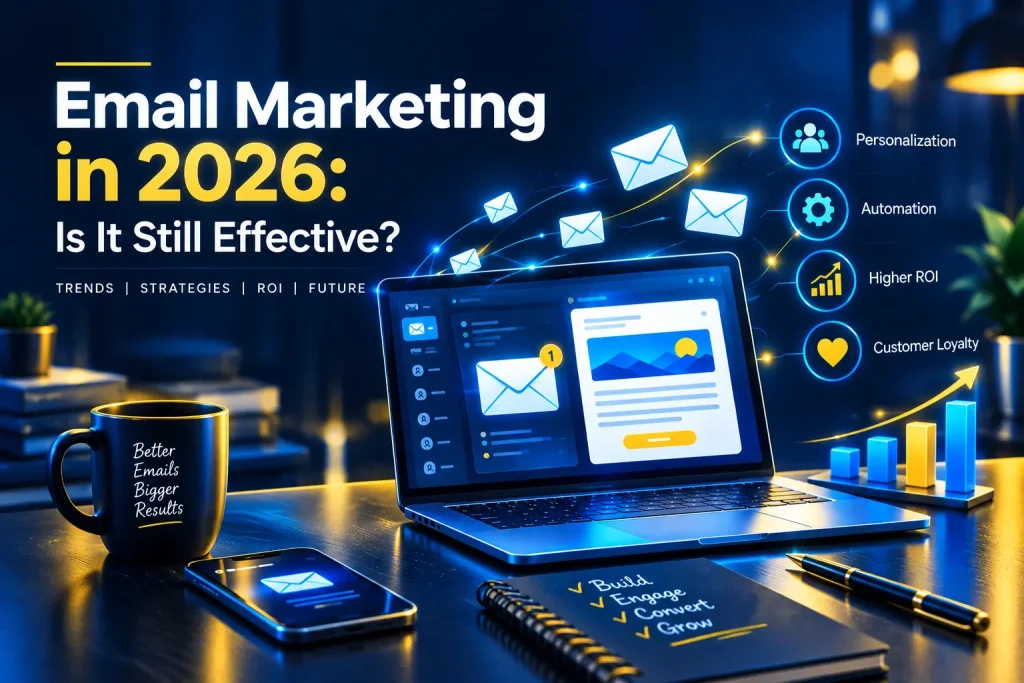
Email Marketing in 2026: Is It Still Effective?
Email Marketing in 2026: Is it Still Effective With the advent of social media, artificial intelligence, search engines, chatbots, and many other marketing channels, it is reasonable to think, is email marketing still effective in 2026? Short answer: yes, is. But not as you probably think. Email marketing has evolved, not only as a channel to notify and promote to thousands of customers at once, but to personalize, automate, analyze, segment and sell to them, based on behavioral patterns, interests, preferences, and much more. Recent (2026) industry benchmarks show that email marketing can indeed still be effective, with a median return of $36 for every $1 for every dollar spent on them. However, this can vary considerably from industry to industry, and from company to company, depending on the audience, strategy, and metrics used. So, email marketing is not dead, rather, it has evolved into a more sophisticated, personalized, and automated channel to acquire, engage and sell to customers. What Is Email Marketing? Email marketing is a type of digital marketing that involves sending emails to prospects and customers. Companies can use email marketing to do the following: – Drive lead generation– Promote products and services– Deliver educational information– Engage with prospects and customers– Encourage existing buyers to remain loyal– Alert customers to new offers, launches, and promotions– Recover abandoned purchases– Retain customers Unlike social media, which is controlled by an algorithm that only selects what content gets seen by whom, email marketing provides companies a straight channel to those who have given their permission to be marketed to Is Email Marketing Worth It in 2026? Yes, because blasting the same marketing message to 10,000+ email addresses isn’t going to get the same results it did 10 years agoModern email marketing relies on delivering value to the customer. That doesn’t mean companies should stop blasting acquisition-heavy content to their audiences. But there should be a mix of the following types of sequences: – Acquisition: To drive new sign-ups, these would typically go to your blog or newsletter.– Education: Sending helpful content to your prospects.– Recommendation: Recommending products or services to past customers.– Recovery: To target those who’ve abandoned their carts.– Monetization: Offers to your most engaged customers.– Re-engagement: To get someone who hasn’t interacted with you in a while to come back. The above sequences would get your audience to feel like they’re being taken care of by your brand rather than getting blasted with ads.Also, as of now, industry benchmarks still report healthy returns on investment (ROI) for email marketing, with many companies reporting a $36-$42 ROI for every $1 spent in 2026. Why Email Marketing Still Works in 2026 1. Email Marketing Lets You Get Into the Hands of the Customers Social media platforms are algorithm-driven, while email marketing is much more direct. When a person subscribes to an email list, they give up a bit of ownership. That is precisely why social media’s algorithm does not show your post to everyone you want. 2. Email Marketing Can Produce an Excellent ROI One of the reasons people invested in email marketing heavily in 2003 is because the ROI was just ridiculous. For a $1 investment, you would get 27 cents. But then it started averaging just over $$36 for every $ A study published by EmailToolTester showed that in 2003, most ROI for ecommerce and consumer products ranged between But wait, that number can be yours per dollar. 3. Email Marketing Automations Save Time Email marketing automation has made the channel so much more effective. The ability to make automated sequences helps to reduce the workload and improve results. All kinds of marketing professionals rely on automation, like automated welcome mail lead nurturing sequences abandoned cart recovery birthday or anniversary emails post-purchase sequences product recommendation emails re-engagement campaigns 4. Personalized emails help sell a lot better than bland ones designed by the CEO Customers do not want to receive unspecific emails. A personal touch in an email campaign is essential if the emailer wants to make a sale. Some simple things can personalize an email, like a name website activity the customer’s location the products he or she has shown an interest in his or her interaction data with the brand’s emails customer lifecycle stage It is crucial that emails are not personalized simply because a name was added to the front of the email. True personalization should make the message applicable to that specific person and his or her intent and stage in the buying cycle. The trends to watch out for in email marketing in 2026. AI-Augmented Marketing Emails Artificial Intelligence (AI) in email marketing will become a must in 2026. AI can write an email, write a subject line, analyze campaign performance, predict customer behavior, recommend products, personalize content, optimize send dates, and segment lists. But remember that AI-driven campaigns should be strategically designed to maximize an email marketer’s efforts and not replace what a professional marketer brings to the table. Automated Behavioral and Time-Sensitive Emails One of the hottest trends in email marketing in 2026 is using behavioral and time-based triggers to send emails. For example, if a customer browses a website and leaves, an abandoned cart email can be sent. After the customer makes a purchase, a thank you email, product educational email, and cross-sell email might follow. Segmentation Is King There has never been a better time to segment lists and nurture customers. Sending one mass email to a list is not the most effective practice in modern-day marketing. Instead, segment lists and send emails accordingly. For instance, new leads may need nurturing emails. prospects may need product or service-oriented emails. existing customers may find value in looking at some special offers. inactive users may get special re-engagement campaigns. Email Marketing Metrics Businesses Should Track in 2026 Your open rate should never dictate if your business needs to tweak their email campaigns Due to Apple’s Mail Privacy Protection feature; companies need to start placing a bigger emphasis on other engagement and