
From Clicks to Customers: How Digital Marketing Drives Business Growth
In the modern era of technology-based business interactions, companies must do more than offer good services or products. Their representatives should be able to reach the target audience and effectively communicate their selling points to get more clients. Digital marketing helps to accomplish this goal and enhances a company’s reputation, attracts new customers, and increases sales.
Thanks to marketing services, businesses get many different ways to promote their products. From social media and search engines to email marketing, online advertising makes the company known across the globe. Moreover, they can get high-quality traffic to their site, engage visitors, and convert them into customers.
Thus, a company can benefit from digital marketing greatly. Any small business, startup, online shop, or an established enterprise with vast experience can use it to get new clients and promote their goods and services. Now, let’s see what advantages digital marketing brings to businesses and how they can help companies get more customers.
What Is Digital Marketing?
Digital marketing definition entails the use of online media to promote goods and services. It is different from traditional marketing since it enables the marketer to identify a niche audience and interact with them through electronic channels. SEO, social media, email, and other online strategies are all part of digital marketing.
Here are some common digital marketing tactics:
- Search engine optimization
- Social media marketing
- Content marketing
- PPC advertising
- Email marketing
- Influencer marketing
- Affiliate marketing
- Conversion rate optimization
While boosting web traffic is just one component of a digital marketer’s job, driving high-quality visitors to a landing page and persuading them to purchase is what determines a successful digital marketing campaign.
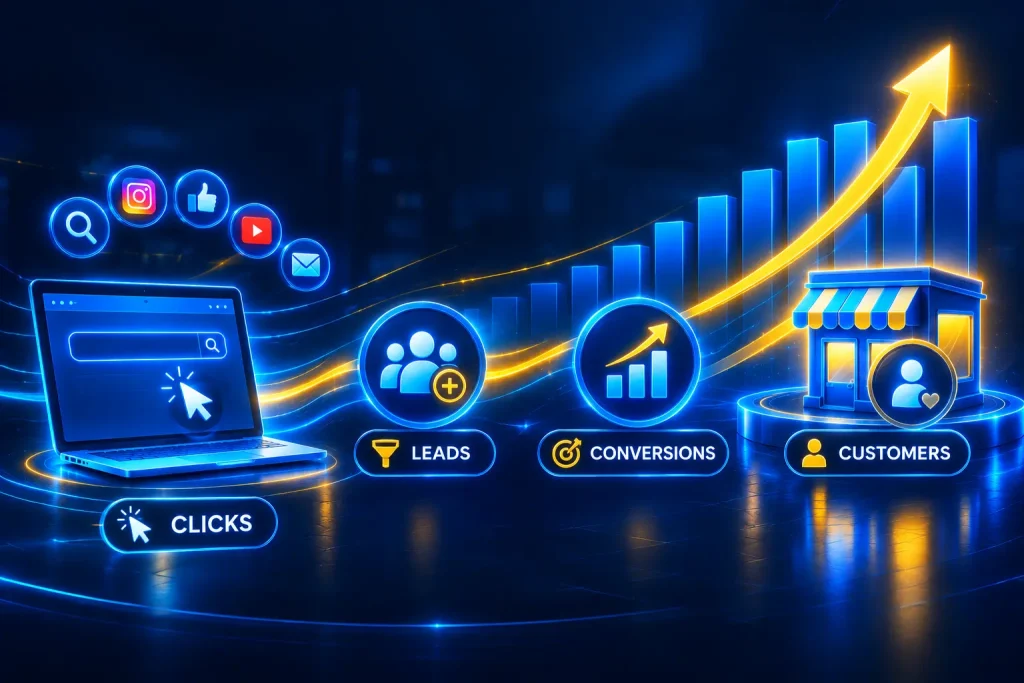
How Digital Marketing Drives Business Growth
How Digital Marketing Drives Business Growth
1. Increasing the Visibility of the Brand
The process of any marketing starts with the fact that a person needs to become aware of the existence of a particular business.Search engine optimization, social networks, content marketing, and advertising can help a company appear in front of the person who is looking for exactly the services that the company provides.
For instance, in the case of a sports equipment company, one can create content marketing, optimize it for search engines, and thereby appear in front of those who search for keywords such as “home training equipment,” which leads to brand awareness.Moreover, increasing the visibility of the brand means that there will be more people who can potentially become a customer.
2. Target Audience Reach
Furthermore, the possibility of digital marketing to increase audience reach implies that the company can also target specific groups of people.Demographics, location, interests, and many other characteristics can be taken into consideration for finding the target audience.
By using digital marketing, companies can specifically choose the audience to which they want to target their promotion and thereby waste less money on advertising.Besides, by attracting the attention of people who are interested in what a company sells, the company will have more potential customers.
3. Lead Generation
Leads are one of the critical points in any marketing system.Simply put, companies need more visitors to their website to generate more sales.Digital marketing helps with this as it provides a variety of lead generation methods.Those include landing pages as separate pages on the website, modal windows, pop-ups, contacting consultants, getting discounts, newsletter subscription, free samples or trials, and many others.
For instance, a company can offer its visitors to get a free trial of its product under certain conditions.In that case, the company can later on contact those people and get them to become a customer.
4. Building Trust and Recognition
It is vital that a company builds trust with its potential customers.Often before buying a product or a service people look for reviews or other information about the company.Therefore, digital marketing once again comes in handy as it can help in recognition and trust-building with the target audience.With that being said, creating quality content that would not ignore the needs and the questions of the customers is of paramount importance.
A company should regularly post articles, reviews, testimonials, videos, and much more. All of that would build trust as a company would be able to show its potential customers that it can help them in whatever issue they are facing. It is important to note that nowadays content marketing is one of the most effective marketing methods.
5. Converting Visitors to Customers
Although generating leads is essential, without converting them to customers, a company will find itself at a deadlock.In other words, it is not enough to attract new visitors; a company should provide them with reasons to choose their brand.
Thus, a company has to optimize its website to encourage conversions.Conversion rate optimization includes several methods, such as reducing the bounce rate, improving website design, providing better content, and others.As an example, “Call to Action” buttons can be optimized.
A button that says “Get a Free Consultation” will yield better results than a button that says “Learn More.” This particular step will help a company to build a relationship with the customer and provide them with an answer.
Key Digital Marketing Strategies for Business Growth
Search Engine Optimization SEO
SEO could potentially boost the appearance of your company in the organic search results.A good SEO strategy typically contains keyword research, engaging content, technical SEO, internal linking and a website that provides excellent UX.
The ultimate aim of SEO is to attract more visitors to the website and increase the number of visitors who are searching for the products or services offered by the company.
Social Media Marketing
Social media is a powerful tool for community building, word of mouth marketing, and two-way communication with one’s customers.
Companies could benefit from both organic social media marketing and paid social media advertising. The key to success in social media marketing lies in figuring out which social media networks one’s target audience is active on, and what content they would like to see.
Content Marketing
Content marketing is all about creating content that educates and entertains one’s target audience. There are many types of content marketing, including:
• Articles
• Blogs
• Videos
• Social media content
• Infographics
• Case studies
• E-books
• White papers
• Podcasts
Unlike traditional marketing, where the emphasis is on promoting the brand, content marketing is about delivering value to the customers by addressing their needs and answering their questions.
Pay Per Click PPC
PPC is a great marketing channel that helps companies to drive leads and sales by targeting customers at the very moment when they express interest in the products or services offered. Since PPC campaigns could be segmented in great detail, they are effective in both lead generation and bottom of the funnel sales-oriented activities. However, since PPC is an expensive marketing channel, it is essential to analyze and optimize the performance of the PPC campaigns on a continuous basis.
Email Marketing
Email marketing is yet another powerful marketing tool that helps in nurturing prospective customers and communicating with one’s audience. By sending out newsletters, emails, product announcements, special offers, and other types of marketing communications, companies could drive more sales and build stronger relationships with their customers. It is important to note that email marketing could be exceptionally effective because it allows for one-to-one conversations with the customers.
How to Measure Digital Marketing
One of the crucial benefits of digital marketing is that it can be easily measured. That way, businesses can analyze such as
- website traffic,
- organic traffic growth,
- CTR or click-through rate,
- conversion rate,
- CPL or cost per lead,
- CAC or customer acquisition cost,
- ROI or return on investment,
- open and click rates for email marketing,
- and customer retention.
While clicks and impressions are essential, a business should not evaluate the success of its campaign based purely on these figures. For instance, a marketing campaign with thousands or even millions of impressions and clicks will fail if no customers have been acquired through it. In other words, the ultimate goal should be what a company is trying to achieve with its marketing activities.
Therefore, apart from measuring a basic CTR or conversion rate, a business should consider the long-term value of this campaign for the consumer, which, eventually, will reflect its success or failure.
From Clicks to Customers: Building the Digital Marketing Funnel
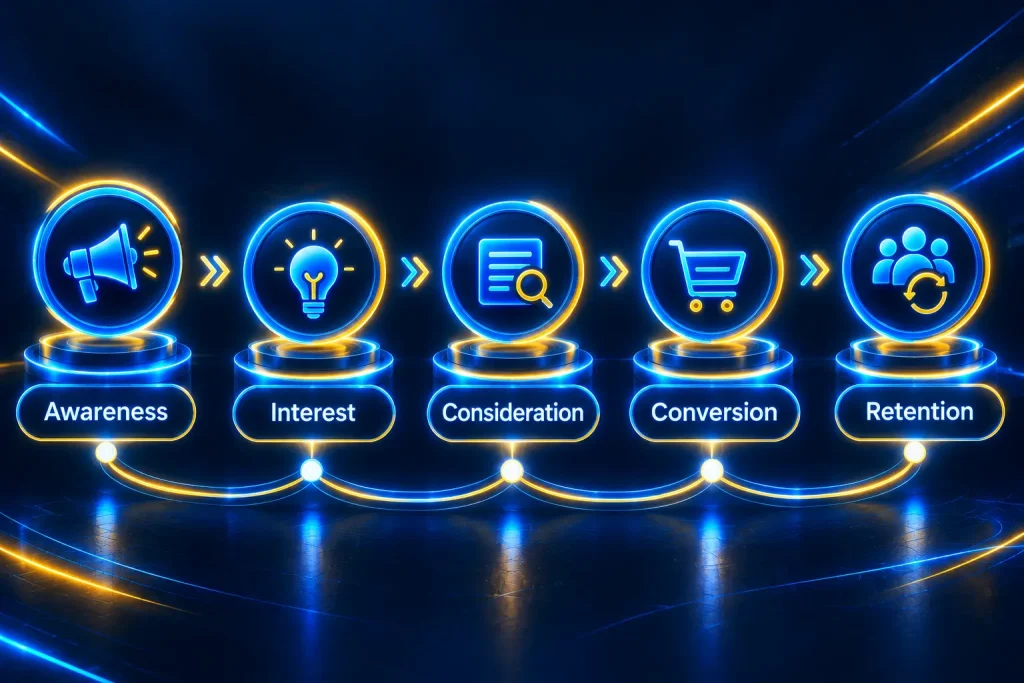
A successful digital marketing campaign is designed to take a customer from A to B through the funnel. Let’s take the buyer’s journey and see how digital marketing can fit in:
- Awareness
- Consideration
- Conversion
- Retention
At the top of the funnel, Search Engine Optimization, social media, ads, and other means of marketing can get you in front of prospects.Then, as they move down the consideration phase, content, reviews, testimonials, product descriptions, and nurturing emails will aid in building a case for your product/service.
At the bottom of the funnel, conversion, it’s all about landing pages, calls-to-action, checkout process, and special offers.
Finally, with the sale done, the relationship can be further fostered with emails, customer support, loyalty programs, and more to keep them coming back. This is how a digital marketing campaign can build customers for you.
Why Businesses Need a Consistent Digital Marketing Strategy
Digital marketing is an ongoing process: the way people search for information, their expectations, the actions of competitors, and the platforms themselves are constantly evolving. Thus, a properly developed strategy, which would take into account these and many other factors, allows you to:
• maintain and increase visibility;
• create awareness of the brand;
• get stable leads;
• study the audience;
• test marketing strategies;
• retain customers;
• grow the company.
The main advantage of such a strategy will be the ability to work with multiple channels at once, rather than relying on the capabilities of just one.
Frequently Asked Questions
Explore answers to common questions and learn more about how we can help your brand grow.
Digital marketing helps in building brand image, reaching out to the target audience, shortlisting the right customers, converting them into the business’s clients, and retaining existing customers.
Digital marketing employs various techniques and tools to engage prospects, educates them about the brand, encourages them to take a free trial/sample, and communicates with them through websites, landing pages, call-to-action buttons, and other interactive tools. This helps in guiding the customers from entry pages to the final point of purchase.
Depending upon the requirement, budget, target audience, and other factors, multiple strategies can be utilized together to achieve business goals. Search engine optimization, content marketing, use of social media, and pay-per-click marketing can work in unison to offer excellent results.
Every business’s requirement is different, and therefore, the time taken may vary. Whereas some activities, such as using paid-marketing would show results immediately, others, like improving content, might take a while. However, measuring the results through traffic, sales, engagement, and other metrics is essential.
By comparing expenditures and returns, the return on investment of digital marketing can be calculated. In addition, an analysis of how different strategies contribute towards revenue, leads, conversions, and other aspects can help in identifying ROI.