
Introduction
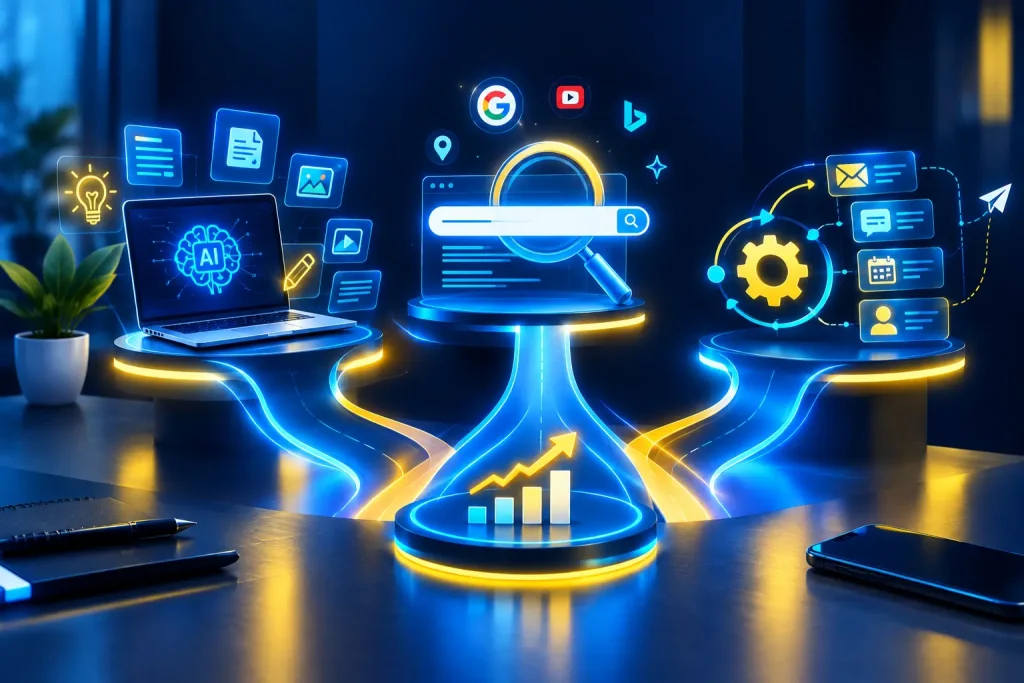
Nowadays, digital marketing is evolving rapidly due to artificial intelligence, changing search landscapes, automations, and personalization of the media space. Businesses are now realizing that their traditional ways of SEO and advertisement might not be sufficient in the nearest future. Such strategies as SEO, social media marketing, and traditional advertising will remain relevant but occupy a smaller and smaller proportion of the marketing budget. Search engines are becoming smarter, marketing technologies are enabling marketers to create and analyze their content faster, and automations are taking over repetitive tasks in the sphere of marketing. At the same time, artificial intelligence and personalization will allow creating engaging and relevant content for each particular customer.
However, it should be noted that for businesses, the future of digital marketing will not be different from what we are used to seeing in traditional media: the technology should be used as an instrument to meet the needs of customers and build a relevant strategy. With that in mind, let us take a closer look at the future of digital marketing and its main trends.
How AI Is Revolutionizing Digital Marketing
Artificial intelligence (AI) is proving to be a true asset in helping marketers navigate the ever-growing complexities of digital marketing.
With AI, marketers find new ways forward such as analyzing massive quantities of data to unearth patterns, ideas and opportunities, generating content, personalizing the customer experience and automating tasks to help drive productivity.
AI-Powered Content Creation
Marketers are already seeing value in leveraging AI to help support content creation ideation including:
- blog topic suggestions,
- content outlines,
- ad copy,
- social media ideas,
- email draft development,
- product descriptions,
- as well as keyword research.
But, businesses need to recognize the importance of quality and avoid getting trapped in a race to produce as much content as possible with AI. Instead, marketers should be focused on creating informative, original and valuable work to customers.
Personalization at Scale
AI’s ability to learn and understand customer behaviors and help businesses deliver far more personalized experiences to customers at scale. For example, an ecommerce site can harness AI to recommend products based on a customer’s browsing or buying behaviors or, in the context of email marketing, a service can use AI to help decide which email offer to send out based on specific customer activity.As such, it’s fair to say that personalization is going to fuel the future of digital marketing.
The Future of Search Isn’t What It Used to Be
Searching isn’t what it used to be. Search results are now increasingly more visual and offer a broader range of discovery options than just the traditional “blue links” results. For example, AI-powered assistants can answer questions, compare products, find information and more. As such, businesses need to shift their digital marketing approach and embrace this new era of discovery beyond just the traditional first page of Google.
SEO Is Still Important But Evolving
SEO will always be important but will be increasingly fueled by satisfying search intent and creating helpful, informative content.
Marketers need to consider things like search intent, helpful information, website architecture, improved user experience, topical authority, trust and credibility, technical SEO and keyword optimization to help improve their overall SEO strategy.
While keyword volume and difficulty used to dominate SEO strategy-making, businesses should be increasingly focused on addressing the search intent and needs of its ICP.
Beyond Google: Embracing A Multi-Channel Search Approach
Consumers are discovering information using a number of digital channels including social media, video platforms, marketplaces and more in addition to traditional search engines. As such, marketers should be thinking about building a multi-channel digital marketing strategy that not only includes search but extends across other discovery platforms on the web.
Marketing Automation Is Growing in Importance
Marketing automation is a great illustration of how digital marketing efforts are being enhanced by emerging technologies to drive productivity and performance.
By putting automation in place, not only can companies be more productive, it helps free up marketing teams to do more high-level marketing analysis. Some of the everyday marketing tasks that can be automated across any business include:
- email marketing
- nurturing prospects
- follow-up sequences after a meeting
- social media publishing
- report generation
- audience clustering
- ad optimization
- CRM management
- cart abandonment recovery
AI + Automation = Marketing Superpower
AI can support businesses in taking marketing automation to the next level.
While traditional forms of automation might just be about sending out the same message to everyone, with AI, you can use that technology to help improve existing forms of automation so you’re serving audiences in an even more personalized way such as delivering a unique message or offer to a customer based on their behaviors.
The Importance Of Being Data-Driven
Over the years, data has been critical to powering effective digital marketing campaigns and strategies. With increasing access to additional data, businesses need to be smart about utilizing these resources effectively. In particular, marketers can use data and analytics to uncover insights into:
- customer behaviors
- email campaign performance
- website performance
- conversion trends
- audience needs and desires
- customer journeys
With that said, businesses need to think about how they’re respecting consumers’ privacy and obtaining that data in responsible manners as data will play a bigger and bigger role in digital marketing.
First-Party Data Is The New Currency
Data privacy and access to third-party data is proving to be a big challenge in the marketing and advertising world. As such, marketers and companies must start thinking about how they’ll maximize their own first-party data and understand the value of it.
In particular, first-party data refers to any information that a company collects directly from its first-hand sources including newsletter sign ups, purchases, preferences and more. Companies can start to build meaningful dossiers about its customers to help fuel its marketing and advertising approaches.
To supercharge such an effort, businesses can utilize tactics such as building email lists, loyalty programs, surveying customers and setting up customer accounts to help obtain more information to better personalize their outreach while also strengthening customer relationships.
Humans Aren’t Going Away As Marketers Continue To Think About The Role Of AI
While AI is clearly playing a bigger role in the marketing mix, it’s critical that businesses realize that technology alone can’t tell businesses exactly what to say or how to position an offering. Even if companies are using AI to drive greater levels of productivity, businesses still need to focus on the human aspect of marketing and always remember that, while helpful at a certain level, the power of AI lies when it’s layered on top of human creativity. Ultimately, marketers should continue to focus on their overall business goals while also trying to utilize the technologies to help elevate their overall marketing approach.
So, the future won’t be about humans versus technology. Looking ahead, effective marketing will continue to be driven by a combination of both.
Key Digital Marketing Trends Worth Noting
There are several key digital marketing trends that will shape the future of the field:
1. AI Empowerment
Marketers will witness increased application of artificial intelligence (AI) to empower copywriting, analytical tools, personalization, chatbots, and advertising.
2. Conversational Search
A rising number of searches are turning into conversations, and marketers should tweak their strategies to feature rich responses to long-tail questions.
3. Omnichannel Marketing
Consumers are interacting with brands across multiple digital channels and devices, including websites, search engines, social media, email, and mobile phones, and traditional platforms. As such, businesses need to embrace omnichannel marketing to offer a unified experience and maximize engagement.
4. Predictive Analytics
Marketers will apply predictive analytics to anticipate the needs of their customers and make smarter business moves.
5. Hyper-Personalization
Consumers are no longer impressed by generic approaches. They demand relevance and are willing to pay a premium for brands that deliver on their individual expectations. Personalization will go far beyond inserting the consumer’s name in an email.
How Businesses Can Prepare Themselves for the Future of Digital Marketing
While it may be impossible to embrace all the changes in the future of digital marketing businesses can take a few strategic steps to prepare themselves for the oncoming changes and reap the rewards of being ahead of the game.
These include:
- Testing AI-powered tools for research, analytics, and automation
- enhancing SEO strategies, including technical optimization, high-quality content, and search intent
- building first-party data warehouses
- automating repetitive and time-consuming tasks
- focusing on actionable metrics
- letting humans rule over AI
- experimenting with new search and content trends.
- Firms that are willing to adapt and change their strategies and structures stand a better chance to survive and thrive in the future of digital marketing.
The Future of Digital Marketing: What Comes Next
The future of digital marketing will continue to be driven by artificial intelligence and embrace automation to increase productivity and creativity. Search engines will continue to evolve and become more conversational and support multiple search formats. Marketers will apply predictive analytics to personalize consumer experiences and boost sales. Data, including first-party data, will play a critical role in informing better business decisions. At the same time, there will be a greater need for human intelligence to keep AI in check. The field will remain consumer-centric and focus on building long-term loyalty by prioritizing quality over quantity. Thus, while the need for cutting-edge technology is undoubted, human interaction will always be of prime importance. And, the most successful marketers of tomorrow will be those that can combine the two effectively.
Frequently Asked Questions
Explore answers to common questions and learn more about how we can help your brand grow.
The future of digital marketing is predicted to be dominated by AI, automation, personalization, data analytics, and changing search technologies that will continue to prioritize the customer experience.
While artificial intelligence can make many of the repetitive tasks of a digital marketer obsolete, human qualities such as creativity, critical thinking, brandmanship, and intuition are difficult to replicate. In other words, AI is more likely to supplement than to replace digital marketers.
Yes, SEO is still going to be important because the search landscape will continue to change, but companies must pivot their content creation strategies to satisfy the end-users’ intent and be found in these evolving spaces by focusing on the technical, helpful, and trustworthy aspects of their offering.
Small businesses can leverage AI for content research, customer service, email marketing, analytics, and social media, as well as for automating repetitive tasks.
Marketing automation is important to let businesses’ marketing operations scale without the need to perform monotonous tasks manually, focus on nurturing relationships with leads and customers, and be more efficient and productive.
Ready to Future-Proof Your Digital Marketing Strategy?
The future of digital marketing is already taking shape. AI, search, automation, and personalization are creating new opportunities for businesses to reach customers more effectively.