
Introduction
Artificial intelligence (AI) is no more a novelty that powers chatbots to answer simple questions from customers. It has become an integral part of strategies that companies use to reach out to and interact with their audiences.
May it be search, predictive analysis, automated ads, or personalized experiences — the role of artificial intelligence in modern digital marketing is impossible to overestimate. As such, businesses are integrating AI technology into their operations at all levels, from acquisition to conversion and retention.
The trend is justified as real-time big data analysis, crucial for any marketing process, is unable to keep up with the amount of information that modern customers generate and that companies need to analyze to find meaningful patterns. AI helps to automate and accelerate repetitive marketing tasks and decision-making in general.
But what else can AI do apart from chatbots? Let’s take a closer look at AI-driven digital marketing below.
What Does AI Mean in Digital Marketing?
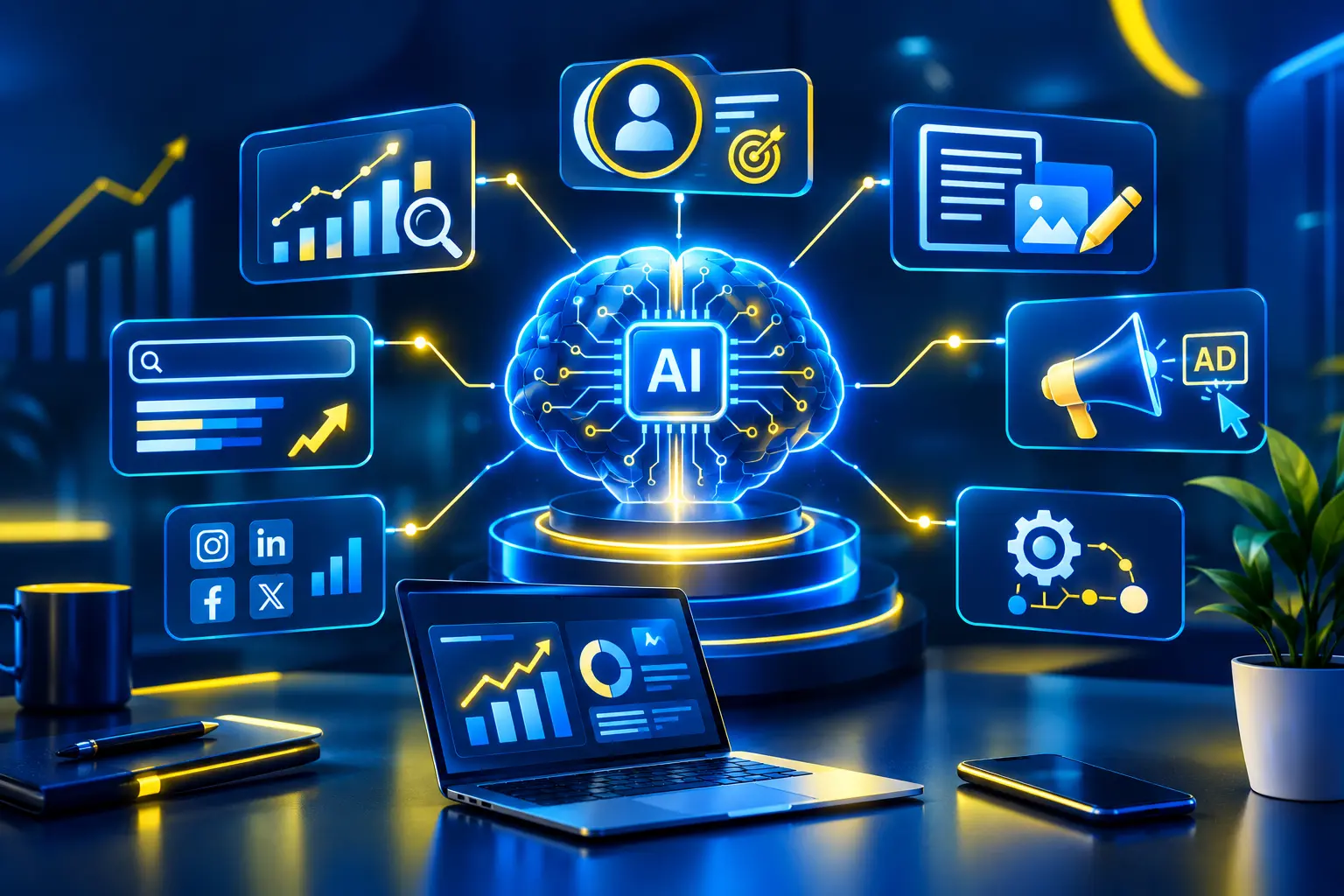
AI in digital marketing means the ability of artificial intelligence to analyze data, recognize patterns, automate processes, create content, forecast, and influence clients.
Thus, AI in marketing is not just about addressing customers but also covering all stages of the customer’s journey.
In other words, the technology can be used to:
- Analyze the current customers’ behavior
- Make predictions about clients’ future actions
- Create personalized experiences on websites
- Generate contenteditable content for different media
- Optimize SEO
- Automate advertising processes
- Segment clients
- Recommend products or services
- Analyze and optimize marketing campaigns
Therefore, the technology goes far beyond customer service automation and becomes the marketing intelligence layer that transforms the traditional marketing processes into automated ones.
How AI Is Transforming Digital Marketing Essay
1. AI-Powered Personalization
Customers are expecting more personalized experiences than ever before.
With AI, you can take information such as browsing behavior, history, purchases, and engagement into account to help you better personalize your marketing mix.
For example, you can use AI to power product recommendations on your e-commerce site or recommend articles based on someone’s interests and engagement.
By applying AI to create better personalized experiences, you can supercharge:
- Product recommendations
- Email marketing
- Website experience
- Customer segmentation
- Promotions
- Content recommendations
Instead of blasting the same marketing message to everyone, you can personalize the customer journey and deliver more value.
2. Predictive Analytics and Customer Insights
One of the most interesting applications of AI marketing is that it can analyze huge amounts of data and find patterns and insights.
Vanilla data analytics can tell you what has happened and even why it happened to a degree. Predictive analytics can help you determine what will happen in the future based on past and present data.
With AI, you can uncover insights such as:
- Who are your customers that are most likely to buy
- What products will sell
- What campaigns will be the most successful
- Who is likely to churn
You can then use these insights to inform your marketing budget and marketing mix.
3. AI Is Transforming SEO and Search
Another area where AI is having an impact is in SEO, search marketing, and search engines in general.
Traditional SEO used to be about putting the right keywords on a page so that Google could easily find and rank the page higher in the search results. With AI, the way we optimize web pages and create content is changing.
SEO is becoming more about search intent, helpful content, and topically relevant content as well as content quality, information architecture, and much more. There are many factors that influence how Google will rank your page in the search results.
AI can also help you optimize your content, find new keywords and topics, analyze competitors, and much more. As far as SEO is concerned, it’s not about writing more content; it’s about writing better content for the right audience.
4. Automated and Smarter Advertising Mix
One of the biggest areas where AI is being applied in marketing is programmatic advertising.
Advertising platforms are becoming increasingly automated and use AI to analyze signals and make decisions in order to meet your advertising goals.
AI can help you with smarter advertising, such as:
- Better audience segmentation
- Optimized ad budgets
- Bid optimization
- Ad variations
Leveraging AI for advertising does not mean you should stop caring about your advertising campaigns. It means you can focus on different parts of your advertising mix, such as creative, audience insights, and much more, while the tedious parts can be automated.
5. AI-Powered Content Creation
AI is transforming content marketing and marketing copywriting in general.
With AI language models, you can create blogs, social media posts, email marketing copy, ad copy, product descriptions, video scripts, research reports, and much more. You can use generative AI to help you with your content creation tasks, such as outlining a blog post or writing social media copy.
However, AI is not a magical marketing content creation machine. It can still make mistakes, and marketing copy created by AI can sound generic or untrue. Humans are needed to add quality, originality, brand voice, and much more.
AI-assisted marketing content creation is much better than fully relying on AI to create marketing content.
AI Marketing Automation: Getting More for Your Effort
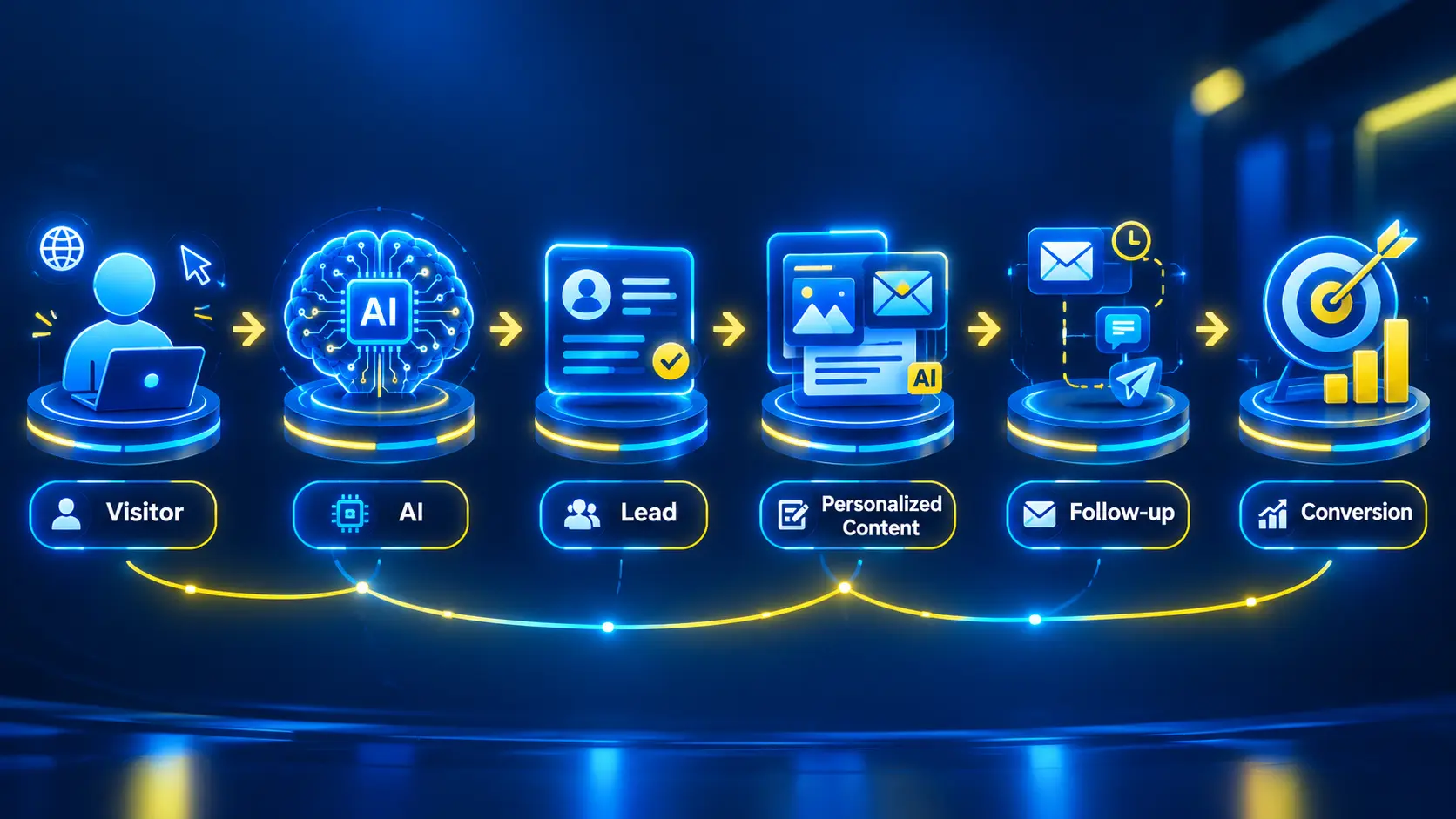
Marketing departments are wasting a lot of time doing the same tedious and boring tasks over and over again like reporting, creating segments, chasing down leads, qualifying prospects, and monitoring campaigns.
With AI automation, you can save the marketing team time by doing some of the tedious work for them.
Visitor → AI → Lead → Personalized Content → Follow-up → Conversion
That’s time that the marketing team can spend doing more creative and important tasks instead of doing mundane and robotic tasks that anyone could do.
AI and Customer Experience
Additionally, it should be noted that AI can also change the customer experience.
Beyond the application in chatbots, companies can utilize such technology to personalize recommendation, enable natural language search and assistance, offer virtual helpdesks, and engage in proactive communication.
An example of the application of AI in customer experience management can be seen when a customer does not have to look through hundreds of items searching for something they need as the AI can recommend products to the customer based on their individual preferences.
This way, AI can make the buying process more convenient and interactive.
Human Element in Marketing Analytics
Although a significant number of marketing activities can be automatized with the help of AI, marketing professionals and analysts will still be needed in the future.
While AI can collect and analyze big sets of data and present them in a clear way, only humans will be able to
- think creatively,
- develop marketing strategies,
- understand brands,
- offer ethical guidance,
- have industry knowledge,
- think from the customer’s point of view.
Thus, it can be concluded that the future competitiveness of marketers will not be held back by the appearance of AI technologies in marketing analytics. Instead, the marketers’ unique ability to combine their creative thinking with the analytical power of AI will give them a significant advantage.
Challenges of Using AI in Digital Marketing
There are challenges presented by incorporating Artificial Intelligence (AI) in the digital marketing.
Data Privacy
Organizations have an ethical responsibility to protect customer data and comply with personal data protection laws.
Accuracy
The information generated by AI algorithms may at times be misleading or entirely wrong.
Brand Authenticity
Heavy use of AI in marketing may dilute a brand’s authenticity.
Biases
When developing or training algorithms, programmers may introduce some biases that are inadvertently carried to the new systems.
Automation
Automation of marketing activities to such an extent may lead to a loss of the personal touch that is usually appealing and authentic.
For organizations to be successful in marketing using AI, there is a need for both technology and responsible use of such technology.
The Future of AI in Digital Marketing
AI has the potential to be embedded in all aspects of digital marketing in the future.
It is expected that the future of marketing will involve having data analytics, marketing automation, customer service, and generative AI all working together.
With such integration, it will be easier and faster to execute marketing campaigns as compared to the current situation in many organizations. As a result, marketing activities will be more effective and personalization at scale will be achievable.
On the other hand, it is important to note that success in marketing will be determined by effective application of these technologies and not just their adoption for the sake of trends.
Frequently Asked Questions
Explore answers to common questions and learn more about how we can help your brand grow.
While AI can complete numerous marketing tasks, it cannot replace human brains. It cannot take over the complete process of marketing and branding a business. The software can only supplement and support human efforts.
The applications of artificial intelligence in digital marketing include personalization, predictive analytics, SEO, content creation, advertising, segmentation, marketing automation, customer insight, and campaign analysis.
While AI can support businesses in coming up with quality content, it is advisable to use personalization and editing to make the information more appealing and informative before uploading it to a website.
Small businesses can start using AI for marketing by first identifying key areas for implementation, including content creation, email personalization, segmentation, campaign analysis, social media, and marketing automation.
The future of AI and digital marketing will see the two integrated closely. The main applications in the future include search, advertising, content, personalization, analytics, and automation. Humans will continue to play a significant role in the two because of the need for smart management.
Conclusion
AI is changing the game when it comes to digital marketing, and it goes far beyond chatbots, impacting customer understanding, content creation, ad optimization, SEO, personalization and automation, and more.
The most important thing to realize is that while AI can help you create more marketing, the real value is in creating smarter marketing while still letting humans bring their creative genius to the table.
For companies looking to future-proof their digital marketing, the question is not whether to use AI, but rather where to use it.
Ready to take your digital marketing strategy to the next level?
Explore how AI-powered SEO, content, advertising, and automation can help your business attract the right audience and build stronger digital experiences.