
October 1, 2026

Content marketing strategy featuring blog posts, videos, social media, podcasts, email, eBooks, and growth analytics.
DIGITAL MARKETING

More Than Just Blog Posts: The Complete World of Content Marketing

More Than Just Blog Posts: The Complete World of Content Marketing Although many people still associate content marketing with blog posts, this type of marketing comprises many more elements. Of course, maintaining a blog and publishing articles there is an essential strategy for any company that wants to promote its products or services successfully. However, in addition to blogs, companies also use social media, video content, podcasts, infographics, email marketing, case studies, ebooks, webinars, interactive media, and much more. Therefore, it is especially important for entrepreneurs to understand what all content marketing entails to build the most effective strategy for their business. All these types of content marketing help companies reach their target audience and properly position their brand. At the same time, for different companies, different marketing tools are relevant at different stages of the customer journey. What Is Content Marketing? Content marketing is a type of digital marketing that focuses on attracting and retaining a target audience by providing informative content, developing it, and distributing it consistently. In other words, instead of focusing on promoting a product or service, content marketing creates useful content that educates, advises, informs, or entertains consumers. For example, a digital marketing agency can create content marketing assets, such as SEO guides, social media posts, marketing videos, reports, email marketing content, customer studies, checklists. Through constant creation and sharing, the business can also build itself as an authority in the field and drive traffic to its website to complement its marketing and sales strategy. Why Content Marketing Matters for Businesses Content marketing can be leveraged at different stages of the customer journey. It can raise brand awareness, build trust, and even drive sales. It Can Raise Brand Awareness Informative content can be utilized to educate prospective clients and improve brand image.The marketing assets can also be optimized to increase organic reach and appear in search results, thus, driving traffic and creating brand awareness. Content marketing enables businesses to increase their discoverability and reach new customers. With the help of SEO-friendly blog posts, videos, social media content, and images, businesses can be found by more prospective clients. It Can Help Build Trust Consumers tend to trust companies that offer valuable content regarding their niche or industry. Reports, guides, how-to articles, whitepapers, and case studies introduce businesses as reliable and informative sources in their space. It Can Complement SEO Strategy SEO and content marketing usually work together. Creating blog posts and videos with SEO in mind will improve a website’s ranking on search engines. Moreover, through keyword research, the content published on the business’s website will also aim to answer the questions of prospective clients searching online. While SEO content marketing is essential for improving the visibility of a business online, marketers should avoid keyword stuffing. Instead, they should focus on providing informative, helpful, and high-quality content that will fulfill users’ intent. It Can Generate and Nurture Leads Content created by businesses can persuade website visitors to become leads. For instance, a helpful article can entice readers to download an informative guide. In turn, they may subscribe to the company’s newsletter and be nurtured to a lead and eventually a paying customer. Therefore, content marketing can generate leads and help move them through the sales funnel by providing informative content instead of hard-selling. The Complete World of Content Marketing A successful content marketing strategy makes use of various content types, as opposed to relying on a single source, such as blog posts. Blog Posts & Articles Blogging is the most popular and versatile kind of content marketing. Businesses can leverage blog articles to share informational content marketing , including how-to guides, tutorials, industry insights, listicles, comparisons, beginner’s guides, FAQs, trends. Instead of focusing on the sheer volume, it is advised to prioritize quality over quantity while publishing blog content marketing . In other words, not every business blog post should purely serve the purpose of improving the number of web pages. Video Content Modern content marketing strategies give much importance to video content marketing . Businesses can leverage videos in social media posts and on their websites to narrate a compelling story and effectively communicate their ideas, values, and vision. The content marketing ideas could include educational and informative videos, product or service demos, tutorials, customer testimonials, short videos for social media, behind-the-scenes glimpses. Visual Content Many businesses prefer to complement written content marketing with visual resources, such as infographics or images. Visual content marketing is ideal for presenting data, statistics, and other information in a visually appealing manner. It could also be used for conceptualizing certain ideas and making them more accessible and engaging. eBooks, Guides, Reports EBooks are long articles that offer more in-depth information on a specific topic. Guides could include special offers or reports to help attract clients or improve lead generation. Moreover, businesses could provide potential clients with helpful tips, guides, and tools, asking them to exchange their contact details for the information. Case Studies Many companies prefer to share their success stories and experiences with products and services that helped them achieve their business goals. A compelling case study usually describes what the company was looking for, the background and circumstances of the case, what they eventually did, and the final outcome or result. Email Content Email marketing is crucial for nurturing existing subscribers and clients. Businesses could send email newsletters, updates, news, product announcements, and other special offers to their mailing lists. This way, companies could also keep their clients up-to-date on the latest news regarding a particular topic, industry, or field. Instead of relying only on regular blog postings, business owners could encourage their clients to join the company’s mailing list, where they will receive relevant content marketing updates. Podcasts Companies could share podcast episodes covering a range of topics relevant to their niche or industry. Podcasting is a great way for businesses to demonstrate their areas of expertise and expand their audience reach. Podcasts allow for in-depth conversations, interviews, and even discussions with specialists on various
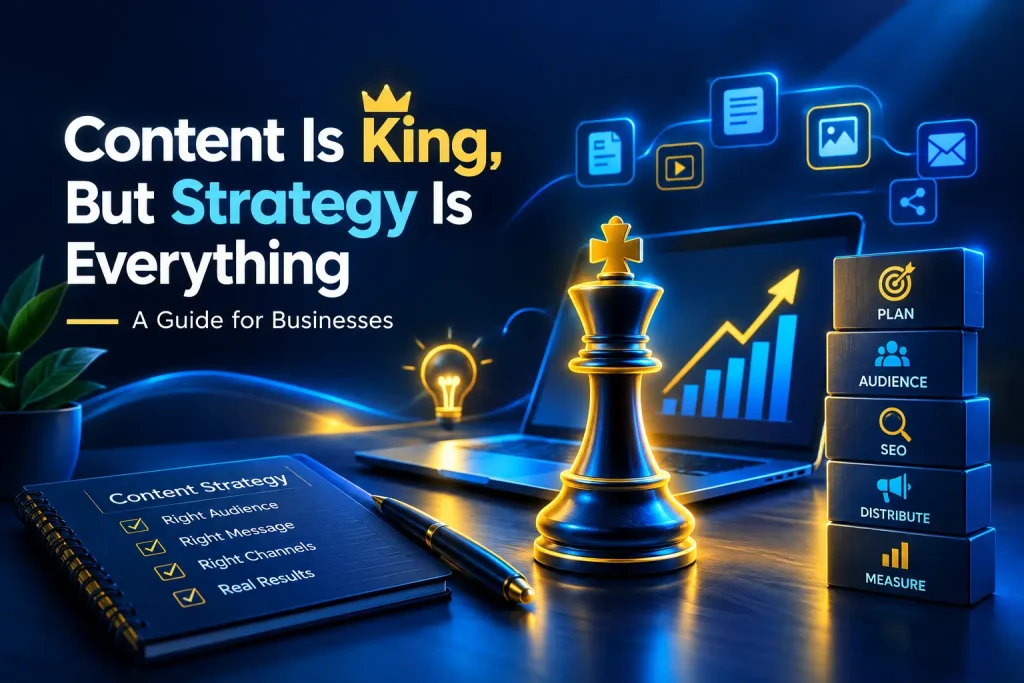
Content strategy with analytics, planning blocks, and digital marketing elements
DIGITAL MARKETING

Content Is King, But Strategy Is Everything: A Guide for Businesses

Content Is King, But Strategy Is Everything Ideas for Businesses In the realm of digital marketing, there is a popular saying that “Content is King.” However, when it comes to content creation for businesses, having great content is not enough. A company can churn out articles for its blog, post on social media, make videos, and send emails without a second thought about what they are doing. Unfortunately, this kind of content creation will most likely fail to reach the desired outcome. Therefore, the following visual could serve as a reminder to businesses about the importance of developing a content marketing strategy: Content is King, but strategy is everything. A good content marketing strategy should focus on the content’s purpose, audience, research, and business goals. In other words, a company should invest in content that serves a specific goal, appeals to the target audience, has done the necessary research, and has measured results. Therefore, when companies think about what they want to post, who they want to reach, and what action they want the audience to take, they have a solid base for creating a content marketing strategy. The next section will provide more ideas about creating a successful content marketing strategy. Why Content Is Not Enough  Nowadays, anyone can create content. Whether it is blog posts or social media, video or infographic, email or something else, creating content is no big deal. The problem is that different platforms attract different audiences, and it is not always clear what and how to post to engage with the public. For instance, if a software company writes ten blog posts per month about various issues related to the whole tech industry, not about the company’s niche, it does not mean that these articles are useless. However, if they do not raise any concerns relevant to the company’s potential customers and do not address their problems, then this content marketing campaign will not be very successful. Instead, a company should develop a content strategy that would define its target audience, their problems, what keywords they search, their place in the buyer’s journey, the content type that would appeal to them, what goal it should fulfill,  how to measure the performance. Otherwise, a company would simply waste resources on creating content for nobody. What Content Strategy Means for Businesses In general, a content strategy is a plan of creation and promotion of content items in order to meet certain goals. There is always a specific purpose of each created and published piece, and businesses should closely define their target audience and segment it into groups of people with similar concerns.With the help of these segments, companies can come up with topics and formats that would appeal to their clients the most. Moreover, an efficient content strategy should also include SEO optimization and measurement of results.Therefore, businesses should define their goals, research their audience, create customer personas, write down topics and keywords, choose the content types, establish a publishing schedule, distribute posts, optimize content, and measure results. Start With Clear Business Goals Before writing post, you should define your goals.Depending on your business needs, you may have several goals that your content has to meet. For instance, your blog’s content may have to build brand awareness, bring leads, boost sales, or establish your authority. Let’s take a closer look at each of these goals. Increase Brand Awareness The blogs and social media posts about your products, services, and industry news and events can help you build brand recognition and awareness. Lead Generation You can use lead magnets, landing pages, webinars, case studies, and how-to articles and guides about your industry to get more qualified leads. Drive Sales Product page reviews, product comparison articles, customer testimonials, case studies, and in-depth service reviews can help you increase sales. Establish Authority High-quality content marketing, blog posts, whitepapers, research studies, and expert guides and reviews can position you as an expert in the field. Understand Your Target Audience Before rushing to generate content, make sure to get to know your target audience.Identify what questions they may have, concerns, purchasing habits, and preferences. Focus on the problems they need to be solved, objections they may have when making a purchase, and what platforms they like to consume content on, and what media types interest them.A B2B audience may favor whitepapers, compared to a more consumer-oriented audience that may be attracted to video content. Audience research allows you to shift from generalities about your customers to specifics: the actual people who serve your content will matter greatly to the shape of your copy.  Develop Content Around the Customer Journey One of the main concepts behind content marketing strategy involves the idea that your potential customers are looking for something specific.It’s important to recognize that customers will need different information at different stages of their journey. The usual customer journey breakdown is as follows: 1. Awareness2. Consideration3. Decision4. Retention At the beginning of the journey (the awareness stage), customers may come to your website searching for general information about a particular condition, niche, or product.Types of materials that are helpful at this stage include: • Educational blog posts• How-to guides• Social media• Educational videos• InfographicsAt the consideration stage, prospects will be looking for solutions to the problems they have identified.Applicable materials at this stage may include:• Comparison articles• Blog posts• Case studies• Webinars• In-depth guidesAt the decision stage, the customer is preparing to finalize the purchase and will be looking for testimonials, pricing information, product descriptions, and specifics about how they should make the purchase.Materials at the decision stage:• Testimonials• Reviews• Demos• Pricing guides• FAQsAt the retention stage, the customer is interacting with your company as a post-purchase partner, looking for ways to gain more value through the application of your product or service, or after-sales support.Materials at the retention stage: • Email newsletters• Tutorials• Knowledge base• Product announcements• Educational content Focus on SEO Content Strategy. No matter how good your content is, it will not serve its purpose if none of

AI-powered social media marketing featuring a smartphone, social media icons, analytics charts, and glowing AI technology on a dark blue neon background.
SOCIAL MEDIA MARKETING

Best Ways to Use AI for Social Media Marketing

Best Ways to Use AI for Social Media Marketing  Social media marketing has become increasingly competitive, which means businesses must find innovative ways to engage with their audiences. They need to produce appealing content, quickly respond to customers’ inquiries, understand audience psychology, and be consistently present on various digital platforms.That is why the best way to use AI for social media marketing is by relying on its capacity to perform routine operations, come up with new ideas, analyze data, personalize the customer experience, and accelerate the decision-making process. Artificial intelligence is not a replacement for marketing professionals. It is, rather, a tool that can help them become more productive and efficient. From generating social media posts to analyzing statistics, there are multiple ways in which businesses can use AI for social media marketing in 2026. Let’s take a closer look at the best ways to use AI for social media marketing below. 1. Generate Social Media Content Ideas One of the leading challenges in social media marketing is thinking of fresh ideas for content. With the right prompts, AI can generate ideas for topics, audiences, industries, and even past content performances. For example, you can use AI to come up with social media ideas like: • Instagram post ideas • Facebook content topics • LinkedIn posts • Short video content ideas • Reels and Shorts topics • Poll and questions ideas • Educational carousel topics • Seasonal campaign ideas Instead of spending hours brainstorming social media content ideas, marketers can use AI to generate a list of topic ideas for their brand. How to Use AI It’s important to give the AI system information about the target audience, industry, voice, and marketing goals to help it come up with relevant content ideas. 2. Create Social Media Captions Faster Creating social media captions can be very time-consuming, especially if you have multiple posts to publish weekly or even daily. With AI, you can generate multiple caption options for a specific topic, image, product, or campaign. For example, businesses with a new service can use AI to generate short Instagram captions, professional LinkedIn posts, promotional Facebook copy content, hooks, calls to action, and hashtags. However, note that AI content should not be used verbatim. It’s important to go through the suggestions, edit, and tweak them to fit a brand’s voice. 3. Use AI for Social Media Content Personalization Not all leads and customers are the same. In fact, they have varying preferences, concerns, questions, and buying stages. With access to consumer data, AI can help marketers personalize social media content for different audiences. For example, businesses can use social media personalization to target: • New followers – Educational and informative content • Engaged followers – Product-focused content • Potential customers – Offers, testimonials, and reviews • Existing customers – Loyalty-based content This way, businesses can improve the relevance of their content to different audience segments. 4. Automate Social Media Tasks There are various recurring tasks in social media marketing, including scheduling, content categorization, organization, analytics tracking, etc. AI can help social media marketers automate repetitive tasks to save time and effort. For example, you can use AI for: • Scheduling social media content • Categorizing social media content • Creating multiple variations of a post • Tracking brand mentions • Reporting campaign performance • Detecting patterns in engagement This way, marketers can focus on more important areas instead of getting stuck in routine, time-wasting activities. AI Automation Should Support, Not Replace, Human Interaction While automation can dramatically speed up tasks, it should not replace human interaction. In other words, make sure to automate the mundane while keeping human qualities at the forefront. 5. Improve Social Media Customer Service Fast and efficient customer support is one of the main reasons why customers keep coming back to a brand. AI can help businesses with social media customer support by providing 24/7 customer care assistance. For example, businesses can use AI to help customers with: • Business hours • Product-specific questions • Pricing inquiries • Shipping details • Service availability • Order tracking It’s important to note that AI chatbots are great for simple and commonly-asked questions. More complex issues should be forwarded to a human representative. 6. Analyze Social Media Performance Perhaps the most important use of AI in social media marketing is analyzing performance. There’s so much data in social media, including likes, comments, shares, saves, clicks, views, followers, DMS, conversions, and more. AI can help businesses analyze this data to discover patterns and trends useful in future marketing campaigns. For example, AI can help answer questions like: • What content engagements the most? • What topics get the most clicks? • What times of the day are the best for posting? • What campaigns gets the best response from the audience? 7. Use AI for Social Listening Social listening is the art of analyzing conversations about a brand, product, service, competitor, or industry in social media. Thanks to its incredible language-modeling capabilities, AI can help marketers find mentions of their brand and sort through conversations in search of themes or common sentiments. For example, marketers can use AI social listening to identify: • What customers are saying about the brand • What topics customers are interested in • Industry-related trends • Common customer complaints • What competitors are saying • What trends are emerging Once again, AI can help by identifying patterns in mentions and themes. For example, if many users are complaining about the same issue, it’s a good indication that something needs to change. 8. Create Better Visual Content Social media is a visual space, meaning businesses need to put more effort into creating images, videos, and other visual content. AI can help with social media graphics, video creation, image-making, and more. For example, AI can help create: • Social media graphics • Video content • Image variations • Backgrounds • Ads • Visual content layout • Short video ideas In essence, AI can dramatically reduce the amount of

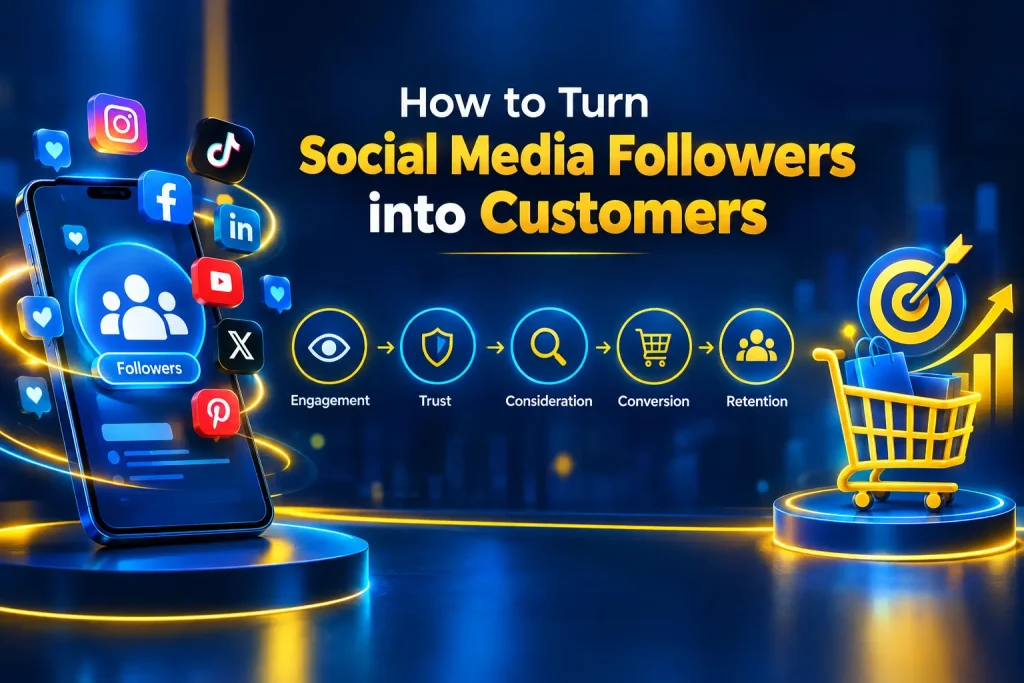
Social media followers turning into customers through engagement, trust, consideration, conversion, and retention, shown in a glowing blue and gold digital marketing design.
SOCIAL MEDIA MARKETING

How to Turn Social Media Followers into Customers

How to Turn Your Social Media Followers into Customers  Having thousands of social media followers can be very exciting, even if they do not bring you any income. But what if they could? What if someone could take your social media followers and turn them into customers? Social media is an essential tool for virtually any business, whether one only has a small online presence or one is a well-established company with hundreds of employees. This tool, when used correctly, can provide the business with a steady stream of customers. However, it requires proper usage to turn social media impressions into actual sales. This blog will provide you with useful tips that will help you get more customers from your social media. In addition, it will teach you how to turn those followers into a social media funnel. Why Do Your Social Media Followers Not Want to Buy From You? A social media follower is a person who follows your social media account. In almost every case, a person who follows you will not be a paying customer right away. A follower could be your friend, family member, or someone who enjoys reading about a particular topic. To turn followers into customers, you need to get them through the buying cycle: AWARENESS → ENGAGEMENT → TRUST → CONSIDERATION → CONVERSION → RETENTION Therefore, your social media activities should not only be focused on getting more followers. 1. Get to Know Your Social Media Audience First of all, understand who your social media followers are. You may track certain metrics such as age, geography, interests, and other audience demographics available on the platform. You may also identify problems they try to solve, products or services they want to buy, types of content they like to consume on social media, and what motivates them to shop. By and large, the social media content you are going to create and share should be solving your buyers’ problems, not necessarily be focused on selling something. Your social media activity should serve more as your digital calling, attracting people who have genuine interest in what you are doing. It makes sense to outline major personas your business is targeting on social media, such as Start Up Owner (who wants to spend less money on marketing) and Small Business Owner (who wants to be able to market more efficiently). Once you understand who you are marketing to, you have better chances to market effectively. 2. Show Value Before Making Any Sales pitch People are not going to shop from you if you spam your social accounts with sales pitches. Instead, prove to buyers that you can help them solve a particular problem. You may do that by publishing valuable content that addresses common questions and concerns. Your social posts may also feature how-to’s, various tips, stories and testimonials from your other customers, video reviews, how your business was created, helpful hints and many other types of content. If you are a digital marketing agency, you are unlikely to post ‘Buy Our SEO Service’. Instead, you may publish content on Search Engine Optimization and its benefits and position your business is a go-to resource for those who want better organic traffic. 3. Add Strong Call-to-Actions To Your Posts A strong call-to-action (CTA) is one of the easiest ways to convert your social media audience. One of the biggest mistakes social media marketers make is forgetting to include a CTA. With a solid call-to-action in your text posts, stories and other social media content, you can get your target buyers to take action and move them through the buying cycle. Your CTA may depend on your content and your stage of the buying cycle. For instance, your CTA may invite people to: Visit your website Contact you Download a guide Book a consultation Subscribe to your email list Inquire for a quote Shop online Try a product for free. Your CTA should be specific and clear. If possible, avoid such unclear CTAs as ‘Learn More’, and instead, use CTAs such as ‘Book a Free Social Media Marketing Consultation’. 4. Create Content That Encourages Two-way Communication Although likes and comments are good, they do not necessarily mean that people are going to shop from you. Therefore, encourage social media users to communicate with you and your brand in an effort to build meaningful relationships and qualify buyers. When you get comments to your posts and messages via DM or Messenger, engage those who express some interest in your offerings. Instead of replying to website inquiry sample messages such as ‘What do you charge per hour?’, ask qualifying questions such as ‘What is it that you are trying to accomplish?’. That way, an engaged prospect will let you know if they actually intend to buy something soon, as opposed to a person who only likes and comments on the posts but does not get in touch. As always, it is important to respond to comments and messages in a timely fashion. If you always reply to inquiries, chances are prospects will also have time to respond. 5. Use Social Proof to Reduce Customer’s Buying Anxiety Some people are simply not going to spend any money unless they know that there are others who have benefited from working with you. That is why a lot of brands leverage on social proof. Social proof refers to the information and numbers demonstrating that you are a reliable company. For example, you can share customer testimonials, reviews and ratings, case studies, and others. It is important to make sure that social proof reflects authentic buyers’ experiences. After providing the first couple services, you may, for instance, post a testimonial from a happy client who appreciates your work. 6. Entice Your Follows With Special Offers As a marketer, it is a good idea to provide social media-exclusive special offers to your followers. Those could be any of the following: Time-sensitive pricing Exclusive buying options Bundles Free trial of a particular subscription plan A free

Scroll to Top