Author name: Vinisha Rajpal@

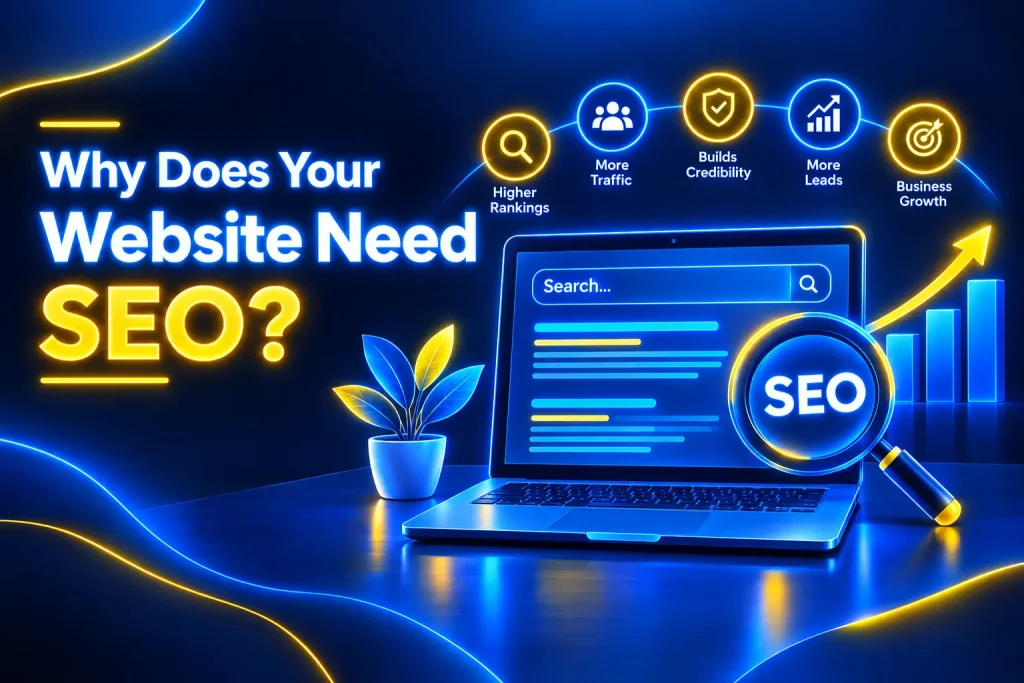
Why Does Your Website Need SEO? — SEO benefits including higher rankings, more traffic, credibility, leads, and business growth shown with a laptop, SEO search icon, and growth chart.
SEO

Why Does Your Website Need SEO?

Why Does Your Website Need SEO? Having a website is no longer sufficient for having a good online presence. A huge number of sites can be found on the Internet, meaning your site can get lost in the crowd. To make your site stand out from the rest, it is required to make it show up in the search results when someone is looking for something that your site offers. But why SEO is so important for our website? SEO helps search engines to find and index your site so that your site appears in their results whenever somebody is searching for something that your business provides. SEO is essential for any site that wants to get more traffic, visitors, and clients and secure a spot on the first pages of Google and other search engines.Local, E-commerce, Services, Startups, Professionals, or Blogs — all types of websites benefit from SEO.SEO is critical for your website to grow exponentially and become visible to your target audience. In this article, we will look at why SEO is vital for a website, its importance, and benefits. What Is SEO? In short, search engine optimization (SEO) is the set of measures that can be taken to improve the visibility of a website in organic search results (i.e., those that appear naturally in the search results without paid promotion). This includes a number of subtasks, such as conducting keyword research, on-page SEO, technical SEO, optimizing content, working with internal links, mobile optimization, improving server response speed, building backlinks, local SEO. For example, if a digital marketing agency offers digital marketing services for small businesses, SEO will help rank higher in the search results for the query “digital marketing services for small businesses.” Note that SEO is not just about putting keywords on a page. SEO practice has evolved and now emphasizes the creation of quality content, improving the user experience, and making the website understandable to search engines. Why does Your Website Need SEO? SEO allows you to compete for visibility in organic search results. These are the key reasons why the practice is beneficial for your website. 1. SEO Enhances Website Visibility The primary benefit of SEO is the increased visibility in search results. By ranking well in organic search results for relevant queries, a company can reach more customers. Without SEO, even high-end websites go unnoticed since they lack exposure to the relevant audiences. For instance, a company specializing in custom furniture requires optimization to ensure that its web data appears before clients searching for such products. The given business would benefit from SEO by targeting queries such as custom furniture, customized wooden furniture, custom furniture near me, handmade furniture 2. SEO Attracts Organic Traffic The next benefit is related to enhanced website traffic. Organic traffic usually brings more customers but does not require the company to invest heavily in payments per click. The more views a website gets, the more prospects it can attract and convert. A company can benefit tremendously from SEO if it can target the right keywords and consistently stay in the first positions in search results. For instance, a business targeting a relevant keyword for digital marketing services will attract clients searching for such services. 3. SEO Targets the Relevant Audiences SEO allows the company to reach out to the right customers searching for the given business’s services or products. A company can identify the keywords related to its field by analyzing the audience’s search behavior. Next, the firm integrates the targeted keywords into its website to ensure that the right clients can find it. SEO professionals usually arrange the information according to the buyer’s journey, which has five stages:            Awareness → Interest → Consideration → Conversion → Retention For instance, a digital marketing services provider may integrate the following keywords for each stage: Awareness: “what is digital marketing,” Interest: “benefits of digital marketing for a business,” Consideration: “how to pick a digital marketing company,” Conversion: “digital marketing services,” Retention: digital marketing tactics and tips. The above example demonstrates that SEO helps the company provide prospective clients with the information required at different stages. 4. SEO Enhances Website Credibility and Trustworthiness Customers tend to perceive a company with a higher search result position as more reliable. While such an assumption is incorrect, the enhanced visibility and the provision of relevant information enhance the firm’s reputation and credibility. Besides, SEO requires that the company’s website has helpful and reliable information as well as a variety of helpful tools such as customer-friendly navigation, secure connections, updated information, fast loading, responsiveness, references, contacts. A company with a credible and reliable website attracts more customers since such an organization appears trustworthy. 5. SEO Improves Website’s User Experience (UX) SEO and improved user experience go hand in hand. For instance, the SEO practices require website owners to make their sites easy to navigate and access as the higher traffic volume will affect the visitors’ experience. The optimization practices enhance the website’s speed and responsiveness in terms of mobile devices, connections, menus, internal linking, structure, scannability, and images. The improved website allows visitors to gain a positive experience and easily access the desired information. 6. SEO Increases Leads and Conversions While more traffic is beneficial, website owners should also focus on enhancing the conversion rates. SEO increases the chances of a visitor converting into a lead or a client. For instance, the firm’s services page targeting a commercial keyword would attract clients searching for the given services. Thus, the company can provide the target audience with the exact services they need, which also enhances its conversion rate. The combination of SEO best practices and higher conversion rates can result in more leads and sales for the firm. A company owner needs to keep in mind that an optimized landing page is not enough. The given page should also feature a call-to-action to encourage the visitor to take specific steps. 7. SEO Lets the Firm Compete With Similar Businesses
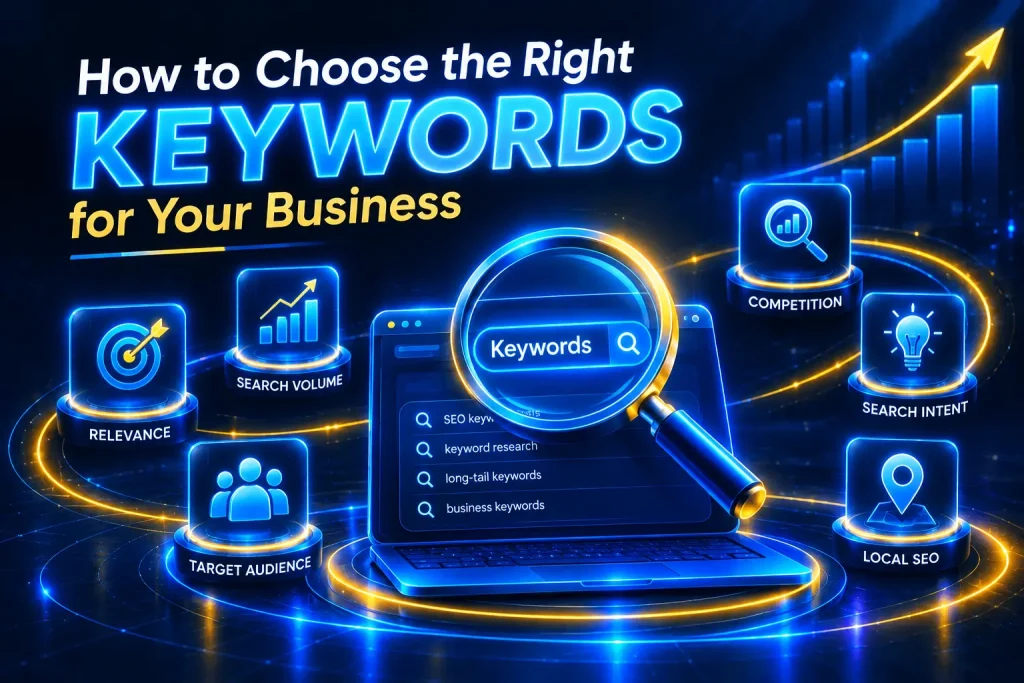
How to choose the right keywords for your business, featuring keyword research, search volume, competition, search intent, target audience, relevance, and local SEO.
SEO

How to Choose the Right Keywords for Your Business

How to Choose the Right Keywords for Your Business If you want to attract the right customers by using search engines, then the choice of keywords is one of the most important aspects of your SEO. Keywords are a bridge between search engines and customers searching for products, services, and information.That said, keyword research is a skillful task since one should be able to pick keywords which reflect the strongest intent to buy and match the customer’s search pattern. A good keyword list will contain relevant keywords matching the customers’ intents and are moderately competitive keywords. After all, it doesn’t matter how much traffic a keyword brings if this keyword has nothing to do with the services or goods that one provides.A company, a local business, an online store, a service provider, or a B2B business – in any case, keyword research will help you attract more customers on your website. In this guide, we’ll show you how to choose the right keywords and use them to boost your SEO. What Are Keywords in SEO? Keywords are words or phrases that users type into search engines to find information, products, services, or solutions.For example, if a company offers digital marketing services, their potential customers may search for: digital marketing agency SEO services for small businesses social media marketing agency affordable SEO services digital marketing agency near me Any of these search terms may be used as keywords. The most important thing is that they should be relevant to your business, i.e., match the user’s request and your service or product offerings. Why Choosing the Right Keywords Matters for Your Business Choosing the right keywords plays an essential role in any SEO campaign. It is critical to optimize the contents for relevant keywords to avoid wasting time and effort on low-quality and highly competitive terms. The importance of choosing the right keywords for a business includes: 1. Ability to target the right audience Using the right keywords assists in targeting the right audience. In other words, keywords define what the business is about; therefore, it is possible to draw the most relevant traffic by optimizing the contents around the words that the target audience may search. For instance, If the business provides website development services to small businesses, it makes more sense to optimize the contents around “website development for small businesses” rather than simply “website.” 2. Attract more relevant traffic to the website Traffic is vital, but it does not mean much if it is irrelevant to the business. It is essential to attract more relevant traffic to a website because it helps convert more visitors into clients. In this case, relevant keywords enable the business to get more traffic that is likely to become customers. 3. Make the website more visible to search engines The search engines’ algorithms work in such a way that they read the contents of the webpage to understand what it is about. As such, it becomes possible to make the website more visible to search engines by choosing the right keywords. 4. Help come up with content ideas It is always challenging to think of what to write about, especially for blog posts, services description, and landing pages. However, finding keywords will help come up with ideas for blog posts or static pages such as FAQs and guides to address the needs and concerns of the target audience. How to Choose the Right Keywords for Your Business Looking for the best keywords in your niche is not as simple as typing in a random search term and hitting the enter key. There are multiple things to consider while selecting keywords for SEO purposes. Let’s see how you can choose the best keywords for your business. 1. Determine your business / audience Before doing anything, have a clear picture of your business and the audience you are trying to reach/interest in your business. You can ask these questions to yourself: What do we offer? Who is our customer base? What problems are our customers facing? What questions do our customers have? What search terms would our customers use to search for us? Which locations do we cater to? For example, if we run a local dental clinic, the keywords that we could target are dentist in [city], dental clinic nearby, teeth cleaning services, etc. Having a clear idea of who our customers are and what do we offer makes our job much easier. 2. Brainstorm seed keywords list Seed keywords are general keywords that would act as a base for your keyword list. For example, if you run a digital marketing agency, your seed keywords could be: digital marketing SEO services social media marketing content marketing PPC advertising if you run an online clothing store, your seed keywords could be: women’s clothing summer dresses casual dresses women’s tops ethnic wear 3. Use keyword research tools Various online tools help you find keywords and provide you with information like search volume, related keywords, keyword difficulty, etc. Some tools are Google Keyword Planner, Google Search Console, Ahrefs, Semrush, Moz keyword explorer, Ubersuggest, etc.It’s a good practice to compare the keyword suggestions from multiple tools and shortlist keywords that are beneficial for your business. While analyzing the keywords make sure you keep in mind things like keyword volume, competition, relevance, search intent, and business value. 4. Understand search intent Search intent is the reason why a user is searching for a specific query. Understanding the search intent is crucial because two very similar search queries may have different search intents behind them. There are four types of search intent: Informational Navigational Commercial investigation Transactional Let’s take an example to better understand the four types of search intent. Suppose a user is searching for the following queries: how does SEO work how to choose keywords how to do keyword research All of the queries have the same search intent, that is, informational intent. This type of search intent is when a person is looking to find information about

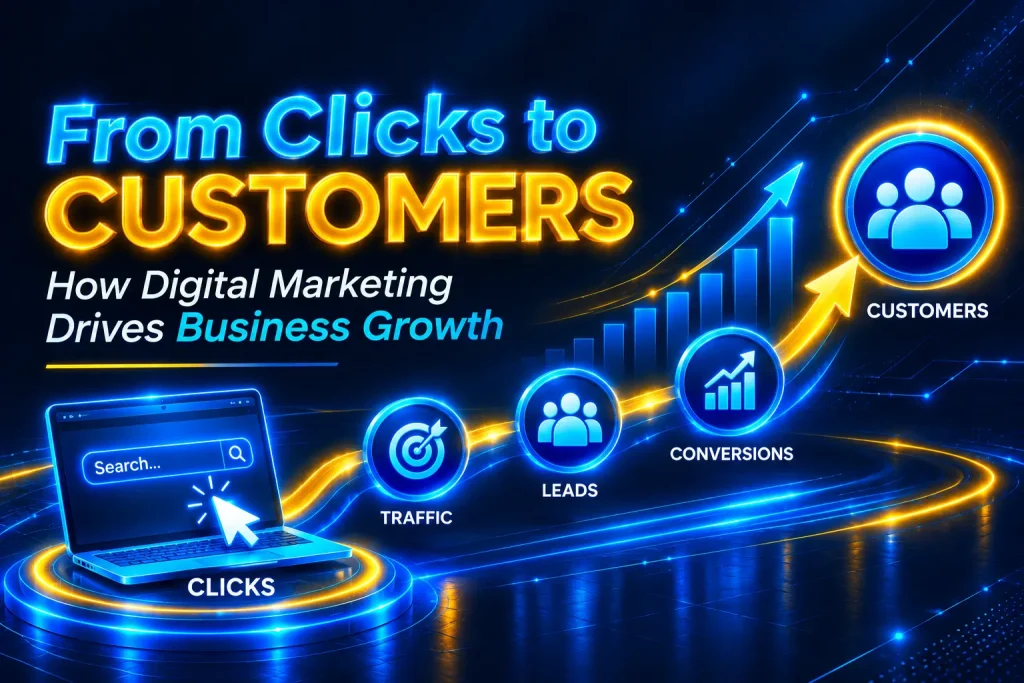
From Clicks to Customers – digital marketing driving business growth through traffic, leads, conversions, and customer acquisition.
DIGITAL MARKETING

From Clicks to Customers: How Digital Marketing Drives Business Growth

From Clicks to Customers: How Digital Marketing Drives Business Growth In the modern era of technology-based business interactions, companies must do more than offer good services or products. Their representatives should be able to reach the target audience and effectively communicate their selling points to get more clients. Digital marketing helps to accomplish this goal and enhances a company’s reputation, attracts new customers, and increases sales.Thanks to marketing services, businesses get many different ways to promote their products. From social media and search engines to email marketing, online advertising makes the company known across the globe. Moreover, they can get high-quality traffic to their site, engage visitors, and convert them into customers. Thus, a company can benefit from digital marketing greatly. Any small business, startup, online shop, or an established enterprise with vast experience can use it to get new clients and promote their goods and services. Now, let’s see what advantages digital marketing brings to businesses and how they can help companies get more customers. What Is Digital Marketing? Digital marketing definition entails the use of online media to promote goods and services. It is different from traditional marketing since it enables the marketer to identify a niche audience and interact with them through electronic channels. SEO, social media, email, and other online strategies are all part of digital marketing.  Here are some common digital marketing tactics: Search engine optimization Social media marketing Content marketing PPC advertising Email marketing Influencer marketing Affiliate marketing Conversion rate optimization While boosting web traffic is just one component of a digital marketer’s job, driving high-quality visitors to a landing page and persuading them to purchase is what determines a successful digital marketing campaign. How Digital Marketing Drives Business Growth How Digital Marketing Drives Business Growth 1. Increasing the Visibility of the Brand The process of any marketing starts with the fact that a person needs to become aware of the existence of a particular business.Search engine optimization, social networks, content marketing, and advertising can help a company appear in front of the person who is looking for exactly the services that the company provides. For instance, in the case of a sports equipment company, one can create content marketing, optimize it for search engines, and thereby appear in front of those who search for keywords such as “home training equipment,” which leads to brand awareness.Moreover, increasing the visibility of the brand means that there will be more people who can potentially become a customer. 2. Target Audience Reach Furthermore, the possibility of digital marketing to increase audience reach implies that the company can also target specific groups of people.Demographics, location, interests, and many other characteristics can be taken into consideration for finding the target audience. By using digital marketing, companies can specifically choose the audience to which they want to target their promotion and thereby waste less money on advertising.Besides, by attracting the attention of people who are interested in what a company sells, the company will have more potential customers. 3. Lead Generation Leads are one of the critical points in any marketing system.Simply put, companies need more visitors to their website to generate more sales.Digital marketing helps with this as it provides a variety of lead generation methods.Those include landing pages as separate pages on the website, modal windows, pop-ups, contacting consultants, getting discounts, newsletter subscription, free samples or trials, and many others.For instance, a company can offer its visitors to get a free trial of its product under certain conditions.In that case, the company can later on contact those people and get them to become a customer. 4. Building Trust and Recognition It is vital that a company builds trust with its potential customers.Often before buying a product or a service people look for reviews or other information about the company.Therefore, digital marketing once again comes in handy as it can help in recognition and trust-building with the target audience.With that being said, creating quality content that would not ignore the needs and the questions of the customers is of paramount importance. A company should regularly post articles, reviews, testimonials, videos, and much more. All of that would build trust as a company would be able to show its potential customers that it can help them in whatever issue they are facing. It is important to note that nowadays content marketing is one of the most effective marketing methods. 5. Converting Visitors to Customers Although generating leads is essential, without converting them to customers, a company will find itself at a deadlock.In other words, it is not enough to attract new visitors; a company should provide them with reasons to choose their brand. Thus, a company has to optimize its website to encourage conversions.Conversion rate optimization includes several methods, such as reducing the bounce rate, improving website design, providing better content, and others.As an example, “Call to Action” buttons can be optimized. A button that says “Get a Free Consultation” will yield better results than a button that says “Learn More.” This particular step will help a company to build a relationship with the customer and provide them with an answer. Key Digital Marketing Strategies for Business Growth Search Engine Optimization SEO SEO could potentially boost the appearance of your company in the organic search results.A good SEO strategy typically contains keyword research, engaging content, technical SEO, internal linking and a website that provides excellent UX. The ultimate aim of SEO is to attract more visitors to the website and increase the number of visitors who are searching for the products or services offered by the company. Social Media Marketing Social media is a powerful tool for community building, word of mouth marketing, and two-way communication with one’s customers. Companies could benefit from both organic social media marketing and paid social media advertising. The key to success in social media marketing lies in figuring out which social media networks one’s target audience is active on, and what content they would like to see. Content Marketing Content marketing is all

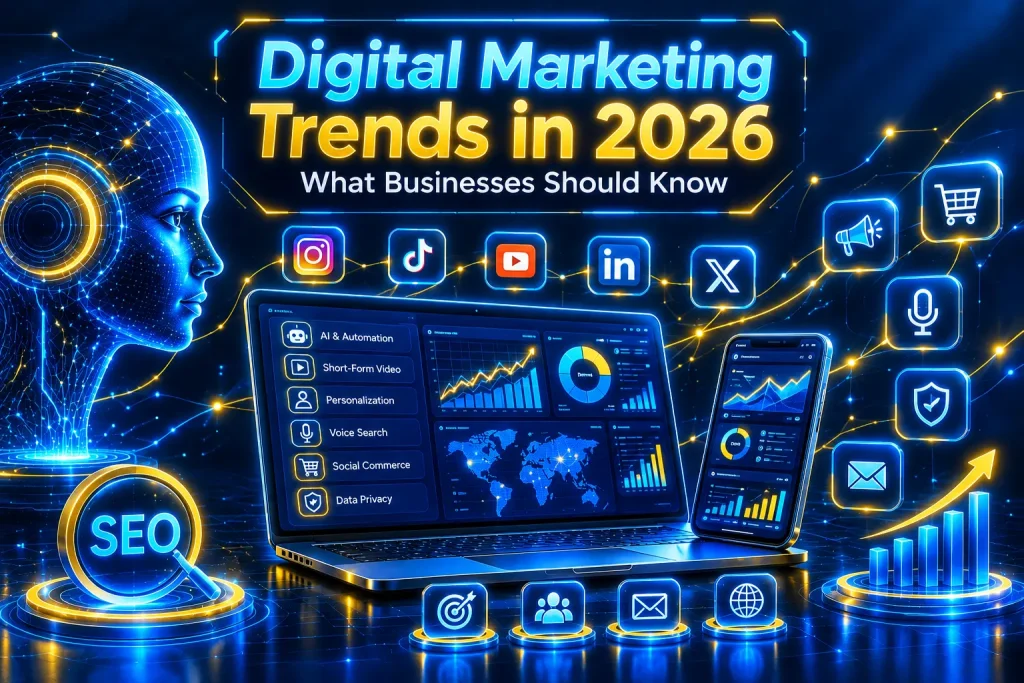
Futuristic digital marketing trends in 2026 with AI, SEO, social media, analytics, laptop dashboard, and business growth icons in a blue and gold neon theme.
DIGITAL MARKETING

Digital Marketing Trends in 2026: What Businesses Should Know

Digital Marketing Trends in 2026: What Businesses Should Know Keeping your business in front of customers on the web doesn’t depend only on doing what you did last year. The ways that customers behave, artificial intelligence, and online search evolve at an astonishing rate. Staying aware of the trends in digital marketing 2026 is a must for any founder, marketer, or small business owner who wants to be able to consistently acquire new customers. Your customers do not engage with the website or social media as they used to. Search engines return synthesized information directly in search results, social networks prioritize real conversation, and privacy rules kill the old practice of buying followers. Customers want to feel safe and served – their expectations of brands are at the highest level. To adapt to the new circumstances, your marketing team does not have to re-invent the wheel. You should rather understand what trends are worth adopting to increase revenue and leave the unworthy ones aside. This article highlights the most significant digital marketing trends 2026 and gives advice on how to harness their potential. ★ The Core Theme of 2026: Technology has made it easy for anyone to produce content, which has made generic marketing ineffective. The winning formula in 2026 combines automated operational efficiency with an undeniable human expertise and audience trust. Why Digital Marketing Trends Matter for Businesses in 2026 Any change in technologies provokes shifts in the ways prospective clients search for and investigate your brand, leading to the necessity of updating your marketing strategy. Such changes as the development of conversational search or the growing importance of social algorithms make obsolete any traditional approaches to promoting a product or service. Paying enough attention to marketing trends for businesses enables you to avoid failures due to inefficient spending on failed advertising campaigns. Besides, the growing consumer awareness of aggressive marketing tactics makes customers skeptical of conventional advertising. In this regard, any organization needs to shape its unique value proposition to identify itself as an expert in a specific sphere recognized by the target audience. Moreover, those who dare to innovate and update their knowledge on a regular basis acquire a competitive advantage. It allows them to reduce their cost per acquisition and build customer loyalty, which other companies find difficult to achieve. Finally, being aware of modern marketing tendencies helps understand how to direct time and resources to achieve better results in promoting the company’s goods or services. It is essential to keep in mind that not all information referring to your business underlines its importance for customers; thus, it must be prioritized depending on the context of the interaction. Top Digital Marketing Trends in 2026  Here are 9 major digital marketing trends that organizations should be aware of this year: 1 AI-Powered Digital Marketing Artificial intelligence and generative AI tools, in particular, have become essential assets to marketing teams in 2026. Marketers are using AI to analyze customer data, develop email copy variations, predict customer churn, and target customer journeys better in digital advertising. However, marketers realized in 2026 that AI should be used as an assistant rather than a primary content creation tool. Companies that posted purely AI-generated content suffered from poor user engagement and search engine rankings. Advanced teams use AI to speed up their research and administrative duties while reserving human workers for creative, fact-checking, and proofreading tasks. 2 Search Is Becoming More AI-Driven Modern search engines are evolving from lists of blue links to AI-driven research assistants that help users find the information they need. With generative AI, searchers can ask for advice on the search window and receive answers on the topic instead of sifting through tens of irrelevant documents. For websites, this trend means that the semantic SEO and topical authority have become even more critical. Instead of creating generic content pieces, webmasters should focus on publishing unique insights, research data, expert opinions, and solutions to specific problems. Search engines prioritize informative and reliable resources that directly address the searcher’s needs and concerns. 3 Short-Form Video and Visual Content Short vertical videos dominate engagement on social media platforms such as Instagram Reels, Facebook, TikTok, and YouTube Shorts. The general public prefers watching a brief tutorial than reading an extended guide. Marketers can capitalize on this trend by distributing various visual content, including short product videos, customer testimonials, employee highlights, and even raw unedited footage. Such video content is easier to produce than many marketers think, and it has a more significant impact than traditional sales-oriented marketing materials. Many companies use video content to respond to frequently asked questions by their viewers. 4 Personalized Marketing and Customer Experience Modern customers have grown tired of one-size-fits-all marketing communications. Using the same marketing email for all clients may lead to poor engagement and unsubscribes. Marketers can employ personalization techniques to recommend products and offer relevant content to individual clients better. At the same time, personalization practices should respect the privacy of the clients. Wherever possible, always seek permission to collect and use personal data. In addition, never use the customer’s data in a way that they did not expect. 5 First-Party Data and Privacy-Focused Marketing As regulatory compliance becomes increasingly important, many traditional marketing strategies, such as installing tracking pixels on the website, become obsolete. Modern customers are concerned about their privacy, and they limit the amount of personal data they share with websites. Marketers should focus on developing first-party data and audience lists rather than using the third-party tracking options. In addition, it is critical to ensure transparency in how the marketer collects, stores, and uses the consumer data. For example, you could build an email list, ask your clients for voluntary assistance in providing feedback, and improve your loyalty program. Having direct access to the consumer is vital when changes to the tracking regulations make it impossible to reach your audience. 6 Social Media Marketing Is Becoming More Community-Focused Many social media platforms are rethinking their policies and have shifted towards

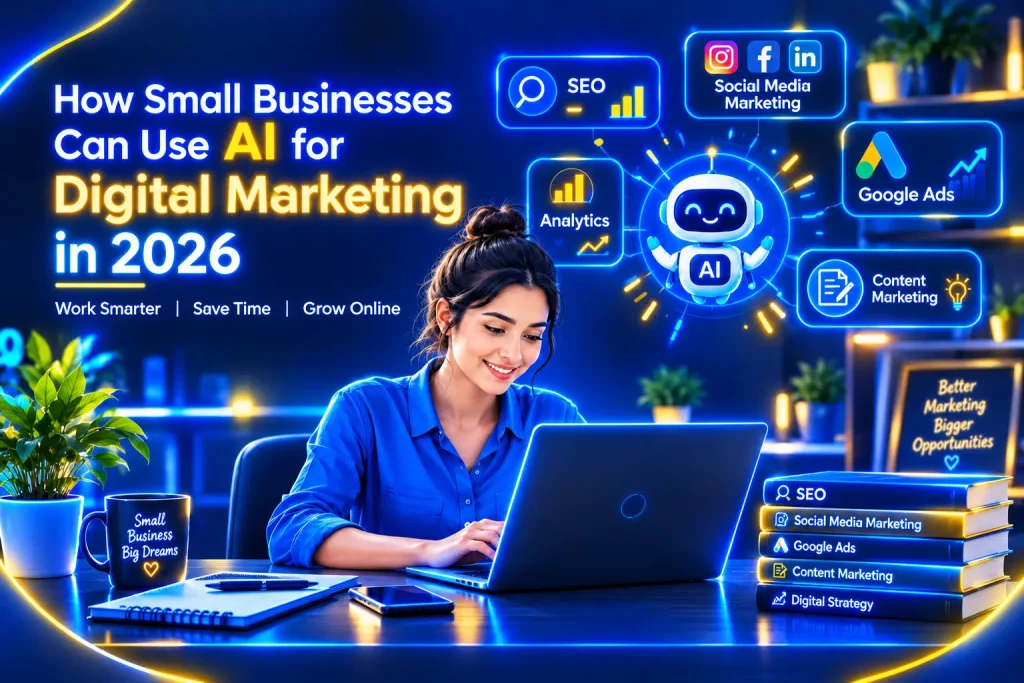
How small businesses can use AI for digital marketing in 2026, featuring AI-powered SEO, social media marketing, analytics, Google Ads, and content marketing.
ARTIFICIAL INTELLIGENCE

How Small Businesses Can Use AI for Digital Marketing in 2026

How Small Businesses Can Use AI for Digital Marketing in 2026 Digital marketing has become a strategic cornerstone in the development of modern business. However, for small companies, optimization of search engine results, social media, content, advertising, and relationships with customers with a limited staff and resources can be overwhelming. In this regard, businesses should consider artificial intelligence solutions that can help to manage multiple tasks and achieve competitive advantages. In 2026, artificial intelligence can transform business by enabling organizations to optimize time, develop ideas, understand the audience, create and manage content, and perform multiple other functions. Nevertheless, it is essential to recognize that AI is not a magic bullet but a tool that makes the work of marketers, managers, and other specialists more efficient and effective. Now, small businesses must consider how they can harness the power of AI for digital marketing to maximize their benefits. What Is AI in Digital Marketing? AI in digital marketing refers to the applications of intelligent software and artificial intelligence tools to perform specific marketing tasks. These programs are capable of analyzing data, understanding language, recognizing patterns, coming up with ideas, and doing various other tasks.One of the examples of using AI in digital marketing is a small business applying AI to generate blog and social media post ideas research keywords come up with social media captions write email texts analyze customer reviews develop various options for ad copy summarize marketing data In other words, one can think of AI as a marketing assistant that can help with a variety of tasks. However, it is essential to remember that one’s own expertise about the company, customers, and brand is still vital and necessary. Why Should Small Businesses Use AI for Digital Marketing? For small business, time and budget are usually limited factors, and one should consider how AI can help to optimize them accordingly. 1. Time-savingAI can automatize lots of routine operations like brainstorming, collecting and structuring information, creating outlines and drafts of any documents and reports. As a result, you will have more time for other essential activities related to your business development. 2. Content creationIt can be challenging sometimes to think of fresh and relevant ideas for content creation. With the help of AI, you can get inspiration and support with generating ideas for blog posts, social media content, emails, and other types of content. 3. Customer’s insightsAI can help to analyze the frequently asked questions, comments, and concerns and come up with solutions or respond to them accordingly. 4. Marketing analysisMarketing strategies require thorough research and consideration of multiple factors. With AI, you can track and analyze more data and have an opportunity to get a bigger perspective. 5. Overcome the resource limitationsSmall businesses often lack experienced specialists and have a smaller budget. However, with the help of AI, one can automatize most of the routine tasks and spend time and effort on more critical issues. How Small Businesses Can Use AI for Digital Marketing in 2026 AI can be useful in almost every part of digital marketing. Here are some practical ways small businesses can use it. 1. Use AI for SEO and Keyword Research SEO is how businesses appear in search results when potential customers search for specific products or services online. AI can help with SEO in various ways, including supporting marketers in: Generating keyword ideas Finding long-tail search queries Understanding search intent Developing content outlines Grouping keywords into topics Identifying customer questions to target Suggesting meta title and description For instance, a local bakery would be able to use an AI to come up with ideas for content targeting searches such as birthday cakes near me, custom cakes for birthdays or the best cakes for special occasions. While the use of AI for SEO seems to be very beneficial, it is important that the work done by it and its recommendations are not taken as an end point. There is still a need to look up, verify and fact-check the keywords, competition, results and relevant data about the business’s offerings using trusted sources and SEO research tools. 2. Use AI for Content Marketing Creating content on a regular basis can be a challenge for a small business. The good news is that an AI can help with that.An AI can generate content ideas for you, such as blog post topics, article outlines, social media captions, email copy, product descriptions, video scripts, FAQs The key is to never publish anything that was created by an AI without first adding your own thoughts, examples, and expertise to it. Otherwise, you’re just creating generic content that won’t be very helpful or appealing to your audience. By adding your own voice and personality to it, you can make your content more engaging and informative – and most importantly, it’ll have your brand’s unique touch. 3. Use AI for Social Media Marketing Maintaining an active social media presence requires consistency. AI can help small businesses plan and create content more efficiently.For example, one blog post can be turned into: An Instagram caption A LinkedIn post A short video idea A carousel outline A few educational tips AI can also help create content calendars and suggest different caption styles. For example, if a salon publishes a blog about hair-care tips, AI can help turn that information into several social media posts. 4. Use AI for Google Ads and Paid Advertising Google Ads can offer businesses a chance to target customers who are currently searching for products or services that the company offers. The use of artificial intelligence can greatly assist in advertising, as it can aid marketers in developing and testing multiple approaches. Such programs as Google Ads can utilize AI in a variety of ways, including generating different options for ad headlines creating multiple versions of an ad’s text suggesting possible keywords analyzing information about the campaign identifying trends enhancing the message of the landing page. However, one should be careful that the advertising process does not become fully automated,

Scroll to Top