Author name: Vinisha Rajpal@

Email Marketing in 2026 with email automation, personalization, ROI, and customer engagement visuals
DIGITAL MARKETING

Email Marketing in 2026: Is It Still Effective?

Email Marketing in 2026: Is it Still Effective With the advent of social media, artificial intelligence, search engines, chatbots, and many other marketing channels, it is reasonable to think, is email marketing still effective in 2026? Short answer: yes, is. But not as you probably think. Email marketing has evolved, not only as a channel to notify and promote to thousands of customers at once, but to personalize, automate, analyze, segment and sell to them, based on behavioral patterns, interests, preferences, and much more. Recent (2026) industry benchmarks show that email marketing can indeed still be effective, with a median return of $36 for every $1 for every dollar spent on them. However, this can vary considerably from industry to industry, and from company to company, depending on the audience, strategy, and metrics used. So, email marketing is not dead, rather, it has evolved into a more sophisticated, personalized, and automated channel to acquire, engage and sell to customers. What Is Email Marketing? Email marketing is a type of digital marketing that involves sending emails to prospects and customers. Companies can use email marketing to do the following: – Drive lead generation– Promote products and services– Deliver educational information– Engage with prospects and customers– Encourage existing buyers to remain loyal– Alert customers to new offers, launches, and promotions– Recover abandoned purchases– Retain customers Unlike social media, which is controlled by an algorithm that only selects what content gets seen by whom, email marketing provides companies a straight channel to those who have given their permission to be marketed to   Is Email Marketing Worth It in 2026? Yes, because blasting the same marketing message to 10,000+ email addresses isn’t going to get the same results it did 10 years agoModern email marketing relies on delivering value to the customer. That doesn’t mean companies should stop blasting acquisition-heavy content to their audiences. But there should be a mix of the following types of sequences: – Acquisition: To drive new sign-ups, these would typically go to your blog or newsletter.– Education: Sending helpful content to your prospects.– Recommendation: Recommending products or services to past customers.– Recovery: To target those who’ve abandoned their carts.– Monetization: Offers to your most engaged customers.– Re-engagement: To get someone who hasn’t interacted with you in a while to come back. The above sequences would get your audience to feel like they’re being taken care of by your brand rather than getting blasted with ads.Also, as of now, industry benchmarks still report healthy returns on investment (ROI) for email marketing, with many companies reporting a $36-$42 ROI for every $1 spent in 2026. Why Email Marketing Still Works in 2026 1. Email Marketing Lets You Get Into the Hands of the Customers Social media platforms are algorithm-driven, while email marketing is much more direct. When a person subscribes to an email list, they give up a bit of ownership. That is precisely why social media’s algorithm does not show your post to everyone you want. 2. Email Marketing Can Produce an Excellent ROI One of the reasons people invested in email marketing heavily in 2003 is because the ROI was just ridiculous. For a $1 investment, you would get 27 cents. But then it started averaging just over $$36 for every $ A study published by EmailToolTester showed that in 2003, most ROI for ecommerce and consumer products ranged between But wait, that number can be yours per dollar. 3. Email Marketing Automations Save Time Email marketing automation has made the channel so much more effective. The ability to make automated sequences helps to reduce the workload and improve results. All kinds of marketing professionals rely on automation, like automated welcome mail lead nurturing sequences abandoned cart recovery birthday or anniversary emails post-purchase sequences product recommendation emails re-engagement campaigns 4. Personalized emails help sell a lot better than bland ones designed by the CEO Customers do not want to receive unspecific emails. A personal touch in an email campaign is essential if the emailer wants to make a sale. Some simple things can personalize an email, like a name website activity the customer’s location the products he or she has shown an interest in his or her interaction data with the brand’s emails customer lifecycle stage It is crucial that emails are not personalized simply because a name was added to the front of the email. True personalization should make the message applicable to that specific person and his or her intent and stage in the buying cycle.  The trends to watch out for in email marketing in 2026. AI-Augmented Marketing Emails Artificial Intelligence (AI) in email marketing will become a must in 2026. AI can write an email, write a subject line, analyze campaign performance, predict customer behavior, recommend products, personalize content, optimize send dates, and segment lists. But remember that AI-driven campaigns should be strategically designed to maximize an email marketer’s efforts and not replace what a professional marketer brings to the table. Automated Behavioral and Time-Sensitive Emails One of the hottest trends in email marketing in 2026 is using behavioral and time-based triggers to send emails. For example, if a customer browses a website and leaves, an abandoned cart email can be sent. After the customer makes a purchase, a thank you email, product educational email, and cross-sell email might follow. Segmentation Is King There has never been a better time to segment lists and nurture customers. Sending one mass email to a list is not the most effective practice in modern-day marketing. Instead, segment lists and send emails accordingly. For instance, new leads may need nurturing emails. prospects may need product or service-oriented emails. existing customers may find value in looking at some special offers. inactive users may get special re-engagement campaigns. Email Marketing Metrics Businesses Should Track in 2026 Your open rate should never dictate if your business needs to tweak their email campaigns Due to Apple’s Mail Privacy Protection feature; companies need to start placing a bigger emphasis on other engagement and
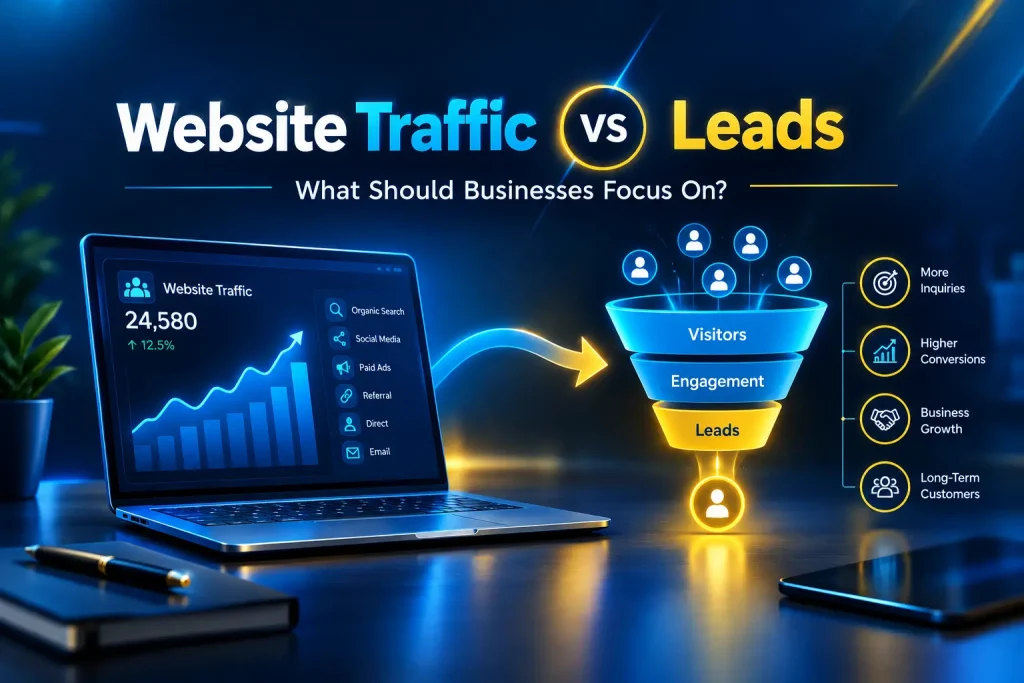
Website traffic converting into leads through a digital marketing funnel.
SEO

Website Traffic vs Leads: What Should Businesses Focus On?

Website Traffic Vs Leads: What Should Businesses Focus On ? For any company that has an online presence, the success is measured in traffic and leads. Website traffic refers to the number of visitors who land on the website, whereas leads denote the number of prospective customers. While traffic is used to measure the reach of the website, leads are a more meaningful metric since it reflects the number of visitors who could be potential customers. However, many companies focus only on the number of website visitors without realizing that they need to concentrate on the leads generated from the website. Leads are crucial to a business’s success as they translate into sales. While the website traffic signifies the scope of the website, leads showcase the potential buyers. A company may have a good number of traffic on its website but if the number of visitors who inquire about buying the products or services is low, the business is not doing well in terms of sales. In contrast, a website that is able to generate enough leads from lesser traffic is capable of translating the visitors into sales. This is essential for any business as sales are the lifeblood of any company and without sales, a company cannot sustain itself in the long run. Therefore, it is essential to have an adequate flow of quality traffic that could be converted into sales. In the following sections, we shall look at the difference between website traffic and leads and understand the importance of both these metrics. What Is Website Traffic? It’s the users who visit your website. These visitors can originate from a variety of different sources, such as: Organic search Social media Paid advertising Referral websites Email marketing Direct access Online communities If you had 10,000 visitors to your website within a month, that means you had 10,000 visitors. Why Website Traffic Matters Unless you have people visiting your website, it makes generating leads and sales very difficult. Having more relevant traffic can allow you to: Boost your brand awareness Drive awareness to any new products or services Create more conversions Drive more sales Lay the groundwork for remarketing Allow you to collect information about your visitors More traffic isn’t always good traffic, however. You could be getting 10,000 visitors a month, but none of them are interested in buying your products or services, which has a significant impact on your bottom line. That’s why it’s important to focus on the quality of traffic, not just the quantity. What Are Leads? A lead is someone or something that will engage with your business and give you an opportunity to sell your products or services. Depending on the type of business you have, a lead might: Fill out your contact form Ask for a quote Book a consultation Subscribe to your email list Download an ebook Attend a webinar Book a demo Call your business Request an inquiry Why Leads Matter Leads directly represent someone who wants to buy from you. A person visiting your website page on the other hand, isn’t likely to provide you with a sale unless you convert them into a lead. Leads gives you a warm start to selling your products or services, and it’s much easier to do so than if you had found a random visitor to the website. Website Traffic vs Leads – The Key Differences  Leads are visitors taking some sort of action at your website It’s the difference between traffic and leads – one measures reach, and the other measures engagement. If we look at two example businesses: Business A Traffic: 50,000 visitors per month Leads: 300 visitors per month Business B Traffic: 8,000 visitors per month Leads: 500 visitors per month Even though Business A has a significantly higher amount of traffic, Business B is doing a considerably better job at generating sales-oriented leads that will actually assist them in generating more revenue. Traffic Measures Reach – Leads Measures Engagement These two important metrics can help you answer a variety of questions about your website, such as: Traffic questions: Are people seeing your website? Where are people finding your website What pages are people engaging with the most? Does your SEO strategy appear to be working? Leads questions: Did they express interest in your offer? What pages are driving the most leads? What are your best channels for generating leads? Is your call to action effective? Why Businesses Need Traffic And Leads There is no need to oppose traffic and leads to each other. Both are part of the same system: Traffic > Engagement > Conversion > Lead > Customer Traffic drives website visitors to engage with the brand. It is the content and website experience that influence a visitor’s decision to become a customer. Calls-to-action and optimized content help to move from engagement to conversion Without traffic, there will be no leads. Without conversion, there will be no customer. Traffic Without Leads Is Simply A Waste Suppose a company invests significantly in SEO and begins to get 20 thousand visitors per month. However, apart from a few inquiries, the business does not see any results. What problem does the company face? The issue may be in the following areas: Target audience Landing pages CTAs Website copy Experience Offer Audience intent The above factors affect traffic conversion into leads. The problem may not be in the lack of visitors but in the inability of the website to convince a visitor to become a lead. Leads Without Enough Traffic Are A Dead End On the contrary, leads without traffic are also not useful. For example, the website receives 500 visitors per month, and all of them become customers. Suppose the company has a good conversion rate, but the number of prospects is still small. In this case, the problem is in the low number of visitors, not in the conversion rate. The company needs to find ways to attract more visitors to the website. Which Is More Important For A

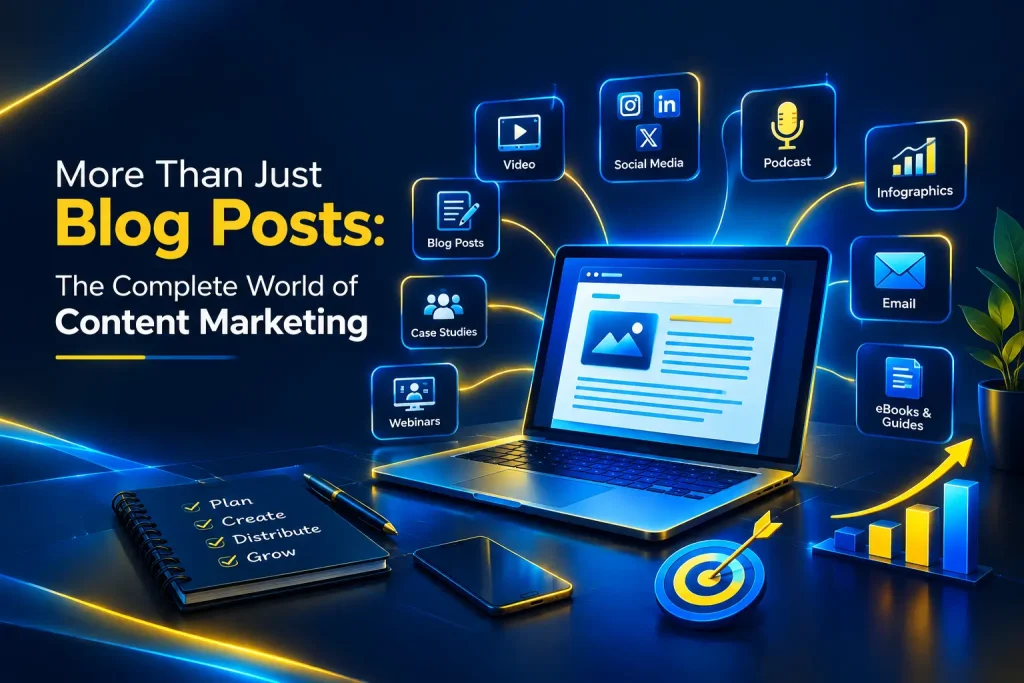
Content marketing strategy featuring blog posts, videos, social media, podcasts, email, eBooks, and growth analytics.
DIGITAL MARKETING

More Than Just Blog Posts: The Complete World of Content Marketing

More Than Just Blog Posts: The Complete World of Content Marketing Although many people still associate content marketing with blog posts, this type of marketing comprises many more elements. Of course, maintaining a blog and publishing articles there is an essential strategy for any company that wants to promote its products or services successfully. However, in addition to blogs, companies also use social media, video content, podcasts, infographics, email marketing, case studies, ebooks, webinars, interactive media, and much more. Therefore, it is especially important for entrepreneurs to understand what all content marketing entails to build the most effective strategy for their business. All these types of content marketing help companies reach their target audience and properly position their brand. At the same time, for different companies, different marketing tools are relevant at different stages of the customer journey. What Is Content Marketing? Content marketing is a type of digital marketing that focuses on attracting and retaining a target audience by providing informative content, developing it, and distributing it consistently. In other words, instead of focusing on promoting a product or service, content marketing creates useful content that educates, advises, informs, or entertains consumers. For example, a digital marketing agency can create content marketing assets, such as SEO guides, social media posts, marketing videos, reports, email marketing content, customer studies, checklists. Through constant creation and sharing, the business can also build itself as an authority in the field and drive traffic to its website to complement its marketing and sales strategy. Why Content Marketing Matters for Businesses Content marketing can be leveraged at different stages of the customer journey. It can raise brand awareness, build trust, and even drive sales. It Can Raise Brand Awareness Informative content can be utilized to educate prospective clients and improve brand image.The marketing assets can also be optimized to increase organic reach and appear in search results, thus, driving traffic and creating brand awareness. Content marketing enables businesses to increase their discoverability and reach new customers. With the help of SEO-friendly blog posts, videos, social media content, and images, businesses can be found by more prospective clients. It Can Help Build Trust Consumers tend to trust companies that offer valuable content regarding their niche or industry. Reports, guides, how-to articles, whitepapers, and case studies introduce businesses as reliable and informative sources in their space. It Can Complement SEO Strategy SEO and content marketing usually work together. Creating blog posts and videos with SEO in mind will improve a website’s ranking on search engines. Moreover, through keyword research, the content published on the business’s website will also aim to answer the questions of prospective clients searching online. While SEO content marketing is essential for improving the visibility of a business online, marketers should avoid keyword stuffing. Instead, they should focus on providing informative, helpful, and high-quality content that will fulfill users’ intent. It Can Generate and Nurture Leads Content created by businesses can persuade website visitors to become leads. For instance, a helpful article can entice readers to download an informative guide. In turn, they may subscribe to the company’s newsletter and be nurtured to a lead and eventually a paying customer. Therefore, content marketing can generate leads and help move them through the sales funnel by providing informative content instead of hard-selling. The Complete World of Content Marketing A successful content marketing strategy makes use of various content types, as opposed to relying on a single source, such as blog posts. Blog Posts & Articles Blogging is the most popular and versatile kind of content marketing. Businesses can leverage blog articles to share informational content marketing , including how-to guides, tutorials, industry insights, listicles, comparisons, beginner’s guides, FAQs, trends. Instead of focusing on the sheer volume, it is advised to prioritize quality over quantity while publishing blog content marketing . In other words, not every business blog post should purely serve the purpose of improving the number of web pages. Video Content Modern content marketing strategies give much importance to video content marketing . Businesses can leverage videos in social media posts and on their websites to narrate a compelling story and effectively communicate their ideas, values, and vision. The content marketing ideas could include educational and informative videos, product or service demos, tutorials, customer testimonials, short videos for social media, behind-the-scenes glimpses. Visual Content Many businesses prefer to complement written content marketing with visual resources, such as infographics or images. Visual content marketing is ideal for presenting data, statistics, and other information in a visually appealing manner. It could also be used for conceptualizing certain ideas and making them more accessible and engaging. eBooks, Guides, Reports EBooks are long articles that offer more in-depth information on a specific topic. Guides could include special offers or reports to help attract clients or improve lead generation. Moreover, businesses could provide potential clients with helpful tips, guides, and tools, asking them to exchange their contact details for the information. Case Studies Many companies prefer to share their success stories and experiences with products and services that helped them achieve their business goals. A compelling case study usually describes what the company was looking for, the background and circumstances of the case, what they eventually did, and the final outcome or result. Email Content Email marketing is crucial for nurturing existing subscribers and clients. Businesses could send email newsletters, updates, news, product announcements, and other special offers to their mailing lists. This way, companies could also keep their clients up-to-date on the latest news regarding a particular topic, industry, or field. Instead of relying only on regular blog postings, business owners could encourage their clients to join the company’s mailing list, where they will receive relevant content marketing updates. Podcasts Companies could share podcast episodes covering a range of topics relevant to their niche or industry. Podcasting is a great way for businesses to demonstrate their areas of expertise and expand their audience reach. Podcasts allow for in-depth conversations, interviews, and even discussions with specialists on various

Content strategy with analytics, planning blocks, and digital marketing elements
DIGITAL MARKETING

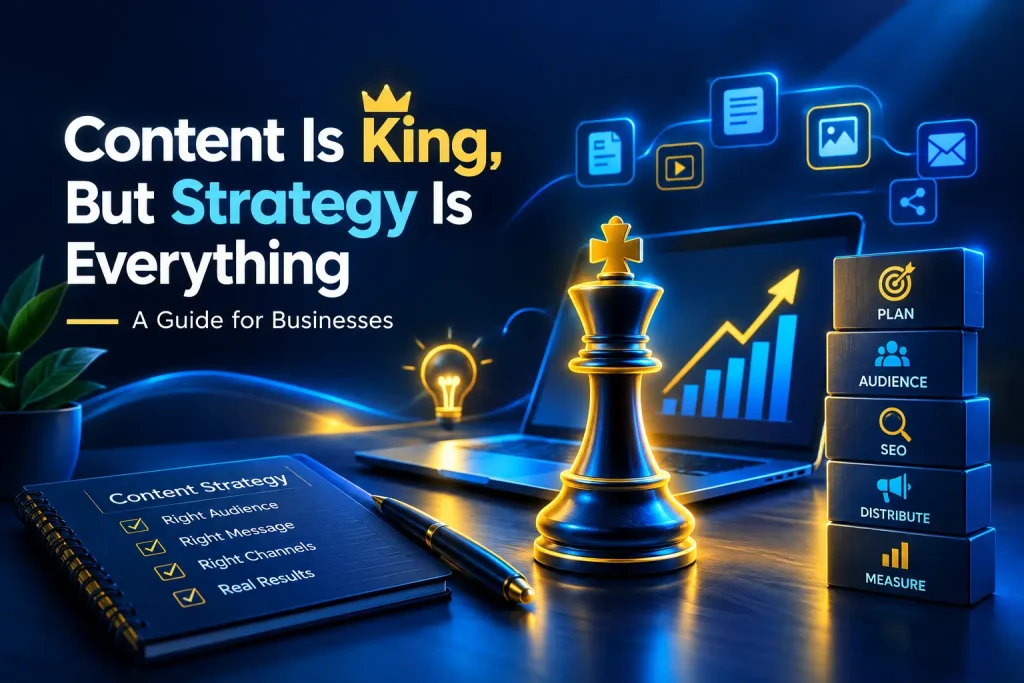
Content Is King, But Strategy Is Everything: A Guide for Businesses

Content Is King, But Strategy Is Everything Ideas for Businesses In the realm of digital marketing, there is a popular saying that “Content is King.” However, when it comes to content creation for businesses, having great content is not enough. A company can churn out articles for its blog, post on social media, make videos, and send emails without a second thought about what they are doing. Unfortunately, this kind of content creation will most likely fail to reach the desired outcome. Therefore, the following visual could serve as a reminder to businesses about the importance of developing a content marketing strategy: Content is King, but strategy is everything. A good content marketing strategy should focus on the content’s purpose, audience, research, and business goals. In other words, a company should invest in content that serves a specific goal, appeals to the target audience, has done the necessary research, and has measured results. Therefore, when companies think about what they want to post, who they want to reach, and what action they want the audience to take, they have a solid base for creating a content marketing strategy. The next section will provide more ideas about creating a successful content marketing strategy. Why Content Is Not Enough  Nowadays, anyone can create content. Whether it is blog posts or social media, video or infographic, email or something else, creating content is no big deal. The problem is that different platforms attract different audiences, and it is not always clear what and how to post to engage with the public. For instance, if a software company writes ten blog posts per month about various issues related to the whole tech industry, not about the company’s niche, it does not mean that these articles are useless. However, if they do not raise any concerns relevant to the company’s potential customers and do not address their problems, then this content marketing campaign will not be very successful. Instead, a company should develop a content strategy that would define its target audience, their problems, what keywords they search, their place in the buyer’s journey, the content type that would appeal to them, what goal it should fulfill,  how to measure the performance. Otherwise, a company would simply waste resources on creating content for nobody. What Content Strategy Means for Businesses In general, a content strategy is a plan of creation and promotion of content items in order to meet certain goals. There is always a specific purpose of each created and published piece, and businesses should closely define their target audience and segment it into groups of people with similar concerns.With the help of these segments, companies can come up with topics and formats that would appeal to their clients the most. Moreover, an efficient content strategy should also include SEO optimization and measurement of results.Therefore, businesses should define their goals, research their audience, create customer personas, write down topics and keywords, choose the content types, establish a publishing schedule, distribute posts, optimize content, and measure results. Start With Clear Business Goals Before writing post, you should define your goals.Depending on your business needs, you may have several goals that your content has to meet. For instance, your blog’s content may have to build brand awareness, bring leads, boost sales, or establish your authority. Let’s take a closer look at each of these goals. Increase Brand Awareness The blogs and social media posts about your products, services, and industry news and events can help you build brand recognition and awareness. Lead Generation You can use lead magnets, landing pages, webinars, case studies, and how-to articles and guides about your industry to get more qualified leads. Drive Sales Product page reviews, product comparison articles, customer testimonials, case studies, and in-depth service reviews can help you increase sales. Establish Authority High-quality content marketing, blog posts, whitepapers, research studies, and expert guides and reviews can position you as an expert in the field. Understand Your Target Audience Before rushing to generate content, make sure to get to know your target audience.Identify what questions they may have, concerns, purchasing habits, and preferences. Focus on the problems they need to be solved, objections they may have when making a purchase, and what platforms they like to consume content on, and what media types interest them.A B2B audience may favor whitepapers, compared to a more consumer-oriented audience that may be attracted to video content. Audience research allows you to shift from generalities about your customers to specifics: the actual people who serve your content will matter greatly to the shape of your copy.  Develop Content Around the Customer Journey One of the main concepts behind content marketing strategy involves the idea that your potential customers are looking for something specific.It’s important to recognize that customers will need different information at different stages of their journey. The usual customer journey breakdown is as follows: 1. Awareness2. Consideration3. Decision4. Retention At the beginning of the journey (the awareness stage), customers may come to your website searching for general information about a particular condition, niche, or product.Types of materials that are helpful at this stage include: • Educational blog posts• How-to guides• Social media• Educational videos• InfographicsAt the consideration stage, prospects will be looking for solutions to the problems they have identified.Applicable materials at this stage may include:• Comparison articles• Blog posts• Case studies• Webinars• In-depth guidesAt the decision stage, the customer is preparing to finalize the purchase and will be looking for testimonials, pricing information, product descriptions, and specifics about how they should make the purchase.Materials at the decision stage:• Testimonials• Reviews• Demos• Pricing guides• FAQsAt the retention stage, the customer is interacting with your company as a post-purchase partner, looking for ways to gain more value through the application of your product or service, or after-sales support.Materials at the retention stage: • Email newsletters• Tutorials• Knowledge base• Product announcements• Educational content Focus on SEO Content Strategy. No matter how good your content is, it will not serve its purpose if none of

AI-powered social media marketing featuring a smartphone, social media icons, analytics charts, and glowing AI technology on a dark blue neon background.
SOCIAL MEDIA MARKETING

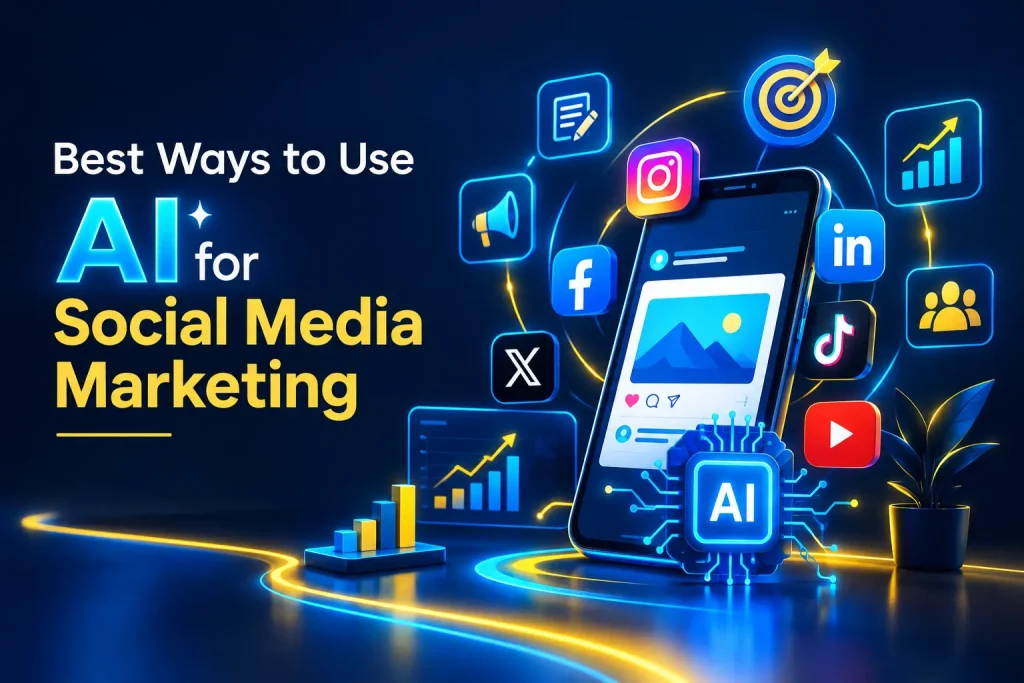
Best Ways to Use AI for Social Media Marketing

Best Ways to Use AI for Social Media Marketing  Social media marketing has become increasingly competitive, which means businesses must find innovative ways to engage with their audiences. They need to produce appealing content, quickly respond to customers’ inquiries, understand audience psychology, and be consistently present on various digital platforms.That is why the best way to use AI for social media marketing is by relying on its capacity to perform routine operations, come up with new ideas, analyze data, personalize the customer experience, and accelerate the decision-making process. Artificial intelligence is not a replacement for marketing professionals. It is, rather, a tool that can help them become more productive and efficient. From generating social media posts to analyzing statistics, there are multiple ways in which businesses can use AI for social media marketing in 2026. Let’s take a closer look at the best ways to use AI for social media marketing below. 1. Generate Social Media Content Ideas One of the leading challenges in social media marketing is thinking of fresh ideas for content. With the right prompts, AI can generate ideas for topics, audiences, industries, and even past content performances. For example, you can use AI to come up with social media ideas like: • Instagram post ideas • Facebook content topics • LinkedIn posts • Short video content ideas • Reels and Shorts topics • Poll and questions ideas • Educational carousel topics • Seasonal campaign ideas Instead of spending hours brainstorming social media content ideas, marketers can use AI to generate a list of topic ideas for their brand. How to Use AI It’s important to give the AI system information about the target audience, industry, voice, and marketing goals to help it come up with relevant content ideas. 2. Create Social Media Captions Faster Creating social media captions can be very time-consuming, especially if you have multiple posts to publish weekly or even daily. With AI, you can generate multiple caption options for a specific topic, image, product, or campaign. For example, businesses with a new service can use AI to generate short Instagram captions, professional LinkedIn posts, promotional Facebook copy content, hooks, calls to action, and hashtags. However, note that AI content should not be used verbatim. It’s important to go through the suggestions, edit, and tweak them to fit a brand’s voice. 3. Use AI for Social Media Content Personalization Not all leads and customers are the same. In fact, they have varying preferences, concerns, questions, and buying stages. With access to consumer data, AI can help marketers personalize social media content for different audiences. For example, businesses can use social media personalization to target: • New followers – Educational and informative content • Engaged followers – Product-focused content • Potential customers – Offers, testimonials, and reviews • Existing customers – Loyalty-based content This way, businesses can improve the relevance of their content to different audience segments. 4. Automate Social Media Tasks There are various recurring tasks in social media marketing, including scheduling, content categorization, organization, analytics tracking, etc. AI can help social media marketers automate repetitive tasks to save time and effort. For example, you can use AI for: • Scheduling social media content • Categorizing social media content • Creating multiple variations of a post • Tracking brand mentions • Reporting campaign performance • Detecting patterns in engagement This way, marketers can focus on more important areas instead of getting stuck in routine, time-wasting activities. AI Automation Should Support, Not Replace, Human Interaction While automation can dramatically speed up tasks, it should not replace human interaction. In other words, make sure to automate the mundane while keeping human qualities at the forefront. 5. Improve Social Media Customer Service Fast and efficient customer support is one of the main reasons why customers keep coming back to a brand. AI can help businesses with social media customer support by providing 24/7 customer care assistance. For example, businesses can use AI to help customers with: • Business hours • Product-specific questions • Pricing inquiries • Shipping details • Service availability • Order tracking It’s important to note that AI chatbots are great for simple and commonly-asked questions. More complex issues should be forwarded to a human representative. 6. Analyze Social Media Performance Perhaps the most important use of AI in social media marketing is analyzing performance. There’s so much data in social media, including likes, comments, shares, saves, clicks, views, followers, DMS, conversions, and more. AI can help businesses analyze this data to discover patterns and trends useful in future marketing campaigns. For example, AI can help answer questions like: • What content engagements the most? • What topics get the most clicks? • What times of the day are the best for posting? • What campaigns gets the best response from the audience? 7. Use AI for Social Listening Social listening is the art of analyzing conversations about a brand, product, service, competitor, or industry in social media. Thanks to its incredible language-modeling capabilities, AI can help marketers find mentions of their brand and sort through conversations in search of themes or common sentiments. For example, marketers can use AI social listening to identify: • What customers are saying about the brand • What topics customers are interested in • Industry-related trends • Common customer complaints • What competitors are saying • What trends are emerging Once again, AI can help by identifying patterns in mentions and themes. For example, if many users are complaining about the same issue, it’s a good indication that something needs to change. 8. Create Better Visual Content Social media is a visual space, meaning businesses need to put more effort into creating images, videos, and other visual content. AI can help with social media graphics, video creation, image-making, and more. For example, AI can help create: • Social media graphics • Video content • Image variations • Backgrounds • Ads • Visual content layout • Short video ideas In essence, AI can dramatically reduce the amount of

Social media followers turning into customers through engagement, trust, consideration, conversion, and retention, shown in a glowing blue and gold digital marketing design.
SOCIAL MEDIA MARKETING

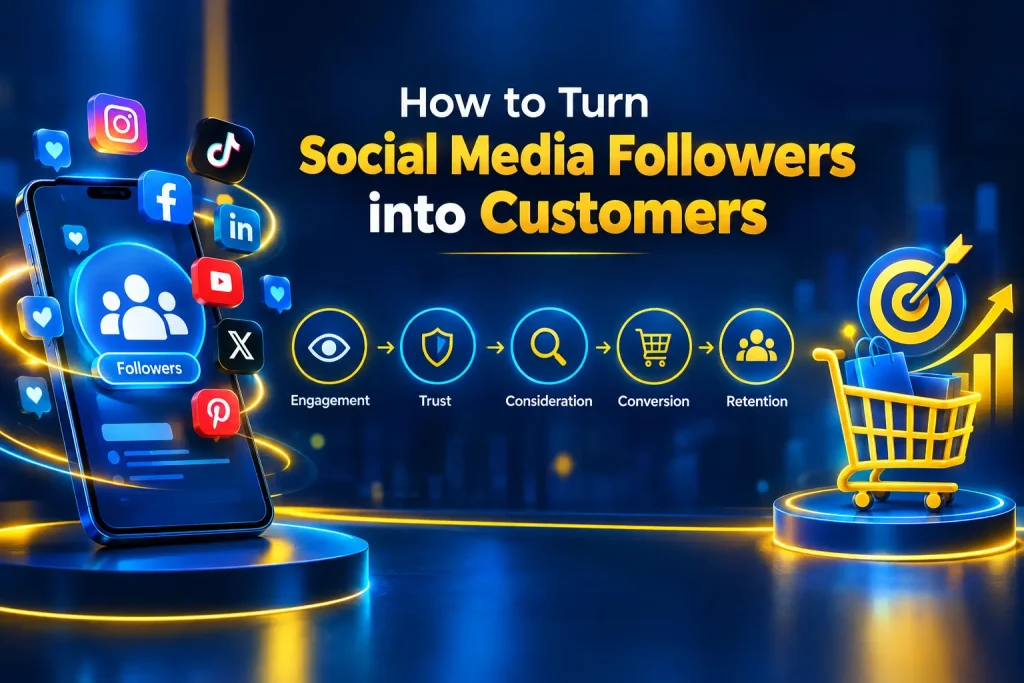
How to Turn Social Media Followers into Customers

How to Turn Your Social Media Followers into Customers  Having thousands of social media followers can be very exciting, even if they do not bring you any income. But what if they could? What if someone could take your social media followers and turn them into customers? Social media is an essential tool for virtually any business, whether one only has a small online presence or one is a well-established company with hundreds of employees. This tool, when used correctly, can provide the business with a steady stream of customers. However, it requires proper usage to turn social media impressions into actual sales. This blog will provide you with useful tips that will help you get more customers from your social media. In addition, it will teach you how to turn those followers into a social media funnel. Why Do Your Social Media Followers Not Want to Buy From You? A social media follower is a person who follows your social media account. In almost every case, a person who follows you will not be a paying customer right away. A follower could be your friend, family member, or someone who enjoys reading about a particular topic. To turn followers into customers, you need to get them through the buying cycle: AWARENESS → ENGAGEMENT → TRUST → CONSIDERATION → CONVERSION → RETENTION Therefore, your social media activities should not only be focused on getting more followers. 1. Get to Know Your Social Media Audience First of all, understand who your social media followers are. You may track certain metrics such as age, geography, interests, and other audience demographics available on the platform. You may also identify problems they try to solve, products or services they want to buy, types of content they like to consume on social media, and what motivates them to shop. By and large, the social media content you are going to create and share should be solving your buyers’ problems, not necessarily be focused on selling something. Your social media activity should serve more as your digital calling, attracting people who have genuine interest in what you are doing. It makes sense to outline major personas your business is targeting on social media, such as Start Up Owner (who wants to spend less money on marketing) and Small Business Owner (who wants to be able to market more efficiently). Once you understand who you are marketing to, you have better chances to market effectively. 2. Show Value Before Making Any Sales pitch People are not going to shop from you if you spam your social accounts with sales pitches. Instead, prove to buyers that you can help them solve a particular problem. You may do that by publishing valuable content that addresses common questions and concerns. Your social posts may also feature how-to’s, various tips, stories and testimonials from your other customers, video reviews, how your business was created, helpful hints and many other types of content. If you are a digital marketing agency, you are unlikely to post ‘Buy Our SEO Service’. Instead, you may publish content on Search Engine Optimization and its benefits and position your business is a go-to resource for those who want better organic traffic. 3. Add Strong Call-to-Actions To Your Posts A strong call-to-action (CTA) is one of the easiest ways to convert your social media audience. One of the biggest mistakes social media marketers make is forgetting to include a CTA. With a solid call-to-action in your text posts, stories and other social media content, you can get your target buyers to take action and move them through the buying cycle. Your CTA may depend on your content and your stage of the buying cycle. For instance, your CTA may invite people to: Visit your website Contact you Download a guide Book a consultation Subscribe to your email list Inquire for a quote Shop online Try a product for free. Your CTA should be specific and clear. If possible, avoid such unclear CTAs as ‘Learn More’, and instead, use CTAs such as ‘Book a Free Social Media Marketing Consultation’. 4. Create Content That Encourages Two-way Communication Although likes and comments are good, they do not necessarily mean that people are going to shop from you. Therefore, encourage social media users to communicate with you and your brand in an effort to build meaningful relationships and qualify buyers. When you get comments to your posts and messages via DM or Messenger, engage those who express some interest in your offerings. Instead of replying to website inquiry sample messages such as ‘What do you charge per hour?’, ask qualifying questions such as ‘What is it that you are trying to accomplish?’. That way, an engaged prospect will let you know if they actually intend to buy something soon, as opposed to a person who only likes and comments on the posts but does not get in touch. As always, it is important to respond to comments and messages in a timely fashion. If you always reply to inquiries, chances are prospects will also have time to respond. 5. Use Social Proof to Reduce Customer’s Buying Anxiety Some people are simply not going to spend any money unless they know that there are others who have benefited from working with you. That is why a lot of brands leverage on social proof. Social proof refers to the information and numbers demonstrating that you are a reliable company. For example, you can share customer testimonials, reviews and ratings, case studies, and others. It is important to make sure that social proof reflects authentic buyers’ experiences. After providing the first couple services, you may, for instance, post a testimonial from a happy client who appreciates your work. 6. Entice Your Follows With Special Offers As a marketer, it is a good idea to provide social media-exclusive special offers to your followers. Those could be any of the following: Time-sensitive pricing Exclusive buying options Bundles Free trial of a particular subscription plan A free

Digital marketing strategy for startups on a small budget, featuring a laptop, piggy bank, growth chart, SEO, social media, content marketing, email marketing, paid ads, and strategic planning elements in a blue and yellow theme.
DIGITAL MARKETING

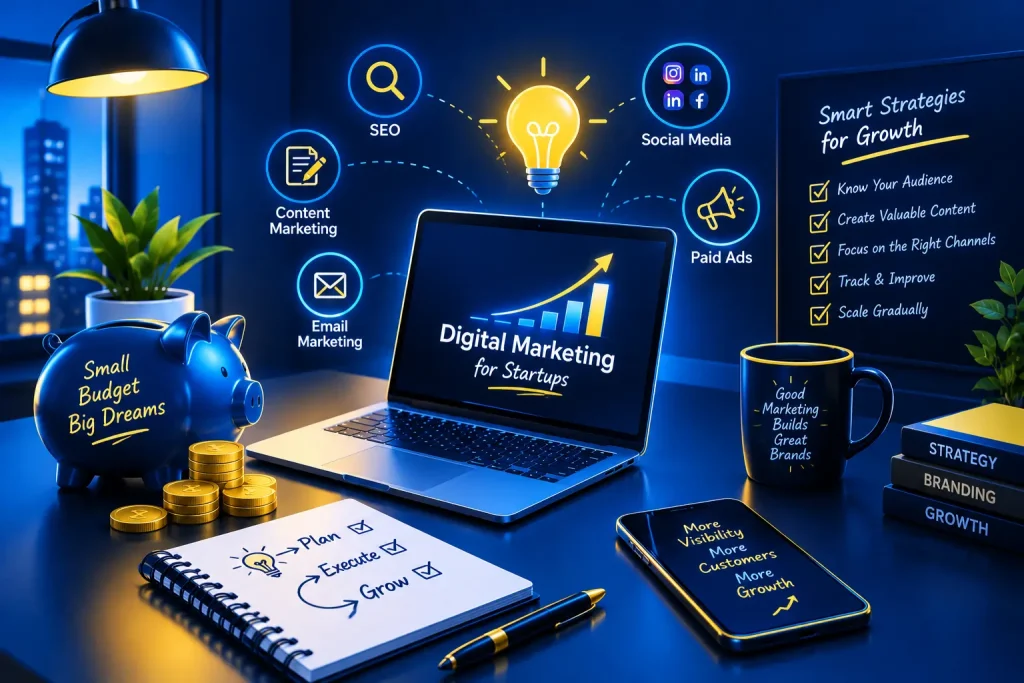
How Startups Can Use Digital Marketing on a Small Budget

How Startups Can Benefit From Marketing Marketing is often the top priority for any startup. However, with a limited budget and a strong competitive environment, companies should be able to maximize their gains by using the most effective tools. Digital marketing in such cases can solve most problems for a company as an experienced team can address all issues on the web and help the startup make the most of their gains. SEO, social media, content, and email marketing are only a few areas where a startup can get tremendous returns on their investment. Therefore, in this article, some of the most viable methods for low-budget marketing will be discussed. Why Digital Marketing Is Important for Startups Traditional advertising may demand a huge amount of money for television, press, billboards, and other traditional media. Digital marketing makes it possible for small businesses to reach out to the target audience via online resources. Moreover, an appropriate campaign may be launched using a small budget. A properly planned digital marketing campaign will help in building online presence, increasing brand awareness, targeting the most suitable customers, generating leads, establishing relationships with the audience, boosting the quantity of visitors to the company’s website, enhancing customer engagement,  evaluating the performance of the marketing effort, scaling the growth. Instead of trying to be omnipresent, it is better to define who are the most likely customers to buy the company’s products or services and invest in those digital platforms where the target audience spends most of their time. 1. Build a Website Your website is often the first impression for a potential customer. You don’t need an expensive website, a simple and sleek mobile-friendly version will do as long as it has what your business offers, who your customers are, why choose you, how to contact you, calls-to-action. A simple website with clear-cut information will be more helpful than a costly one with unclear calls-to-action. 2. Search Engine Optimization Search engine optimization, or SEO for short, is one of the best long-term ROI marketing strategies for a budget-limited startup. SEO focuses on ranking your website on the first page of search engines for relevant keywords. SEO helps your website gain organic traffic as opposed to paying for website visits. Target Long-Tail Keywords Big companies usually target high-volume keywords which is why long-tail keywords are a good place to start for startups. Long-tail keywords are more specific and have lower competition than high-volume keywords. For example, target “affordable digital marketing agency for startups” instead of “digital marketing.” Create SEO Friendly Content SEO content marketing is about creating content your potential customers are searching for.For example, you can create how-to guides, tips, tutorials, comparison articles, case studies, FAQs, beginner’s guides. Having informative content will establish you as an authority in your space. 3. Social Media Marketing One-third of the global population uses social media. So, it’s a great place to invest your time and money to grow your business. But it doesn’t mean you have to be everywhere. Pick one or two social media networks where your target audience spends the most time. Post Valuable Content Don’t market your products 24/7. Instead, focus on educating and entertaining your audience. Here’s a list of ideas you can try: education, short videos, user-generated content, stories, industry insights, product reviews, tips, product tutorials. For example, if you own a productivity software company, you can post tips and tricks about being productive, how to use your product, and how productivity tools transformed someone’s life. The more they follow you, the more they will trust you to solve their problems. 4. Content Marketing If you think about content marketing, you might imagine a well-produced video or a blog post with an attractive design. While these pieces of content require investment, they aren’t mandatory. There are many ways to leverage content marketing on a budget. Repurpose Your Content For example, one blog post can turn into an Instagram carousel, a LinkedIn post, a YouTube video, an email newsletter, 5+ social media posts, and a visual infographic. Repurposing your content helps you maximize your limited resources. Pro tip: focus on creating helpful content your audience wants to consume rather than filling your content calendar with random topics. 5. Email Marketing Email marketing might seem old, but it is still one of the most powerful marketing strategies, especially for startups. You can use email to build relationships with your customers. Email can be used as a marketing tool, a sales tool, and a customer service tool. To do that, you’ll need a list of engaged subscribers. You can grow your list by adding a subscribe button to your website, offering lead magnets, running email contests, posting newsletters, providing free trials, and hosting webinars. Your email marketing content should be focused on being helpful. Here are some email marketing ideas: educational content, newsletters, product announcements, emails with coupons, case studies. 6. Leverage Organic Marketing Before Investing in Paid Ads Paid ads are a great way to acquire customers, but they are also the riskiest and most expensive marketing strategy for a new business. Start with testing your organic posts before investing in ads. For example, if you see that your Instagram post is getting a lot of engagement, or your blog post is driving traffic, you can use this data to create better-performing paid campaigns. Start Small and Scale When you start with paid advertising, focus on one social media network and run one ad campaign. You’ll want to look at your CTR, conversion rate, cost per lead, CPA, and ROAS. Then, reinvest your profits into the most performing ads and scale them. 7. Local SEO Local SEO is a great budget-friendly marketing strategy for local businesses. Local SEO is all about ranking higher in local searches. For example, if someone searches for “digital marketing agency in Prayagraj,” you want your website to show up on the first page of results. Create local content, optimize your website for local searches, get positive reviews, and make sure your

AI-powered digital marketing featuring a futuristic AI interface, predictive analytics, personalization, content creation, AI SEO, smarter advertising, marketing automation, and customer experience.
ARTIFICIAL INTELLIGENCE

Beyond Chatbots: How AI Is Transforming Digital Marketing

Introduction Artificial intelligence (AI) is no more a novelty that powers chatbots to answer simple questions from customers. It has become an integral part of strategies that companies use to reach out to and interact with their audiences. May it be search, predictive analysis, automated ads, or personalized experiences — the role of artificial intelligence in modern digital marketing is impossible to overestimate. As such, businesses are integrating AI technology into their operations at all levels, from acquisition to conversion and retention. The trend is justified as real-time big data analysis, crucial for any marketing process, is unable to keep up with the amount of information that modern customers generate and that companies need to analyze to find meaningful patterns. AI helps to automate and accelerate repetitive marketing tasks and decision-making in general. But what else can AI do apart from chatbots? Let’s take a closer look at AI-driven digital marketing below. What Does AI Mean in Digital Marketing? AI in digital marketing means the ability of artificial intelligence to analyze data, recognize patterns, automate processes, create content, forecast, and influence clients. Thus, AI in marketing is not just about addressing customers but also covering all stages of the customer’s journey. In other words, the technology can be used to: Analyze the current customers’ behavior Make predictions about clients’ future actions Create personalized experiences on websites Generate contenteditable content for different media Optimize SEO Automate advertising processes Segment clients Recommend products or services Analyze and optimize marketing campaigns Therefore, the technology goes far beyond customer service automation and becomes the marketing intelligence layer that transforms the traditional marketing processes into automated ones. How AI Is Transforming Digital Marketing Essay 1. AI-Powered Personalization Customers are expecting more personalized experiences than ever before. With AI, you can take information such as browsing behavior, history, purchases, and engagement into account to help you better personalize your marketing mix. For example, you can use AI to power product recommendations on your e-commerce site or recommend articles based on someone’s interests and engagement. By applying AI to create better personalized experiences, you can supercharge: Product recommendations Email marketing Website experience Customer segmentation Promotions Content recommendations Instead of blasting the same marketing message to everyone, you can personalize the customer journey and deliver more value. 2. Predictive Analytics and Customer Insights One of the most interesting applications of AI marketing is that it can analyze huge amounts of data and find patterns and insights. Vanilla data analytics can tell you what has happened and even why it happened to a degree. Predictive analytics can help you determine what will happen in the future based on past and present data. With AI, you can uncover insights such as: Who are your customers that are most likely to buy What products will sell What campaigns will be the most successful Who is likely to churn You can then use these insights to inform your marketing budget and marketing mix. 3. AI Is Transforming SEO and Search Another area where AI is having an impact is in SEO, search marketing, and search engines in general. Traditional SEO used to be about putting the right keywords on a page so that Google could easily find and rank the page higher in the search results. With AI, the way we optimize web pages and create content is changing. SEO is becoming more about search intent, helpful content, and topically relevant content as well as content quality, information architecture, and much more. There are many factors that influence how Google will rank your page in the search results. AI can also help you optimize your content, find new keywords and topics, analyze competitors, and much more. As far as SEO is concerned, it’s not about writing more content; it’s about writing better content for the right audience. 4. Automated and Smarter Advertising Mix One of the biggest areas where AI is being applied in marketing is programmatic advertising. Advertising platforms are becoming increasingly automated and use AI to analyze signals and make decisions in order to meet your advertising goals. AI can help you with smarter advertising, such as: Better audience segmentation Optimized ad budgets Bid optimization Ad variations Leveraging AI for advertising does not mean you should stop caring about your advertising campaigns. It means you can focus on different parts of your advertising mix, such as creative, audience insights, and much more, while the tedious parts can be automated. 5. AI-Powered Content Creation AI is transforming content marketing and marketing copywriting in general. With AI language models, you can create blogs, social media posts, email marketing copy, ad copy, product descriptions, video scripts, research reports, and much more. You can use generative AI to help you with your content creation tasks, such as outlining a blog post or writing social media copy. However, AI is not a magical marketing content creation machine. It can still make mistakes, and marketing copy created by AI can sound generic or untrue. Humans are needed to add quality, originality, brand voice, and much more. AI-assisted marketing content creation is much better than fully relying on AI to create marketing content. AI Marketing Automation: Getting More for Your Effort Marketing departments are wasting a lot of time doing the same tedious and boring tasks over and over again like reporting, creating segments, chasing down leads, qualifying prospects, and monitoring campaigns. With AI automation, you can save the marketing team time by doing some of the tedious work for them. Visitor → AI → Lead → Personalized Content → Follow-up → Conversion That’s time that the marketing team can spend doing more creative and important tasks instead of doing mundane and robotic tasks that anyone could do. AI and Customer Experience Additionally, it should be noted that AI can also change the customer experience. Beyond the application in chatbots, companies can utilize such technology to personalize recommendation, enable natural language search and assistance, offer virtual helpdesks, and engage in proactive communication. An example of the

The Future of Digital Marketing featuring AI, search, automation, digital marketing analytics, and business growth in a futuristic neon blue and yellow design.
ARTIFICIAL INTELLIGENCE

The Future of Digital Marketing: AI, Search and Automation

Introduction Nowadays, digital marketing is evolving rapidly due to artificial intelligence, changing search landscapes, automations, and personalization of the media space. Businesses are now realizing that their traditional ways of SEO and advertisement might not be sufficient in the nearest future. Such strategies as SEO, social media marketing, and traditional advertising will remain relevant but occupy a smaller and smaller proportion of the marketing budget. Search engines are becoming smarter, marketing technologies are enabling marketers to create and analyze their content faster, and automations are taking over repetitive tasks in the sphere of marketing. At the same time, artificial intelligence and personalization will allow creating engaging and relevant content for each particular customer. However, it should be noted that for businesses, the future of digital marketing will not be different from what we are used to seeing in traditional media: the technology should be used as an instrument to meet the needs of customers and build a relevant strategy. With that in mind, let us take a closer look at the future of digital marketing and its main trends.  How AI Is Revolutionizing Digital Marketing Artificial intelligence (AI) is proving to be a true asset in helping marketers navigate the ever-growing complexities of digital marketing.With AI, marketers find new ways forward such as analyzing massive quantities of data to unearth patterns, ideas and opportunities, generating content, personalizing the customer experience and automating tasks to help drive productivity. AI-Powered Content Creation Marketers are already seeing value in leveraging AI to help support content creation ideation including: blog topic suggestions, content outlines, ad copy, social media ideas, email draft development, product descriptions, as well as keyword research. But, businesses need to recognize the importance of quality and avoid getting trapped in a race to produce as much content as possible with AI. Instead, marketers should be focused on creating informative, original and valuable work to customers.  Personalization at Scale AI’s ability to learn and understand customer behaviors and help businesses deliver far more personalized experiences to customers at scale. For example, an ecommerce site can harness AI to recommend products based on a customer’s browsing or buying behaviors or, in the context of email marketing, a service can use AI to help decide which email offer to send out based on specific customer activity.As such, it’s fair to say that personalization is going to fuel the future of digital marketing. The Future of Search Isn’t What It Used to Be Searching isn’t what it used to be. Search results are now increasingly more visual and offer a broader range of discovery options than just the traditional “blue links” results. For example, AI-powered assistants can answer questions, compare products, find information and more. As such, businesses need to shift their digital marketing approach and embrace this new era of discovery beyond just the traditional first page of Google.  SEO Is Still Important But Evolving SEO will always be important but will be increasingly fueled by satisfying search intent and creating helpful, informative content. Marketers need to consider things like search intent, helpful information, website architecture, improved user experience, topical authority, trust and credibility, technical SEO and keyword optimization to help improve their overall SEO strategy. While keyword volume and difficulty used to dominate SEO strategy-making, businesses should be increasingly focused on addressing the search intent and needs of its ICP.  Beyond Google: Embracing A Multi-Channel Search Approach Consumers are discovering information using a number of digital channels including social media, video platforms, marketplaces and more in addition to traditional search engines. As such, marketers should be thinking about building a multi-channel digital marketing strategy that not only includes search but extends across other discovery platforms on the web.  Marketing Automation Is Growing in Importance Marketing automation is a great illustration of how digital marketing efforts are being enhanced by emerging technologies to drive productivity and performance. By putting automation in place, not only can companies be more productive, it helps free up marketing teams to do more high-level marketing analysis. Some of the everyday marketing tasks that can be automated across any business include: email marketing nurturing prospects follow-up sequences after a meeting social media publishing report generation audience clustering ad optimization CRM management cart abandonment recovery  AI + Automation = Marketing Superpower AI can support businesses in taking marketing automation to the next level. While traditional forms of automation might just be about sending out the same message to everyone, with AI, you can use that technology to help improve existing forms of automation so you’re serving audiences in an even more personalized way such as delivering a unique message or offer to a customer based on their behaviors. The Importance Of Being Data-Driven Over the years, data has been critical to powering effective digital marketing campaigns and strategies. With increasing access to additional data, businesses need to be smart about utilizing these resources effectively. In particular, marketers can use data and analytics to uncover insights into: customer behaviors  email campaign performance website performance conversion trends audience needs and desires customer journeys With that said, businesses need to think about how they’re respecting consumers’ privacy and obtaining that data in responsible manners as data will play a bigger and bigger role in digital marketing. First-Party Data Is The New Currency Data privacy and access to third-party data is proving to be a big challenge in the marketing and advertising world. As such, marketers and companies must start thinking about how they’ll maximize their own first-party data and understand the value of it. In particular, first-party data refers to any information that a company collects directly from its first-hand sources including newsletter sign ups, purchases, preferences and more. Companies can start to build meaningful dossiers about its customers to help fuel its marketing and advertising approaches. To supercharge such an effort, businesses can utilize tactics such as building email lists, loyalty programs, surveying customers and setting up customer accounts to help obtain more information to better personalize their outreach while also strengthening

How AI is changing SEO in 2026 with AI-powered search, SEO analytics, AI Overviews, and digital marketing technology.
SEO

How AI Is Changing SEO in 2026

How is AI Affecting SEO in 2026? Search engine optimization has constantly evolved throughout the years. From keyword-based search to semantic search, mobile-first indexing, voice search, and now generative artificial intelligence, search intent keeps changing with technology. The year 2026 promises to bring even more changes to search engine optimization. Search engines are adopting artificial intelligence to a great extent in understanding queries, comprehending content, summarizing information, and giving answers to users’ questions in search results. Therefore, SEO is not dead, it is only changing, and there are several things to consider when optimizing websites in 2026. Let’s take a look at how SEO is affected by AI and what businesses should do in 2026. What Is AI SEO? AI SEO stands for Artificial Intelligence Search Engine Optimization. It means the use of artificial intelligence (AI) to improve various aspects of search engine optimization (SEO). Businesses and SEO specialists can benefit from the application of AI in SEO in a number of ways: Conducting keyword and topic research Interpreting search intent Identifying content gaps Generating content ideas Optimizing content Conducting competitive analyses Recognizing technical SEO issues Understanding extensive SEO data Personalizing content strategies Tracking search performance However, it is important to note that using AI for SEO does not just mean asking an AI to write hundreds of articles for you. Instead, the way to go is to think of ways to apply AI to make your SEO processes more efficient and leave room for your expertise, creativity, precision, and quality content creation as a human being in 2026. How AI Is Changing SEO in 2026 1. Search Is Becoming More Conversational Traditional search has often revolved around a phrase, for example: “best digital marketing agency” Now, the search process allows for more questions and conversation, for example: “What digital marketing strategies should a small business use to generate leads with a limited budget?” AI-powered search experiences can understand context and the relationship between different parts of a query.For SEO professionals, it no longer suffices to optimize only for individual keywords. Your content must address the complete search intent on a topic. What businesses should do: Answer specific questions Cover related subtopics Use natural language Include useful examples Understand different stages of search intent Create content that solves actual user problems  2. AI Overviews and AI Mode Are Changing Search Visibility One significant change for SEO in 2026 is generative AI features and search experiences.Google’s expanded documentation around generative AI features and has provided guidance for optimizing websites for AI-powered Search experiences.This raises the question for marketers: how can my content be a source for AI-generated search experiences? It’s not as simple as throwing more keywords at the wall. Google’s guidance emphasizes that traditional SEO best practices continue to apply for generative AI search features and underscores the value of providing useful, non-commodity content. Therefore, businesses should focus on: Original insights Accurate information Clear explanations First-hand experience where appropriate Helpful examples Strong topical coverage Crawlable and indexable pages  3. Search Intent Is More Important Than Keyword Density Traditional SEO strategies often revolved heavily around repeating target keywords.Modern search engines are much better at understanding what the user wants.For example, someone typing: “SEO audit”may be looking for: An SEO audit definition An SEO audit checklist SEO audit tools An SEO audit Instructions for conducting an audit Having an AI-powered search experience only emphasizes the need to understand what the user wants. In 2026, successful content should focus on: What does the user want to accomplish? Instead of a generic page for a keyword, create content around the user’s problem and journey.  AI Is Transforming Keyword Research Keyword research is another area where AI is transforming SEO to make it faster and more sophisticated. Traditional keyword research tools may tell you about search volume and competition, but AI can take this process further by helping to identify relationships between topics and to organize around keywords based on intent. For example, instead of randomly creating articles for: SEO services SEO agency SEO company SEO consultant SEO optimization AI can help marketers to identify the broader topic and how these terms should be organized within their content strategy. AI Can Help To Identify: Primary keywords Long-tail keywords Related questions Semantic topics Search intent Content gaps Topic clusters Frequently asked questions The important thing is to see AI as your research assistant. AI Is Making Content Optimization Smarter Content optimization is no longer simply about inserting keywords into headings and paragraphs; AI can analyze content and help identify: Missing subtopics Weak sections Keyword opportunities Readability problems Search intent mismatches Internal linking opportunities Content gaps However, optimization should always serve the reader first. Google’s Search guidance again emphasizes creating helpful content and following fundamental SEO practices over trying to manipulate search systems.  Human + AI Content Workflow A possible workflow for 2026 could be as follows: Research → AI-assisted analysis → Human strategy → Content creation → Expert review → SEO optimization → Performance monitoring AI Is Changing Technical SEO Technical SEO involves many areas that can be hard to track, especially for large websites.AI can help to identify patterns within technical data and prioritize potential issues.For example, AI-assisted tools can help to analyze: Broken links Duplicate content Metadata Internal linking Indexing problems Redirect issues Site architecture Structured data Page performance Google continues to emphasize crawlability, indexing, structured data, and overall page experience as important parts of website optimization. AI can therefore make technical SEO analysis faster, but technical decisions should still be reviewed by knowledgeable SEO professionals. AI Is Making SEO More Data-Driven SEO has a wealth of data, and businesses may need to analyze: Organic traffic Clicks Impressions Rankings Conversions Engagement Search queries Landing pages Content performance AI can help to identify patterns within this data much more quickly than a human. For example, an AI system might help an SEO team to realize that several of their pages are seeing impressions but few clicks, and the opportunities would be to review the

Scroll to Top